
Bhil
भील
At a glance
- Clan word
- Atak
- Descent
- Through the father
- Lives in
- Madhya Pradesh, Gujarat, Rajasthan, Maharashtra, Karnataka, Telangana, Andhra Pradesh, Tripura, Chhattisgarh, Pakistan
- Languages
- Bhili (Indo-Aryan; Devanagari script), Gujarati (Indo-Aryan), Marathi (Indo-Aryan)
- Population
- 1,69,63,913 Census 2011, Table A-11, the Bhil entries added together (they include the Bhilala, Barela, Patelia, Pawra, Vasava and other groups named in the same entries): Madhya Pradesh 5,993,921; Gujarat 4,270,609 (three entries); Rajasthan 4,100,264; Maharashtra 2,588,659; Karnataka 6,204; Tripura 3,105; Andhra Pradesh 604; Chhattisgarh 547. Bhil Mina not included.
- Region
- West
About
The Bhil are a people of the hills of western India, from the Aravallis of southern Rajasthan through the Vindhya and Satpura ranges to the hills of Gujarat and Khandesh in Maharashtra, with their largest numbers in the Dhar, Jhabua, Khargone and Ratlam country of western Madhya Pradesh. The name covers many related groups, among them the Bhilala, Barela, Patelia, Pawra, Vasava and Tadvi. Most speak Bhili dialects and the languages of their neighbours. With nearly seventeen million people in the 2011 census entries, they are the largest Scheduled Tribe in India.
Clans and Kinship
The Encyclopedia of World Cultures describes Bhil clans called atak: patrilineal, exogamous descent groups, spread over wide areas, whose main role is to set the bounds of marriage and of descent. Within each clan are local lineages, nal, that hold rights in property and settle disputes among members; a village is often founded by one lineage, the bhaibeta, which holds the best land, with later lineages, karhan, as tenants. Each village has a hereditary headman (vasawo in Gujarat, tadavi in Ratanmal, mukhi in Kotra) and a council (panch) of senior men. Russell and Hira Lal (1916) found in Nimar septs named after plants and animals, which members honour; a man could not marry in his own sept or in the families of his mother and grandmothers. Enthoven (1920) records that in Khandesh each clan has a devak or totem it will not cut or eat, and that some clans take Rajput names such as Parmar, Jadhav and Rathod. A woman joins her husband's kin group at marriage.
What “Atak” means
Atak is the Bhil word for the patrilineal exogamous clan in the Encyclopedia of World Cultures; Enthoven (1920) calls the same groups clans and their totems devak, and Russell and Hira Lal (1916) call them septs.
33 ataks
- Jamania
Totem: jamun tree
Nimar (Russell). Will not cut or burn the tree; wedding clothes are rubbed against it.
- Rohini
Totem: rohan tree
Nimar (Russell).
- Avalia
Totem: aonla tree
Nimar (Russell).
- Meheda
Totem: bahera tree
Nimar (Russell).
- Mori
Totem: peacock
Nimar (Russell): offerings are laid on a red cloth by a peacock's footprint, and members are not tattooed. Enthoven lists More, peacock, in Khandesh.
- Ghodmarya
Nimar (Russell); 'horse-killer'; may not tame or ride a horse.
- Masrya
Totem: fish
Nimar (Russell); will not kill or eat fish.
- Sanyan
Totem: cat
Nimar (Russell); will not touch a cat except to save it.
- Ghattaya
Totem: grinding mill
Nimar (Russell).
- Solia
Totem: the sun
Nimar (Russell); divided into Ada, Japa, Taria and Tar Solia, who wed at sunrise, at sunset, at starlight and with skeins of thread.
- Moharia
Nimar (Russell); worships Moharia Mata of Moharia village in the old Indore State.
- Maoli
Nimar (Russell); worships the goddess Maoli of Barwani.
- Sesodia
Nimar (Russell); a Rajput clan name.
- Panwar
Nimar (Russell); a Rajput clan name. Enthoven lists Pawar, pigeon, in Khandesh.
- Ahir
Totem: a snake-like fish (ahir)
Khandesh (Enthoven).
- Bhavare
Totem: the gangudli bird
Khandesh (Enthoven).
- Bhor-kole
Totem: the pumpkin gourd
Khandesh (Enthoven); members smear the gourd with red lead and offer slices to the gods.
- Bijary
Totem: polecat
Khandesh (Enthoven).
- Bongade
Totem: the gangudli bird
Khandesh (Enthoven).
- Borshe
Totem: bor (a kind of jujube)
Khandesh (Enthoven).
- Gaikvad
Totem: the pipal
Khandesh (Enthoven).
- Gangode
Totem: the gangudli bird
Khandesh (Enthoven); the scanned text reads 'Gajigode', so the spelling is uncertain.
- Magar
Totem: crocodile
Khandesh (Enthoven).
- Mali
Totem: any flower
Khandesh (Enthoven).
- Pipalsa
Totem: the pipal
Khandesh (Enthoven).
- Shakere
Totem: sparrow
Khandesh (Enthoven).
- Shinde
Totem: the wild date palm
Khandesh (Enthoven).
- Sonone
Totem: a kind of bird
Khandesh (Enthoven).
- Vagh
Totem: tiger
Khandesh (Enthoven); members worship the tiger and mourn when one is killed.
- Katara
Named by Enthoven among Bhil clan names that claim a strain of outside descent.
- Rathod
Named by Enthoven among clan names that claim a strain of outside descent.
- Jadhav
Named by Enthoven among clan names that claim a strain of outside descent.
- Makvana
Named by Enthoven among clan names that claim a strain of outside descent.
First the septs of the Nimar Bhils in Russell and Hira Lal (1916, vol. 2, pp. 286-287), in their order; then the clans and devak of the Khandesh Bhils in Enthoven (1920, vol. 1, article 'Bhils', section on divisions), in his order; then a few of the many clan names Enthoven says claim a strain of non-Bhil descent. The Bhil have many hundreds of clans and the lists differ by region; these are examples from two districts a century ago.
In the Official Lists
Scheduled Tribe
Madhya Pradesh, Gujarat, Rajasthan, Maharashtra, Karnataka, Chhattisgarh, Andhra Pradesh, Telangana, Tripura
Listed as: Bhil
In Rajasthan, Gujarat, Maharashtra and Karnataka one entry: 'Bhil, Bhil Garasia, Dholi Bhil, Dungri Bhil, Dungri Garasia, Mewasi Bhil, Rawal Bhil, Tadvi Bhil, Bhagalia, Bhilala, Pawra, Vasava, Vasave'. In Madhya Pradesh and Chhattisgarh 'Bhil, Bhilala, Barela, Patelia'; Gujarat has that entry too, and a third, 'Tadvi Bhil, Bawra, Vasave'. In Andhra Pradesh, Telangana and Tripura simply 'Bhil'.
The Bhil Mina of Rajasthan, Madhya Pradesh and Chhattisgarh are a separate entry (see the Meena page). Checked against the 2011 census tables of each state and Wikipedia's compilation of the order; the 2011 census counted Andhra Pradesh and Telangana together. Amendments after 2011 were not checked.
Checked on 2026-11-07 against the sources below. The lists are amended from time to time and can differ by district; for a certificate, the current order or the state's list is what counts.
Name and Origin
The name is usually derived from a Dravidian word for bow, villu or billu, the weapon long associated with the Bhil (Russell and Hira Lal 1916, Enthoven 1920, Encyclopedia of World Cultures). Enthoven gives the earliest mention he knew in Sanskrit as the Kathasaritsagara, about the sixth century, which tells of a Bhil chief on an elephant barring a king's way through the Vindhyas. Bhil tradition, as Malcolm and Russell record it, tells of a son of Mahadeo who killed his father's bull and was sent to the forests, the ancestor of the Bhil. Scholars agree that the Bhil were the earliest people of southern Rajasthan and the hills of Gujarat; their original language is not known.
History
By the end of the tenth century much of Rewakantha, the hill country of the Narmada, was ruled by Bhil or Koli chiefs, and between the eleventh and fourteenth centuries they were replaced by chiefs of Rajput or mixed descent (Encyclopedia of World Cultures). Rajput rulers long acknowledged the Bhil as the older owners of the land: at the accession of a Sesodia chief of Mewar a Bhil of Oguna or Undri marked the tika on his forehead with blood from his own thumb (Russell and Hira Lal). In the eighteenth century Maratha and local rulers met Bhil resistance with mass killings, and many Bhils withdrew deeper into the hills. In 1825 the British raised the Khandesh Bhil Corps and offered land and pardon; in Rewakantha an agreement between the political agent Willoughby and Kumar Vasava of Sagbara, a Bhil chief, gave the Bhil land and forest rights. Tantia Bhil, whom colonial writers called a dacoit and Bhils remember as a hero, was hanged in 1889. Ram Pande, cited in Wikipedia's account, describes Govind Guru as a reformer who led many Bhils of the Mewar region to give up meat and liquor and pressed for village councils and an end to forced labour; in 1921 Motilal Tejawat led Bhils and Garasias against forced labour and heavy taxes.
Faith and Worship
Bhil religion varies by region. The Encyclopedia of World Cultures records local deities such as Wagh Deo, the tiger god, and Nandervo, god of the crops, a supreme deity called Bhagwan (in Ratanmal also Mahadeva), and Kalika, the earth mother, for whom Holi is kept; priests called badava act as mediums and healers. Russell and Hira Lal (1916) found Khande Rao (Khandoba) the favourite god of the Nimar Bhils. Hinduism, Islam and Christianity are the main faiths among Bhils today, Hindu belief having the widest influence; the Tadvi of Khandesh and Madhya Pradesh and the Nirle of Maharashtra are Muslim and keep the urs of the village pir, and some Bhils are Christian. The encyclopedia also notes the Hindu Bhagat movement among the Bhils.
Deities named in the sources: Wagh Deo, Khandoba
Customs
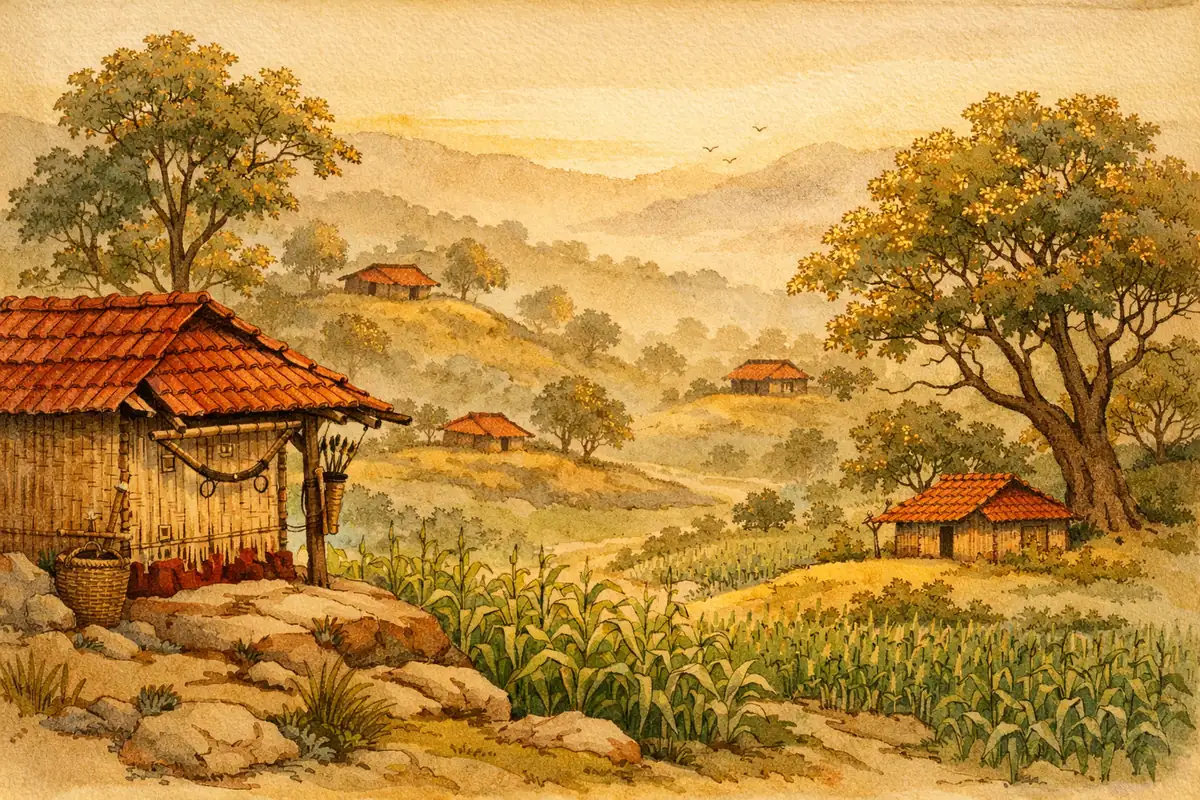
Bhil houses stand apart from one another on hilltops with their fields around them, so a village of a few dozen families may spread over three or four square kilometres (Encyclopedia of World Cultures). Clan exogamy is kept everywhere; in some areas marriage with a father's sister's daughter is preferred. A bride-price is paid, and marriage may be arranged, by elopement or by service. Russell records the custom of elopement at the Tosina fair in Mahi Kantha. Bhils of western Madhya Pradesh keep the Bhagoria fairs in the Holi season, and the Bhils of Udaipur the Gavari after Holi.
Festivals
Holi
Phalgun, February or March
A main post-harvest festival among the Ratanmal Bhils, kept for Kalika, the earth mother (Encyclopedia of World Cultures); the Bhagoria fairs fall in the same season.
Gavari
After Holi
Kept each year by the Bhil community of Udaipur, as Wikipedia's account of the Bhil records.
Stories and Legends
The tika at Mewar
Russell and Hira Lal, quoting Tod, tell how Goha, the ancestor of the Sesodia Rajputs, grew up among the Bhils of Idar, who chose him as their king in play, and one of them marked his forehead with blood from his own finger as the tika of rule. In memory of this, Russell records, the Bhil landholders of Oguna and Undri claimed the right to mark the tika on each new Sesodia chief with blood from the thumb and to seat him on the throne.
Notable Personalities
Tantia Bhil
1840-1889
Born at Pandhana in Nimar, he defied British and Holkar forces in the hills of Nimar for about twelve years and was remembered as Tantya Mama, a protector of the poor; colonial writers, Russell among them, called him a dacoit. He was hanged at Jabalpur on 4 December 1889.
Related communities
+ 4 moreShow fewer
Sources
- R. V. Russell and Hira Lal, The Tribes and Castes of the Central Provinces of India, vol. 2 (1916), 'Bhil'. Vol. 2, article beginning p. 278: name and home p. 278; the Rajput tika and history pp. 279-285; subdivisions and septs pp. 285-287; marriage pp. 287-288; religion p. 289
- R. E. Enthoven, The Tribes and Castes of Bombay, vol. 1 (1920), 'Bhils'. Vol. 1, article beginning p. 161: name and Sanskrit references pp. 161-163; divisions, clans and devak in the section 'Divisions' that follows
- 'Bhil', Encyclopedia of World Cultures, vol. 3: South Asia (Orientation, History and Cultural Relations, Settlements, Kinship, Marriage and Family, Sociopolitical Organization, Religion)
- Wikipedia, 'Tantia Bhil' (dates of birth and death, and his place in Bhil memory; read 2026-11-07)
- Wikipedia, 'Bhil' (pointer for Bhili, the Bhagoria and Gavari festivals, Govind Guru and the Bhil of Sindh; read 2026-11-07)
- Census of India 2011, Table A-11, State Primary Census Abstract for individual Scheduled Tribes (Madhya Pradesh, Gujarat, Rajasthan, Maharashtra, Karnataka, Tripura, Andhra Pradesh, Chhattisgarh). NADA catalog 42962 (Madhya Pradesh), 42963 (Gujarat), 42947 (Rajasthan), 42966 (Maharashtra), 42968 (Karnataka), 42955 (Tripura), 42967 (Andhra Pradesh), 42961 (Chhattisgarh)
- Constitution (Scheduled Tribes) Order, 1950, as amended, Parts for the states named (as compiled in Wikipedia's List of Scheduled Tribes)
Practice differs by village and family. If something here does not match your family's tradition, trust your elders.