
Bhotia
भोटिया
At a glance
- Clan word
- Village clan
- Descent
- Not recorded in the sources used
- Lives in
- Uttarakhand, Uttar Pradesh
- Languages
- Byansi (Sino-Tibetan (Tibeto-Burman)), Chaudansi (Sino-Tibetan (Tibeto-Burman)), Darmiya (Sino-Tibetan (Tibeto-Burman)), Rangkas (Shaukiya Khun) (Sino-Tibetan (Tibeto-Burman)), Kumaoni and Garhwali (Indo-European (Indo-Aryan))
- Population
- 44,302 Census 2011, Table A-11: Bhotia in Uttarakhand (39,106) and Uttar Pradesh (5,196)
- Region
- North
About
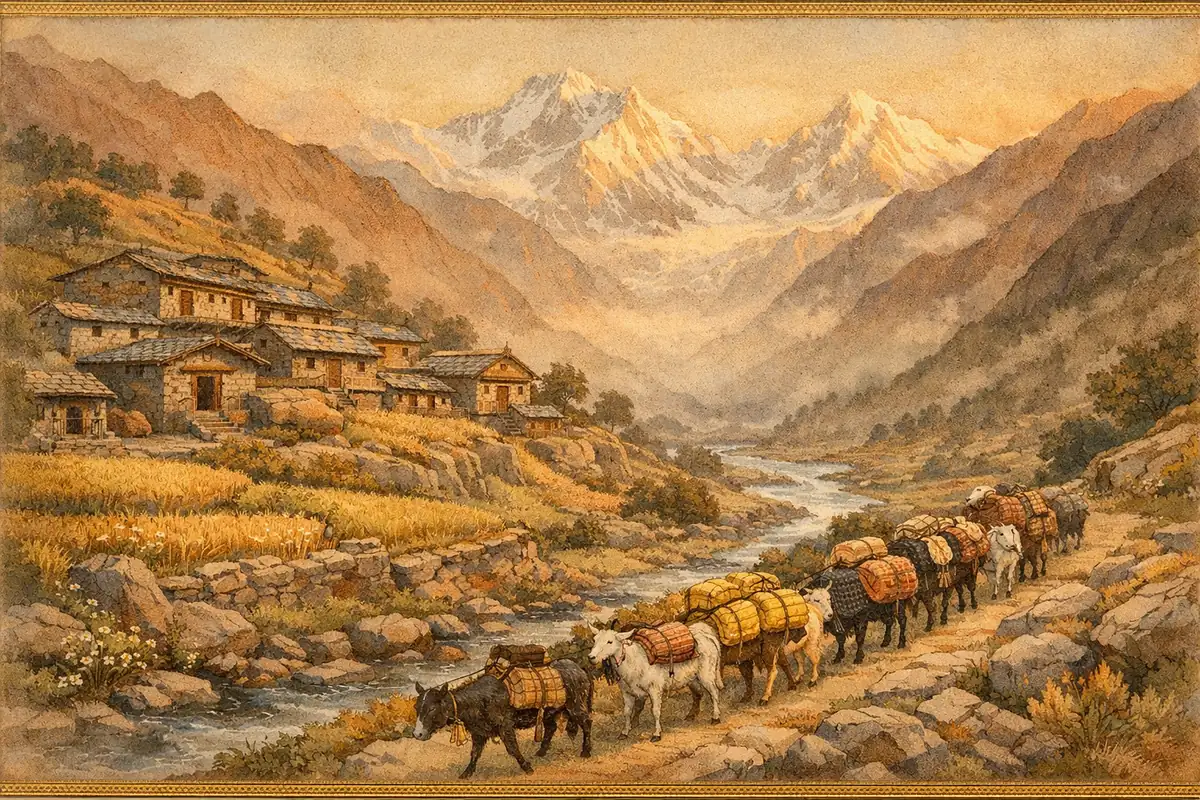
The Bhotia of Uttarakhand are the people of the high valleys along the Tibetan border: Johar, Darma, Byans and Chaudans in the Kumaon hills, and Niti and Mana in Garhwal. For centuries many of them were traders who crossed the Himalayan passes into Tibet several times a year and carried goods down to the foot of the hills. C. A. Sherring (1906) described them as of Tibetan stock but not Tibetan, and as several distinct groups rather than one tribe; some speak Tibeto-Burman languages of their own and others the hill speech of their neighbours. They are a Scheduled Tribe in Uttarakhand and Uttar Pradesh.
Clans and Kinship
Sherring (1906) stresses that the Bhotias are not one homogeneous tribe and describes them group by group: the Jethoras of Goriphat, Talla Johar and Malla Danpur, who were cultivators rather than traders; the Marchas and Tolchas of the Niti and Mana valleys; the Rawats or Shaukas of Johar; and the Byansis, Chaudansis and Darmiyas of the eastern valleys. In Johar each village holds a different clan, named after the village, and marriage must be with someone of another village: a Biljwal may marry a Martolia but not a Biljwal. The Marchas of Mana are divided into five clans that intermarry, and with the Rawal, Dimri, Duryal and Joshyal they form the Panch Dimris of the Badrinath temple. The father owns the family property and sons can demand its partition, and a widow often goes as wife to her husband's younger brother.
What “Village clan” means
Among the Johar Bhotias each clan takes the name of its village and marries outside it (Sherring 1906); Sherring also speaks of the kinsmen of the gotra in the mourning rites.
21 village clans
- Pangtiya
Johar (Shauka or Rawat)
- Dhamsaktu
Johar (Shauka or Rawat)
- Nikhurpa
Johar (Shauka or Rawat)
Admits a Tibetan origin and worships the god Dhurma (Sherring).
- Nitwal
Johar (Shauka or Rawat)
Also called Tolcha.
- Milamwal
Johar (Shauka or Rawat)
Its ancestor is said to have founded Milam and Burphu.
- Jangpangi
Johar (Shauka or Rawat)
- Burphwal
Johar (Shauka or Rawat)
- Biljwal
Johar (Shauka or Rawat)
- Martolia
Johar (Shauka or Rawat)
- Tolia
Johar (Shauka or Rawat)
- Laspal
Johar (Shauka or Rawat)
- Paspal
Johar (Shauka or Rawat)
- Mapwal
Johar (Shauka or Rawat)
- Sumdyal
Johar (Shauka or Rawat)
- Pachhpal
Johar (Shauka or Rawat)
- Rilkutiyal
Johar (Shauka or Rawat)
- Khinchyal
Johar (Shauka or Rawat)
- Malpha
Marcha of Mana
Said to be of Tibetan origin, with clansmen living north of Toling.
- Badwal
Marcha of Mana
Said to have come from Barahat near Gangotri.
- Bhatrajia
Marcha of Mana
Said to have come from the Girthi river.
- Dharkoli
Marcha of Mana
Said to have come from Malla Nagpur.
The village clans of the Johar Shaukas (Rawats) in Sherring's order, and four of the five intermarrying clans of the Marchas of Mana (the fifth being the original people of Mana), from C. A. Sherring (1906); his plural forms are given in the singular. The clans of the Jethoras, Darma, Byans and Chaudans are not listed here.
In the Official Lists
Scheduled Tribe
Uttarakhand, Uttar Pradesh
Listed as: Bhotia
The Bhot or Bodh of Himachal Pradesh and the Bhutia of Sikkim and West Bengal are separate entries for other Tibetan-speaking peoples and are not counted here. Checked against the Census 2011 tables and Wikipedia's compilation of the order.
Checked on 2026-11-07 against the sources below. The lists are amended from time to time and can differ by district; for a certificate, the current order or the state's list is what counts.
Name and Origin
Bhotia comes from Bhot, the Indian name for Tibet (Bod) and its border lands (Crooke, 1896). Sherring (1906) found that most Bhotia groups did not admit a Tibetan origin, except the Nikhurpas of Milam and the people of Malpha in Mana; others traced their ancestors to Garhwal, to Doti in Nepal, to Benares or to Tibet. In Johar the Milamwal Rawats say their ancestor obtained leave from the Tibetan authority at Gartok to trade, and founded Milam and Burphu.
History
The Bhotias of Johar, Darma and Byans were the traders of the Kumaon and Garhwal passes; the headman of Milam held a grant at Khiunglung in Tibet that entitled him to goats, ghee and carriage on his journeys (Sherring). Sherring found the Johar Bhotias taking up Hindu ceremonies, a change he dated from the coming of the Butaula Rawats some three hundred years before, while the Darma, Byans and Chaudans groups kept more of their older customs. The Marchas of Mana received a yearly payment from the Badrinath temple, which stands on their land.
Faith and Worship
Sherring describes most Bhotias as Hindus, the Johar Bhotias following Hindu rites most fully, with Brahmans who came from the south serving as their priests, while some older Tibetan deities are still worshipped: the Nikhurpas worship Dhurma. The Jethoras worship Durga, Devi and Mahadeo, and also the Panchachuli mountain, Goril and Maheswar. A bone of the head of the dead is kept to be cast into Mansarovar lake or the Ganges.
Customs
Among the Johar Bhotias marriage followed Hindu forms, the couple walking seven times round the fire; a bride might be given as a gift (kanyadan), for a price, or in exchange for another. In Darma, by contrast, the couple chose each other at a mature age, and many people remained unmarried (Sherring). After a cremation a head-bone is kept with a little gold in a brass box until it can be taken to Mansarovar or the Ganges, and the annual death rites are repeated year after year.
Related communities
Sources
- C. A. Sherring, 'Notes on the Bhotias of Almora and British Garhwal', Memoirs of the Asiatic Society of Bengal, vol. 1, no. 8 (1906). pp. 93-119: languages, divisions, Jethoras, Marchas and Tolchas, Shokas or Rawats, ceremonies, worship
- W. Crooke, The Tribes and Castes of the North-Western Provinces and Oudh, vol. 2 (1896), 'Bhot, Bot, Bhotiya'. Vol. 2, 'Bhot, Bot, Bhotiya', pp. 61-63
- Constitution (Scheduled Tribes) Order, 1950, and the companion orders, as amended: Parts for Uttarakhand, Uttar Pradesh (as compiled in Wikipedia's List of Scheduled Tribes)
- Census of India 2011, Table A-11: State Primary Census Abstract for individual Scheduled Tribes, Uttarakhand, Uttar Pradesh. censusindia.gov.in NADA catalog 42946 (Uttarakhand), 42948 (Uttar Pradesh)
Practice differs by village and family. If something here does not match your family's tradition, trust your elders.