
Bodo
At a glance
- Clan word
- Mahari
- Descent
- Through the father
- Lives in
- Assam, Meghalaya
- Language
- Bodo (Boro) (Tibeto-Burman (Bodo-Garo))
- Part of
- Bodo-Kachari
- Region
- North-East
About
The Bodo, who call themselves Boro or Bodo, are a Tibeto-Burman people of the Brahmaputra valley in Assam, living most densely in the Bodoland Territorial Region north of the river, with others in Meghalaya. Older books call them Kachari, the name their Assamese neighbours used, or Mech in Bengal. Bodo families carry the name of their mahari, or clan, as a surname, and most of these end in -ary, 'folk'. Many keep the traditional religion, Bathou. They are a Scheduled Tribe in Assam as Boro, Borokachari and in Meghalaya as Boro Kacharis.
Clans and Kinship
Bodo writers call the clan mahari (or mahary), and a family's clan name is its surname, usually ending in -ary, -ari or -hary, 'folk' (Hargouri Narzary, 2018). Endle (1911) called the same groups sub-tribes or septs and wrote their names with the suffix ároi; in his day many had lost all trace of a separate existence. Their names point to a role or a namesake: the heaven folk supplied priests, the earth folk were the landholders, the jute folk had a part with jute in the great rites, and the tiger folk mourned when a tiger died near the village. Descent and the clan name pass through the father; Endle notes that even the children of a marriage with another tribe belong to the father's group. Sources differ on the old marriage rule. Endle believed each sub-tribe had once married only within itself; Gurdon, editing the book, doubted it, pointing out that the Mech septs were exogamous, and an old Kachari told a district officer that before the Dewangari war Kacharis could not marry within their own sub-tribe. Hargouri Narzary writes that the clans now carry no difference of status and that members of all clans eat and drink together.
What “Mahari” means
Mahari (also written mahary) is the Bodo word for a clan in Hargouri Narzary's study of Bodo myths (2018). Endle (1911) used sub-tribe or sept and the suffix ároi, 'folk'; Gurdon's note in Endle's book records men in Mangaldai speaking of their kur.
22 maharis
Heaven folk; the priestly clan, entrusted with the worship of Bathou. Endle: Swarga-ároi, from whom deoris and ojhas were chosen.
- Ramchiary
Named after Ramcha (Endle: Ramsha), a place in Kamrup south of the Brahmaputra.
Jute folk, from narzi, dried jute leaves; they supply narzi for the cremation rites. Endle: Narze-ároi.
- Yaophramnarary
Named as the cooks in the Bodo myth of the clans.
Earth folk, the landholders; their members could use land for burial or cremation without paying for it. Endle: Basumati-ároi.
Tiger folk, from musa, tiger; also written Mosahary or Mushahary, and Baglary in some places. Endle: Mosá-ároi.
- Laoary
River folk, from daima, big river; once fishermen. Endle: Doimá-ároi.
- Kherkatary
Also Jigabnarary; suppliers of thatch and firewood, found mostly in Kamrup. Endle has a Kherkhatha-ároi, which he reads differently, as squirrel folk.
- Owary
Bamboo folk, who supply bamboo for the Kherai and Garja rites.
- Lahary
Wikipedia (Lahari): collects leaves in large quantities for the festival.
- Khaklary
Also Khangklary, from khangkla, reeds, which they supply for the Kherai. Endle: Khangkhlo-ároi.
- Sibingary
Sesame folk. Endle: Sibing-ároi, the only sub-tribe once allowed to grow sesame.
- Ganjlerary
Slug folk. Endle: Gandret-ároi, the leech folk.
- Hajoary
Hill folk.
- Bingiary
Musician folk. Endle: Bing-bing-ároi, itinerant musicians.
- Sabaiary
Black-gram folk; also written Sobaiary.
- Goyary
Areca-nut folk. Endle: Goi-bári-ároi.
- Thalirary
Banana folk.
- Kagrabary
Rushes folk; in the Bodo story, those who saved themselves from drowning by holding on to rushes.
- Nolobary
Reeds folk; those who held on to reeds in the same story.
- Mahilary
Business folk. Endle: Mohila-ároi.
The first twelve are the clans that Bodo tradition counts as the original ones, in the order Hargouri Narzary (2018) gives from Bhaben Narzi (2006); the rest are further clans the study names. Notes give the duty or namesake it records, and the matching name in Endle's list of twenty Kachari sub-tribes (1911, pp. 24-27) where one is clear. Endle's list also has groups not given here, among them the Brahma folk (Brahm-ároi), a quasi-priestly group of Upper Assam, and the fern folk. Spellings differ between families and books.
In the Official Lists
Scheduled Tribe
Assam
Listed as: Boro, Borokachari
In the part of Assam's list for the plains, outside the autonomous districts.
Scheduled Tribe
Meghalaya
Listed as: Boro Kacharis
Nagaland's list has an entry 'Kachari' and Assam's list for the autonomous districts has 'Dimasa, Kachari'; whether either covers the Bodo was not checked, so neither is counted here. Checked against a compilation of the Order; amendments of 2022 to 2024 were not checked.
Checked on 2026-11-06 against the sources below. The lists are amended from time to time and can differ by district; for a certificate, the current order or the state's list is what counts.
Name and Origin
Boro or Bodo is the people's own name: J. D. Anderson, introducing Endle's book in 1911, wrote that in Assam the Hindus called them Kacharis and in Bengal Meches, but that their own name for their race was Boro or Bodo. Wikipedia, citing Bodo scholars, derives it from Bara-fisa, 'son of Bara', where Bara means man. Endle treated the Bodo of the northern Brahmaputra valley as one branch of a wider 'Bara' family of peoples that included the Dimasa of the North Cachar Hills, the Mech of Goalpara and others, whose speech is closely related. The sources read do not give a single origin tradition.
History
Sidney Endle, a missionary at Tezpur in Darrang, described the Bodo of Darrang and Kamrup in The Kacharis (1911); it is the main early account, and its judgements of the people are not repeated here. In the early twentieth century Kalicharan Brahma (1860 to 1938, born Kalicharan Mech) led a reform movement, Brahma Dharma, among the Bodo of the lower Brahmaputra valley; his followers came to be known as Brahmas. Satish Chandra Basumatary (1901 to 1974) edited Bibar, the first Bodo magazine, in 1924. From 1919 Bodo associations of students and of the community were formed. The Bodo language is one of the twenty-two languages of the Eighth Schedule, and the Bodo are recognised under the Sixth Schedule through the Bodoland Territorial Region.
Faith and Worship
The traditional religion is Bathou (Bathouism). Endle (1911) found Bathou, or Bathau Brai, 'old Bathau', the chief household deity, guardian of the family, never shown as an image but present in the siju plant (a Euphorbia) grown in the homestead inside a round fence of split bamboo; Mainao is his consort. Offerings were laid at the foot of the siju. Rites were led by deoris (deodais), village elders of standing, for the office was not hereditary; the ojha was the diviner, and at large rites a woman medium, the deodani, took part. Wikipedia names the Kherai and Garja as the chief rites, led by the douri and doudini. Some Bodo follow the Brahma Dharma reform of Kalicharan Brahma, and a minority are Christian, mostly Baptist.
Customs
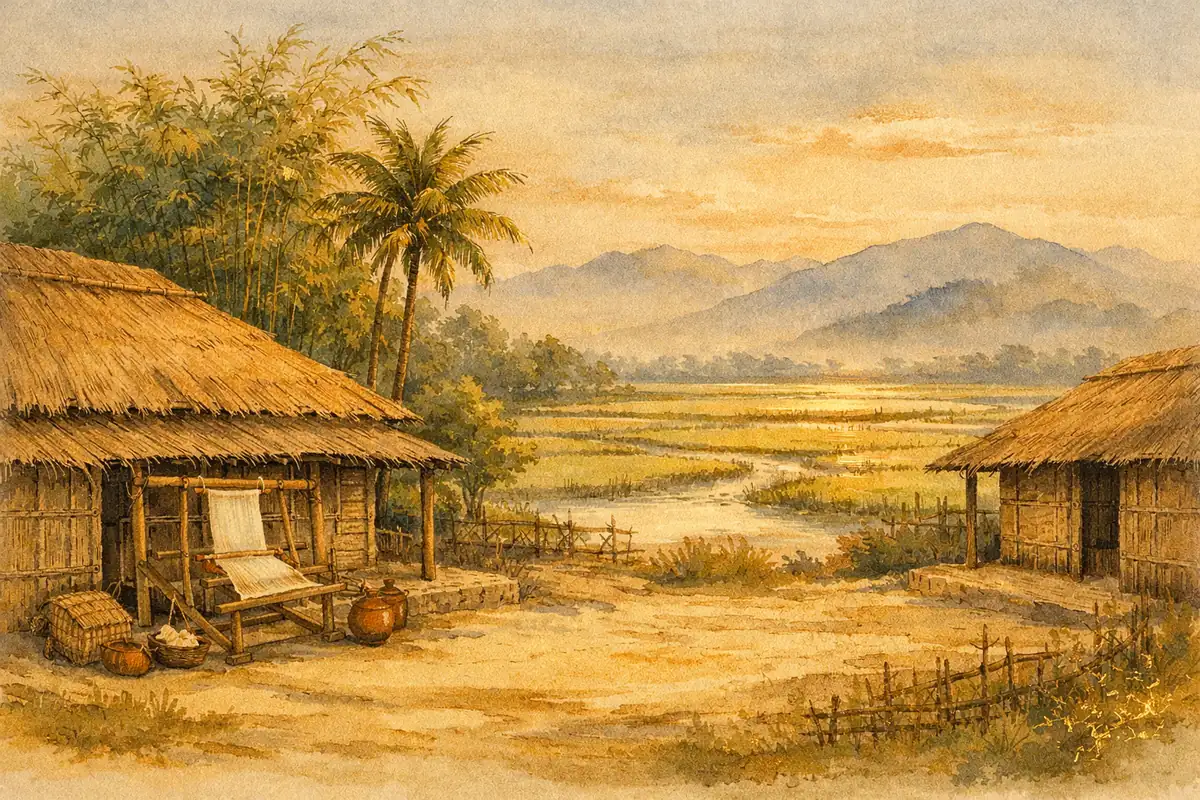
Endle describes marriage arranged by the young man's parents, who carry presents of rice, rice-beer and betel-nut to the girl's parents and settle a bride-price (gadhan) before village elders, who act as witnesses; a man who cannot pay may work for the bride's family instead. The bride does not leave home before she comes of age. A widower may marry his late wife's younger sister but not her elder sister. Children of a marriage outside the Bodo belong to their father's group. Bodo women were known for weaving, above all eri silk on looms set up beside the house. Hargouri Narzary records that some clans still have duties at a cremation: the Narzary supply the dried jute leaves that mourners chew, and a token payment for the cremation ground is left for a Basumatary elder.
Stories and Legends
How the clans were given their work
Hargouri Narzary records a Bodo myth of the clans. When Bodo society had fallen into disorder, a great gathering was held, and the first man, Mwnsingsing Bwrai, came down from heaven by a golden ladder and gave each clan its work: the Swargiary to priestly tasks, the Narzary to sprinkle holy water at ceremonies, the Basumatary to hold the land, the Musahary to hunting and guarding cattle, the Daimary to fishing, and so on. The study reads the myth as an account of how the Bodo clan system came about.
Notable Personalities
Kalicharan Brahma
1860 to 1938
Social and religious reformer, born Kalicharan Mech, who led the Brahma Dharma movement among the Bodo in the early twentieth century (Wikipedia, citing Banerjee, Brahmo Samaj and North-East India, 2006).
Satish Chandra Basumatary
1901 to 1974
Bodo poet and dramatist, second president of the Bodo Sahitya Sabha, and editor of Bibar (1924), the first Bodo magazine (Wikipedia).
Related communities
Sources
- The Constitution (Scheduled Tribes) Order, 1950, as amended, Parts for Assam and Meghalaya, as compiled in Wikipedia's List of Scheduled Tribes. Sections Assam (general areas), Meghalaya, Nagaland
- Sidney Endle, The Kacharis (1911), with an introduction by J. D. Anderson and notes by P. R. T. Gurdon. Introduction (name Boro or Bodo); Section III, Laws and Customs: internal organisation and sub-tribes (pp. 24-29), marriage and bride-price; Section IV, Religion: household deities, Bathau and the siju (pp. 35-37), priesthood (pp. 39-40); Appendix I, the Meches (pp. 81-83); eri silk weaving
- Hargouri Narzary, Myths in Bodo Society: A Folkloric Study (2018), Part 3.2, The Myth of Totemic Clans, via Wisdom Library
- Wikipedia, Bodo people (pointer: name, religion, list of clans after Kameswar Brahma, 1998)
- Wikipedia, Bathouism (pointer: Kherai, Garja, douri and doudini)
- Wikipedia, Kalicharan Brahma; Satish Chandra Basumatary (pointers)
Practice differs by village and family. If something here does not match your family's tradition, trust your elders.