
Chakma
At a glance
- Clan word
- Goza
- Descent
- Through the father
- Lives in
- Mizoram, Tripura, Assam, Bangladesh
- Language
- Chakma (Indo-Aryan; Chakma script)
- Population
- 1,79,389 Census 2011, Table A-11: Mizoram 96,972; Tripura 79,813; Assam 2,032 (autonomous districts); West Bengal 466; Meghalaya 106. Chakma in Bangladesh are not included.
- Region
- North-East
About
The Chakma, who call themselves Changma, are a Buddhist people of the hills of the Chittagong Hill Tracts in Bangladesh, where they are the largest of the hill peoples, and of Mizoram and Tripura in India. They speak Chakma, an Indo-Aryan language close to Chittagonian, which has its own script though it is now mostly written in Bengali letters. Families belong to clans called goza and, within them, to lines called gutthi, reckoned through the father. In the Chittagong Hill Tracts the office of the Chakma Raja, chief of the Chakma Circle, survives. In India they are a Scheduled Tribe in Mizoram, Tripura, Assam, Meghalaya and West Bengal.
Clans and Kinship
Descent among the Chakma is patrilineal: a woman joins her husband's family at marriage and property passes in the male line, though the mother's family takes part in a person's cremation (Encyclopedia of World Cultures). Families belong to clans called goza, which Ghosh and Das (2020) define as groups of clans once under a dewan, each made up of smaller lines called gutthi; they count forty goza and 133 gutthi. Hutchinson (1906) found the goza to be the unit of the tribe for public purposes, each headed by a hereditary dewan who represented the founder's family and once collected the tax for the chief; he wrote that the goza intermarried freely. Ghosh and Das state the rule now kept: marriage is barred within the same gutthi, the blood line through the father for seven generations, and between people of different generations. Hutchinson knew two divisions, the Chakma proper and the Tanchangya; Ghosh and Das name three groups, Anokkya, Tangchongya and Dainnak, the last living in Arakan. In the hill tracts each hamlet has a karbari, each mauza a headman, and the circle a hereditary chief, the raja (Encyclopedia of World Cultures).
What “Goza” means
Goza is the Chakma word for the clan (Hutchinson 1906; Ghosh and Das 2020). Each goza is made up of gutthi, lines of descent through the father, within which marriage is barred.
44 gozas
- Amu
- Bamu
Named after rivers (Risley).
- Barbora
- Baruwa
- Batalya
- Boga
- Borsege
- Bung
- Bungza
- Darjea
- Dawin
Reading uncertain in the scan.
- Dhaona
- Dhurjya
Hutchinson's tradition names a Dhurjiya among the first four dewans.
- Durjea
- Ichapocha
- Kala
- Kengragati
Risley records that its founder presented the chief with a crab so large that a pig could cross the river on its back.
- Khambe
- Khiongje
- Kura
Named after rivers (Risley).
- Kurjya
- Kutua
- Larma
- Leba
- Loskra
- Molima
Named after rivers (Risley).
- Molima-Sege
- Phaksa
- Phe-dang-sirri
- Phedungsa
- Phema
- Pirabhanga
Hutchinson's tradition names a Piabhanga among the first four dewans.
- Poa
- Poma
- Rangyacelunya
- Ranyin
- Sadonga
- Sege
- Sekowa
- Shoalyia
- Theya
- Toinya
- Uksarri
- Warggu
The name of a river (Risley).
The septs (goza) of the Chakma division as listed in the appendix to Risley's Tribes and Castes of Bengal (1892), compared in two scans; his glosses on the names, several of them nicknames, are not repeated. The spellings are his and differ from those families use today. Ghosh and Das (2020) count forty goza and 133 gutthi without listing them; they name the Beng, Tova, Bamon, Naduktuk and Shelochy among clans with taboos of their own, for example that the Beng and Tova may not intermarry.
In the Official Lists
Scheduled Tribe
Mizoram, Tripura, Assam, Meghalaya, West Bengal
In Assam, in the part of the list for the autonomous districts.
As listed in a compilation of the Order and in the Census 2011 tables for these five states; amendments of 2022 to 2024 were not checked.
Checked on 2026-11-07 against the sources below. The lists are amended from time to time and can differ by district; for a certificate, the current order or the state's list is what counts.
Name and Origin
The Chakma call themselves Changma; the Burmese called them Thek or Sak, and the Kukis Tui-thek (Hutchinson 1906; van Schendel in Banglapedia). Chakma historians, as Ghosh and Das (2020) record, derive the name from the Sakya, the clan of the Buddha, part of which was driven from the Himalayan foothills, and say that Sak or Chang, with ma, 'man', became Changma, which the British wrote Chakma. A chronicle tradition, which Hutchinson notes was compiled with the help of Brahmans, tells of a Kshatriya king of Champanagar whose son Bijoygiri marched against Arakan, settled near the Naf river when his brother seized the throne at home, and whose people married Arakanese and became Buddhists. Van Schendel writes that the most convincing view links the Chakma with central Burma and Arakan and with the Sak (Chak, Thek) of the Chittagong hills and Arakan, while the Champaknagar account lacks historical evidence. A Portuguese map of 1550 already marks a Chakma settlement on the Karnaphuli river.
History
Under the Mughals the Chakma chief, living in the Karnaphuli valley, paid tribute in cotton for the trade of the hills; Jalal Khan obtained leave for lowland traders to deal with the hill people in 1713, and Shermust Khan received a zamindari in the Chittagong plains in the 1730s (Hutchinson 1906; van Schendel). When the East India Company raised the revenue, the chief's general Ranu Khan resisted from 1776, and three expeditions failed to subdue him before Jan Baksh Khan came to terms in 1787 to 1789; in 1791 the cotton tax was turned into a cash payment. After the death of Dharam Baksh Khan in 1830 the estate passed through the Court of Wards to his widow Kalindi Rani, who managed it until 1873. When the British annexed the hills they made the Chakma chief one of three circle chiefs, with the Bohmong and the Mong, and his seat moved to Rangamati; the Chittagong Hill Tracts Regulation of 1900 set the system in law, and the office of the Chakma Raja continues. In Tripura, Ghosh and Das (2020) record, Chakmas came in from Arakan through the hill tracts in the distant past and long had close relations with the Tripuri.
Faith and Worship
Most Chakma are Theravada Buddhists, and they are the largest Buddhist people of Bangladesh (van Schendel in Banglapedia). Almost every village has a Buddhist temple, the kaang, where people hear the sermons of monks and novices and make gifts; monks lead the cremation and the prayers of the seventh day after a death. Older beliefs live alongside: spirits held to cause sickness and crop damage are propitiated through exorcists and healers, the baidyo, and a few Hindu goddesses are honoured (Encyclopedia of World Cultures). Ghosh and Das (2020) group Chakma pujas as those of the family, the village, the gutthi and the whole community; a wedding is preceded by the worship of chumulang, conducted by the aja.
Customs
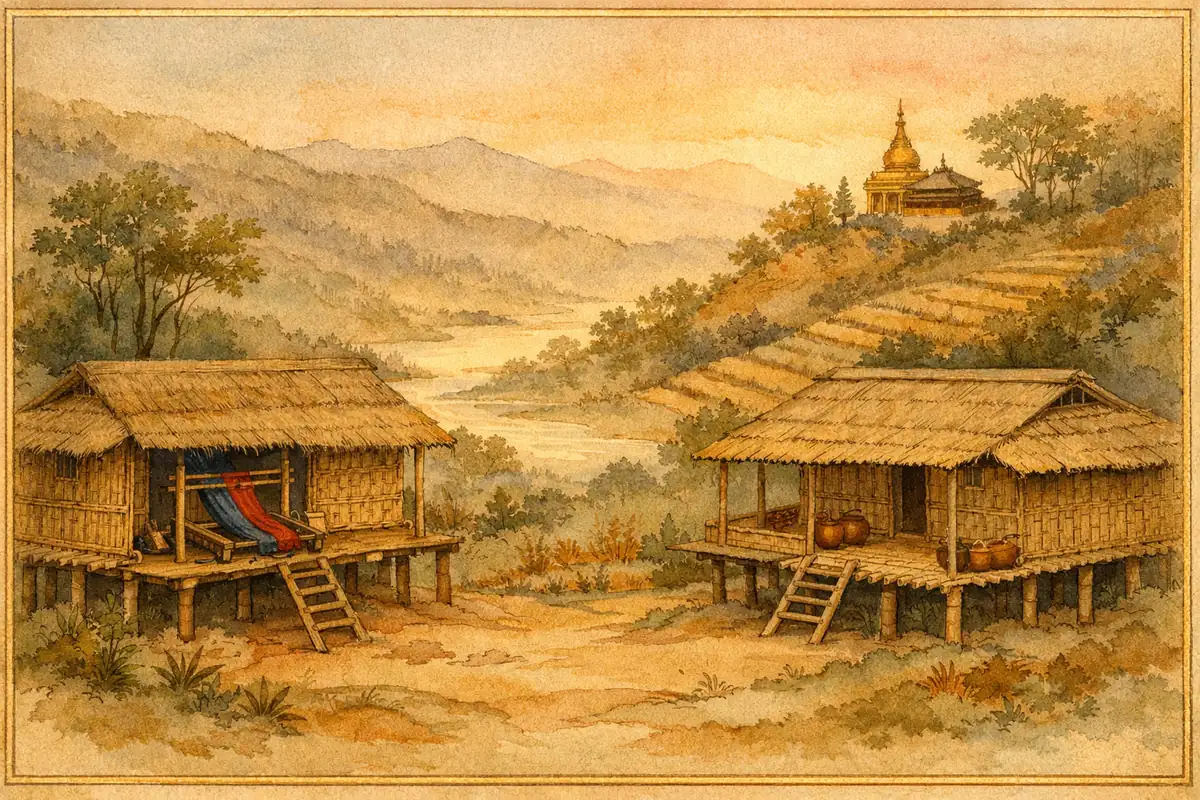
Hutchinson (1906) describes a marriage negotiated through a go-between with three visits by the young man's parents, each bringing wine; on the wedding day two relatives, a man and a woman, bind the couple together with a white cloth, and bride and groom feed each other rice and betel. A bride price was paid, except among headmen, and an eloping couple won the right to marry if the young man carried the girl off a fourth time after her parents had three times reclaimed her. The dead are cremated by a river, the man on five layers of wood with his head to the east and the woman on seven with her head to the west, and a meal is laid out for the departed spirit on the seventh day. Chakma women weave on a back-strap loom; the traditional skirt was of homespun cloth dyed dark blue with a deep red border (Hutchinson 1906; Encyclopedia of World Cultures).
Festivals
Bizu
Chaitra, the last month of the Bengali year (mid-April)
One of the high points of the Chakma year, marking the turn of the year (van Schendel in Banglapedia).
Kathin Chibar Dan
Once a year
A Buddhist festival shared with the Marma, Chak and Tanchangya, at which cotton is spun into yarn, dyed, woven and sewn into robes for the monks within a single occasion (Encyclopedia of World Cultures).
Stories and Legends
Bijoygiri of Champanagar
Hutchinson (1906) records the Chakma chronicle tradition. A Kshatriya king of the Sun line reigned at Champanagar and had two sons, Bijoygiri and Samagiri. Bijoygiri led an army across the Meghna and defeated the Arakanese, but as he prepared to return he heard that his father was dead and his younger brother had taken the throne. He made peace with the Arakanese kings and settled near the Naf river, where his people married into the Arakanese and became Buddhists. Bijoygiri raised four of his captains to be dewans, and their descendants later chose a chief from among them.
Notable Personalities
Kalindi Rani
died 1873
Widow of the Chakma chief Dharam Baksh Khan, recognised in 1855 as head of the estate, which she managed until her death; she pressed the government, without success, to recognise a proprietary right of the chief in the hill lands (Hutchinson 1906).
Related communities
Sources
- The Constitution (Scheduled Tribes) Order, 1950, as amended, Parts for Assam, Meghalaya, Mizoram, Tripura and West Bengal, as compiled in Wikipedia's List of Scheduled Tribes. Sections Assam (autonomous districts), Meghalaya, Mizoram, Tripura, West Bengal
- Census of India 2011, Table A-11, State Primary Census Abstract for individual Scheduled Tribes: Mizoram. State total for 'Chakma'. Companion tables for Tripura (catalog/42955), Assam (catalog/42957), Meghalaya (catalog/42956) and West Bengal (catalog/42958).
- R. H. Sneyd Hutchinson, An Account of the Chittagong Hill Tracts (1906). Ch. IV, the tribes: the Chakmas (numbers, names, sub-tribes, septs and dewans, the Champanagar tradition, list of chiefs, Mughal and British settlements, Kalindi Rani, houses, marriage, birth and death rites)
- Ratan Ghosh and Manoshi Das, Mapping of Chakma Tribes in Tripura (Tribal Research and Cultural Institute, Government of Tripura, 2020). Chakma Tribe in Tripura, a glimpse: sections (Anokkya, Tangchongya, Dainnak), goza and gutthi, marriage rules, pujas, clan taboos
- Willem van Schendel, 'Chakmas, The', Banglapedia (National Encyclopedia of Bangladesh)
- Encyclopedia of World Cultures, Chakma (Kinship; Sociopolitical Organization; Religion and Expressive Culture), via everyculture.com
- H. H. Risley, The Tribes and Castes of Bengal: Ethnographic Glossary, vol. 2 (1892). Appendix I, Chakma: sub-tribes and septs (pp. 31-32); compared with the scan at https://archive.org/details/tribes-and-castes-of-bengal-volume-2
Practice differs by village and family. If something here does not match your family's tradition, trust your elders.