
Gond
At a glance
- Clan word
- Kur
- Descent
- Through the father
- Lives in
- Madhya Pradesh, Chhattisgarh, Maharashtra, Telangana, Odisha, Andhra Pradesh, Uttar Pradesh, Karnataka, Jharkhand, Bihar
- Language
- Gondi (Dravidian)
- Part of
- Gondi
- Region
- Central
About
The Gond, who call themselves Koitur or Koi, are an Adivasi people of central India, living across the old Gondwana country of Madhya Pradesh, Chhattisgarh, eastern Maharashtra and northern Telangana, with others in Odisha, Andhra Pradesh, Uttar Pradesh, Karnataka, Jharkhand and Bihar. Their language, Gondi, is Dravidian, and many Gonds also speak Hindi, Marathi, Odia or Telugu. Gond kings ruled much of central India from the fourteenth century. Gond clans are grouped into numbered, exogamous phratries. They are a Scheduled Tribe in most of these states.
Clans and Kinship
Gond clans are patrilineal and exogamous: a woman passes into her husband's clan at marriage, and marriage within one's own clan is treated as incest (Fuchs). Above the clans are numbered phratries. Russell and Hira Lal (1916) found in Chanda four groups of clans worshipping seven, six, five and four gods, each with ten to fifteen clans and a sacred animal (the porcupine, the tiger, the saras crane and the tortoise), and a man could not marry into a clan that worshipped the same number of gods as his own; in Chhindwara only the six-god and seven-god groups remained, and in Betul the division had lapsed. In Adilabad the phratries are called saga: Yerwen, Sarwen, Siwen and Nalwen, whose names give the number of their ancestors, with a fifth, Sarpe, joined to Sarwen for marriage. Sagas into which a person may marry are soira. The saga works in ritual, has no political role, and all sagas are of equal standing. Within a saga the clans keep an order of precedence from the creation story, and each clan is divided into lineages called kita that have ritual duties. The Muria Gonds of Bastar, Russell records, group their clans under larger exogamous groups named after animals such as the goat, the tortoise and the cobra. Many clans are named after a plant or an animal, which members generally do not harm.
What “Kur” means
Kur, also gotra, is the Gond clan in Stephen Fuchs's account; among the Raj Gonds of Adilabad the clan is called pari. Clans are grouped into numbered phratries, called saga in Adilabad.
29 kurs
- Tekam
Totem: teak tree
One of the four named in the Lingo story, and among the commonest clans in all districts.
- Markam
Totem: mango tree
Among the commonest clans; Russell notes that the Markam clan now honours the tortoise.
- Pusam
One of the four named in the Lingo story.
- Telengam
One of the four named in the Lingo story; Russell takes the name to mean Telugu.
- Garde
Bakaravans (goat), Muria Gonds of Bastar
- Kunjami
Bakaravans (goat), Muria Gonds of Bastar
- Karrami
Bakaravans (goat), Muria Gonds of Bastar
- Vadde
Bakaravans (goat), Muria Gonds of Bastar
- Netami
Kachhimvans (tortoise), Muria Gonds of Bastar
- Kawachi
Kachhimvans (tortoise), Muria Gonds of Bastar
- Usendi
Kachhimvans (tortoise), Muria Gonds of Bastar
- Tekami
Kachhimvans (tortoise), Muria Gonds of Bastar
- Maravi
Nagvans (cobra), Muria Gonds of Bastar
- Potari
Nagvans (cobra), Muria Gonds of Bastar
- Karanga
Nagvans (cobra), Muria Gonds of Bastar
- Nurethi
Nagvans (cobra), Muria Gonds of Bastar
- Dhurwa
Listed under Nagvans among the Muria; in Mandla divided into Tumrachi Dhurwa (tendu tree) and Nabalia Dhurwa (dwarf date-palm). Also written Dhurwe.
- Sodi
Totem: tiger
One of the other large exogamous groups of the Muria.
- Behainsa
Totem: buffalo
One of the other large exogamous groups of the Muria.
- Netam
Totem: dog
Among the commonest clans in all districts; in Bastar it honours the tortoise.
- Chamchidai
Totem: bat
One of the other large exogamous groups of the Muria.
- Irpachi
Totem: mahua tree
- Tumrachi
Totem: tendu tree
- Warkara
Totem: wild cat
- Marabi
Meaning not known to Russell; in Mandla divided into Eti Marabi (goat) and Padi Marabi (pig).
- Uika
Divided into exogamous sub-clans in Betul. Also written Uikey.
- Parteti
Totem: crocodile
Betul.
- Kunjam
Totem: rat
Betul.
- Atram
Named among the common clans (pari) of Adilabad.
Clan names as Russell and Hira Lal (1916, vol. 3, pp. 61-68) give them for the Central Provinces, in their order: the four clans of the Lingo story; the clans of the Muria Gonds of Bastar under the larger groups that hold them (Bakaravans, goat; Kachhimvans, tortoise; Nagvans, cobra) and other Muria groups; the clans they found commonest in all districts, with the plant or animal each is named after; and two Betul clans. Atram is added from the list of common Adilabad clans in Wikipedia's account of Fürer-Haimendorf's work. Russell's spellings are kept. The phratry of each clan differs by region and is not given.
In the Official Lists
Scheduled Tribe
Andhra Pradesh, Bihar, Chhattisgarh, Gujarat, Jharkhand, Karnataka, Madhya Pradesh, Maharashtra, Odisha, Telangana, Uttar Pradesh, West Bengal
Listed as: Gond
In Madhya Pradesh, Chhattisgarh and Maharashtra one long entry that also names Raj Gond, Koitar, Koya, Maria, Muria and some fifty other groups; in Telangana 'Gond, Naikpod, Rajgond, Koitur'; in Andhra Pradesh and Karnataka 'Gond, Naikpod, Rajgond'; in Gujarat 'Gond, Rajgond'; in Odisha 'Gond, Gondo'. In Uttar Pradesh only in named eastern districts: Maharajganj, Siddharth Nagar, Basti, Gorakhpur, Deoria, Kushinagar, Mau, Azamgarh, Jaunpur, Ballia, Ghazipur, Varanasi, Mirzapur and Sonbhadra in the compilation checked.
Scheduled Caste
Uttar Pradesh, Uttarakhand
Listed as: Gond
In Uttar Pradesh in the districts where the Gond are not listed as a Scheduled Tribe; the Scheduled Caste entry excludes the eastern districts named in the Scheduled Tribe entry.
Checked against the compilations of the Scheduled Tribes and Scheduled Castes orders on Wikipedia, not against the ministries' own lists. In Uttar Pradesh the Gond were first listed as a Scheduled Caste and were later moved to the Scheduled Tribe list in named districts only. Amendments of 2022 to 2024 may have changed the Uttar Pradesh districts, so check the current orders before relying on them.
Checked on 2026-11-06 against the sources below. The lists are amended from time to time and can differ by district; for a certificate, the current order or the state's list is what counts.
Name and Origin
Gond is the name outsiders use, and its origin is uncertain; one view links it to the Dravidian kond, hill. Russell and Hira Lal (1916) record that the people's own name for themselves is Koitur or Koi. The origin story most often written down is that of Lingo: in the version Stephen Hislop took down from a Pardhan priest, which Russell and Hira Lal abridge, the first Gonds were shut in a cave and freed by the hero Lingo, who then divided them into clans and set the rule that a man marries outside his own. Russell notes that Gonds commonly placed the cave at Kachikopa Lohagarh, the iron valley in the red hill, which one tradition puts at Kachagarh near Darekasa in the old Bhandara district and another at Pachmarhi. In Gond tradition today, Pari Kupar Lingo freed the ancestral deities, the Angadevs, from the Kachchargardh caves, and the caves are a place of pilgrimage.
History
Russell and Hira Lal (1916) date the Gond kingdoms of central India from the fourteenth century, at Kherla in Betul, Deogarh in Chhindwara, Garha-Mandla near Jabalpur, and Chanda; the region came to be called Gondwana after them. The Chanda kingdom had its first capital at Sirpur in present-day northern Telangana, and Khandakhya Ballal Shah moved it to Chandrapur. Rani Durgavati of Garha-Mandla fought the armies of the Mughal emperor Akbar, and her fort of Chauragarh was taken in 1564. Bakht Buland Shah of Deogarh founded the city of Nagpur. From the 1740s Maratha armies took the plains, and Gond chiefs held out in the hills. In 1910 the Gonds of Bastar rose against colonial forest rules in the bhumkal, and Komaram Bheem of Adilabad later led a rising against the Nizam's government. A Gond Mahasabha was formed in 1916 to keep Gond culture. Christoph von Fürer-Haimendorf studied the Raj Gonds of Adilabad in books of 1948 and 1979.
Faith and Worship
Many Gonds follow their own religion, Koyapunem or Gondi Punem, 'the way of nature', whose founder in Gond belief is Pari Kupar Lingo; in many places it has been shaped by Hinduism, and a few Gonds are Christian or Muslim. Russell and Hira Lal (1916) name Bura Deo as the great god in most places, worshipped in the saj tree. In present accounts the high god is Baradeo, also called Persa Pen, and each clan keeps its own persa pen, its 'great god'. Clan and village deities, ancestors and totems receive most worship, among them Aki Pen, the village guardian. The saj tree and the mahua are revered.
Deities named in the sources: Bura Deo, Persa Pen
Customs
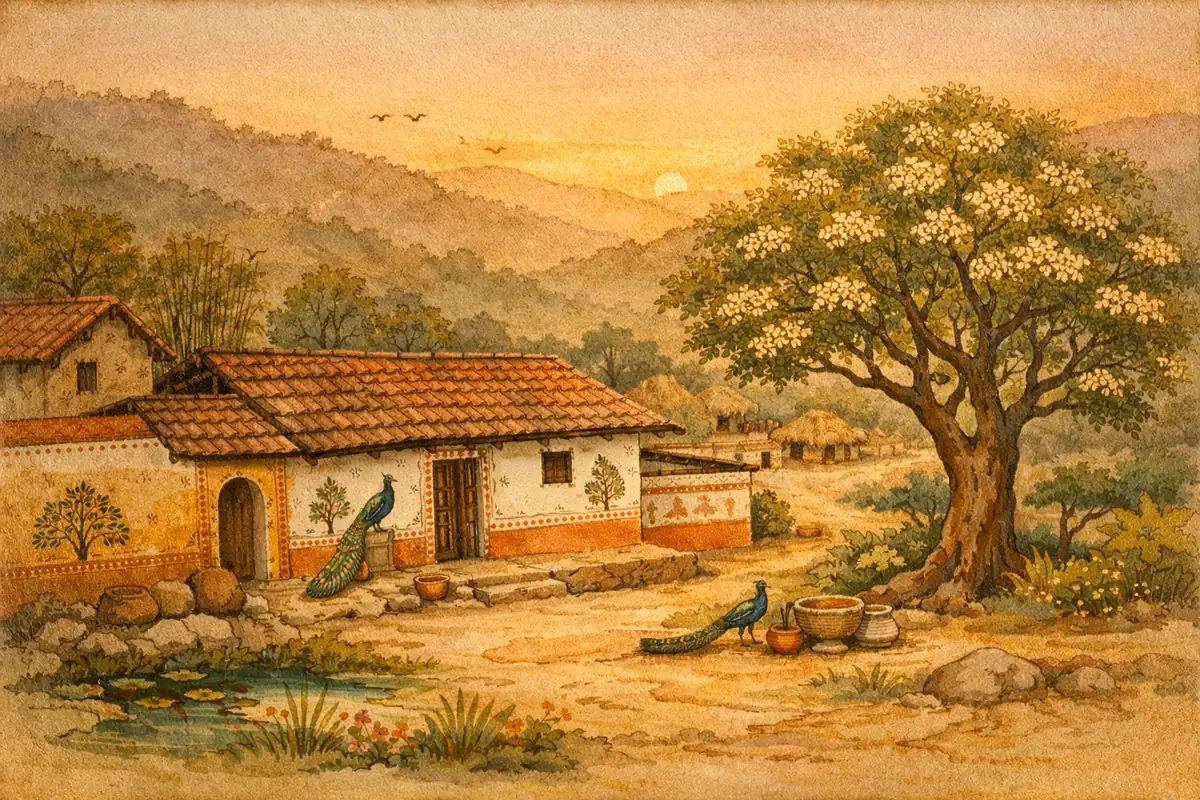
A Gond marries outside his own clan and, where the numbered groups are kept, outside every clan that worships the same number of gods (Russell and Hira Lal). Stephen Fuchs records that cross-cousin marriage is much preferred, that a bride-price is paid, and that the central wedding rite is the couple walking seven times round a post set up in the wedding booth. Among the Raj Gonds of Adilabad, when a clan worships its persa pen, members of a soira saga dress the image and cook the offering. At Diwali the Gonds of Adilabad dance the Gussadi in turbans of peacock feathers.
Festivals
Diwali and the Gussadi dance
Diwali, October or November
Among the Gonds of Adilabad, kept with the Gussadi dance, danced in turbans of peacock feathers.
Stories and Legends
Lingo and the river
In the Lingo story as Stephen Hislop took it down and Russell and Hira Lal abridge it, the Gonds freed from the cave stopped to cook at a river, and a flood came. Four of them, Tekam, Markam, Pusam and Telengam, were left on the bank; a crocodile and a tortoise offered to ferry them, then tried to drown them in midstream, and a great vulture carried them to safety. Lingo then led the Gonds into the forest, divided them into clans, made the oldest man a Pardhan or priest, founded the rule of exogamy and set the marriage ceremonies that are still kept.
Notable Personalities
Rani Durgavati
16th century
Queen of the Gond kingdom of Garha-Mandla who fought the armies of the Mughal emperor Akbar; her fort of Chauragarh was taken in 1564. Russell and Hira Lal quote Sleeman that she built the Rani Talao near Jabalpur and lived on 'in the grateful recollections of the people'.
Komaram Bheem
early 20th century
Gond leader of Adilabad in the former Hyderabad State who led a rising against the Nizam's government, remembered for the slogan jal, jangal, jameen (water, forest, land).
Related communities
Sources
- R. V. Russell and Hira Lal, The Tribes and Castes of the Central Provinces of India, vol. 3 (1916), 'Gond'. Vol. 3, pp. 39-143: names and distribution p. 41; history pp. 44-47; the cave and Lingo pp. 47-62; subdivisions p. 62-64; exogamy and phratries pp. 64-67; totemism pp. 67-70; religion
- Stephen Fuchs, 'Gond', Encyclopedia of World Cultures, vol. 3: South Asia (Kinship, Marriage and Family, Religion)
- Wikipedia, 'Gondi people' (pointer to the sources it cites, among them Fürer-Haimendorf on the Adilabad sagas; read 2026-11-06)
- Constitution (Scheduled Tribes) Order, 1950, as amended, Parts for Andhra Pradesh, Bihar, Chhattisgarh, Gujarat, Jharkhand, Karnataka, Madhya Pradesh, Maharashtra, Odisha, Telangana, Uttar Pradesh and West Bengal (as compiled in Wikipedia's List of Scheduled Tribes)
- Constitution (Scheduled Castes) Order, 1950, as amended, Parts for Uttar Pradesh and Uttarakhand (as compiled in Wikipedia's List of Scheduled Castes)
Practice differs by village and family. If something here does not match your family's tradition, trust your elders.