
Jaunsari
जौनसारी
At a glance
- Clan word
- Aal
- Descent
- Through the father
- Lives in
- Uttarakhand, Uttar Pradesh
- Language
- Jaunsari (Indo-European (Indo-Aryan))
- Population
- 92,384 Census 2011, Table A-11: Jaunsari in Uttarakhand (88,664, printed 'Jannsari') and Uttar Pradesh (3,720)
- Region
- North
About
The Jaunsari are the people of Jaunsar-Bawar, the hill country in the north-west of Dehradun district in Uttarakhand. They speak Jaunsari, which Majumdar counts a branch of Hindi. Jaunsari society was long known for fraternal polyandry, which the people trace to the Pandavas, for lineages called aal that take the place of the gotra, and for the khats, groups of villages each under a headman, the sayana. They are a Scheduled Tribe in Uttarakhand and Uttar Pradesh.
Clans and Kinship
Majumdar (1962) found that no gotra or clan exists among any of the castes of Jaunsar-Bawar. In its place the aal, a lineage of families descended from a common forefather who was an early settler of the village, regulates marriage as an exogamous unit. It is divided into bhera, sub-lineages traced to the division of an earlier family, and the aals of a village or of neighbouring villages may be joined by a fictive brotherhood, dai chara, within which marriage is also barred. At Lakhamandal the lineages are called thok. Descent is patrilineal and residence patrilocal, and the household was traditionally a joint family in which brothers shared a wife. The people of Jaunsar-Bawar include Brahmin and Rajput families, known together as Khasa, and Kolta, Bajgi, Lohar and other communities, each with lineages of its own.
What “Aal” means
Aal, also thok, is the Jaunsari patrilineal lineage, which does the work of the gotra in marriage; it is divided into bhera (Majumdar 1962).
Aals are lineages of particular villages rather than clans of the whole people, so no list is given; Majumdar names, for example, the Raichan, Luman and Gauryan thoks of the Brahmins of Lakhamandal.
In the Official Lists
Scheduled Tribe
Uttarakhand, Uttar Pradesh
Listed as: Jaunsari
The Census 2011 table for Uttarakhand spells the entry 'Jannsari'.
Checked against the Census 2011 tables and Wikipedia's compilation of the order. The Jaunsari are not a PVTG.
Checked on 2026-11-07 against the sources below. The lists are amended from time to time and can differ by district; for a certificate, the current order or the state's list is what counts.
Name and Origin
The Brahmins and Rajputs of Jaunsar-Bawar trace their origin to the Pandavas of the Mahabharata, whose monuments are believed to stand at Lakhamandal on the eastern border of the region, and from them they also trace their custom of polyandry (Majumdar). Stone sculptures excavated at the Lakhamandal temple site point to an old settlement there.
History
Jaunsar-Bawar was divided into 35, later 39, khats or hill sectors. Each had a Khat Sayana who answered for the whole khat to the government, above all for its revenue; village sayanas served under him, and four leading sayanas, the chauntras, distributed the revenue among the khats. The British revenue settlements of the nineteenth century were made with the khats through their sayanas (Majumdar). Majumdar worked in the region from 1937, partly for the census of 1941, and published his study in 1962.
Faith and Worship
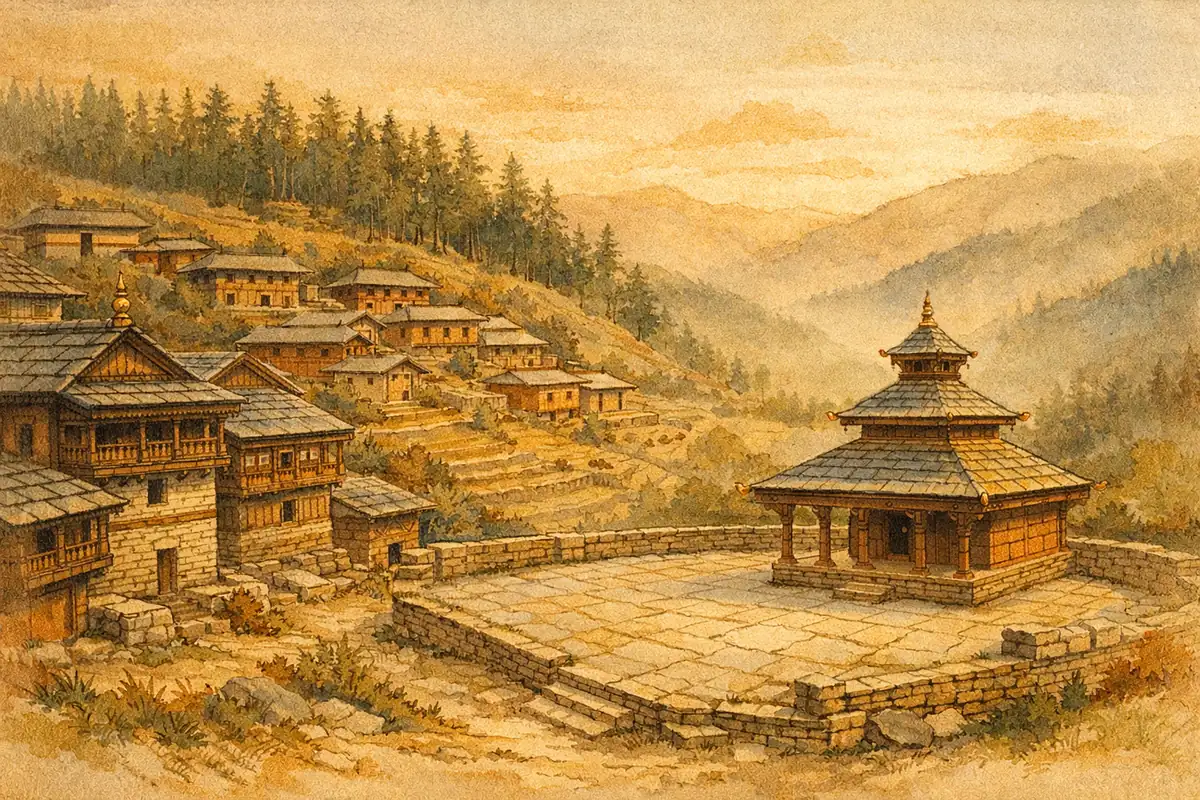
Every village has a temple of Mahasu, the guardian deity of Jaunsar-Bawar, whose holy seat is at Hanol; it usually stands in an open space with a flat ground, the angan, for dancing and village gatherings. Villages also have a temple of Shilguru, the protector of herds, and other shrines (Majumdar).
Deities named in the sources: Mahasu
Customs
Marriage was traditionally fraternal polyandry, the wife of the eldest brother being the wife of all his brothers, and Majumdar found it mixed with monogamy and with households of several wives. He names Magh (January-February), Bissu (April), Jagra (August) and the Jaunsari Diwali (November or December) as the four main festivals. Magh is a month of feasting after the winter sowing, when every house kills a goat set aside and fed since the year before.
Festivals
Magh
January-February
A month-long season of feasting after the winter sowing; each household kills a goat kept for it since the last Magh (Majumdar).
Bissu
April
One of the four main festivals of Jaunsar-Bawar named by Majumdar.
Jagra
August
One of the four main festivals of Jaunsar-Bawar named by Majumdar.
Jaunsari Diwali
November or December
The Diwali of Jaunsar-Bawar, kept later than in the plains (Majumdar).
Sources
- D. N. Majumdar, Himalayan Polyandry: Structure, Functioning and Culture Change, a Field-Study of Jaunsar-Bawar (1962). Ch. 1 (early history, khats and sayanas); kinship structure: lineage and clan (aal, bhera, dai chara); village (Mahasu temple); festivals (Magh)
- Constitution (Scheduled Tribes) Order, 1950, and the companion orders, as amended: Parts for Uttarakhand, Uttar Pradesh (as compiled in Wikipedia's List of Scheduled Tribes)
- Census of India 2011, Table A-11: State Primary Census Abstract for individual Scheduled Tribes, Uttarakhand, Uttar Pradesh. censusindia.gov.in NADA catalog 42946 (Uttarakhand), 42948 (Uttar Pradesh)
Practice differs by village and family. If something here does not match your family's tradition, trust your elders.