
Lepcha
At a glance
- Clan word
- Pü tsho
- Descent
- Through the father
- Lives in
- Sikkim, West Bengal, Nepal, Bhutan
- Language
- Lepcha (Róng) (Tibeto-Burman; Lepcha (Róng) script)
- Population
- 77,028 Census 2011, Table A-11: the Lepcha entries of Sikkim (42,909), West Bengal (33,962) and Tripura (157), added together.
- Region
- North-East
About
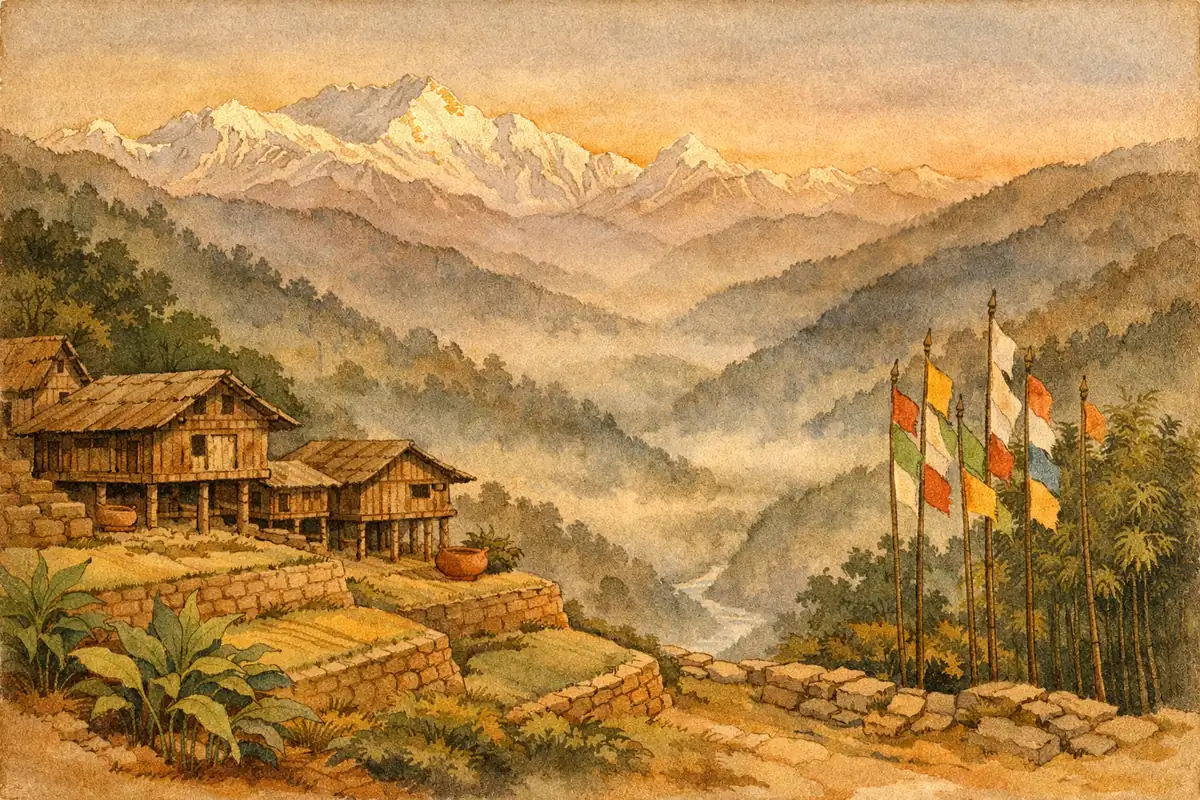
The Lepcha, who call themselves Rong, are held to be the oldest inhabitants of Sikkim, and live also in the Darjeeling and Kalimpong hills of West Bengal and in neighbouring Nepal and Bhutan. Their language has its own script. Lepcha society is built of lineages, pü tsho, which pass through the father and are exogamous, and their older religion, kept by priests called bongthing and mun, honours Kanchenjunga as a mountain god. They are a Scheduled Tribe in Sikkim, West Bengal and Tripura.
Clans and Kinship
The basic unit is the family of a man and his wife, and above it the lineage, pü tsho (Siiger, 1967, pp. 112-117). The oldest reference to it is in the Chronicle's account of the pact between Thekong Tek and Khye Bumsa, about 1641, that all males should be counted as related to the sons and all females to the daughters, and it is commonly said that there are two kinds of pü tsho, one for men and one for women. Each male pü tsho has its origin in a peak, often Kanchenjunga or one of its 'brothers', and each female pü tsho in a lake or tarn, and twice a year every pü tsho holds a ceremony to its peak or lake deity. Marriage is barred if the two pü tsho share any blood relationship within the last seven generations on the father's side and three on the mother's; the marriage is a union of the two lineages, and the husband's pü tsho pays a bride-price (pp. 113, 132). Elders are keenly versed in genealogy and are consulted when a marriage is planned. Each village had its gya pön, the administrative head, nominated for three years, the office passing in turn among the men of the village.
What “Pü tsho” means
Pü tsho is the Lepcha word Siiger (1967) translates as lineage: an exogamous descent line named after its founder or its place, with male lines tied to a mountain peak and female lines to a lake. The Gazetteer of Sikhim writes the ending -putsho, as in Sumba-putsho.
31 pü tshos
- Adinma
In the Lasho mung legend, the line of the man who gathered the people against the demon (Siiger).
- Samik
Those who took the demon's eye (Siiger).
- Gormu
Those who took an ear (Siiger).
- Sadamu
Those who took the hair (Siiger).
- Sangdimu
Those who cut off the fingers (Siiger).
- Sangdyangmo
Those who cut off the toes (Siiger).
- Namtsumo
The line of the astrologer (Siiger).
- Pache Shanga
Given by the ruler to those who brought vegetables (Siiger).
- Kamkum Shanga
Given by the ruler to those who brought a small bird (Siiger).
- Tamsangmu
Its peak is Kanchenjunga itself (Siiger).
- Singyang-mo
Spread over eastern Nepal; Thekong Tek is named as an ancestor (Gazetteer).
- Luksom-mo
Also Yoksom-mo, from the place of that name (Gazetteer).
- Si-ming-mo
Also Smigut-mo; near Rungli Rungliot (Gazetteer).
- Tuk-nyil-mo
Near Cheumthang (Gazetteer).
- Sambo-mo
Also Sumba-putsho; at Namtheng near Chidam (Gazetteer).
- Turgok-mo
Near Rinchingpung (Gazetteer).
- Rong-gong-mo
A numerous clan from Ronggong near Ham (Gazetteer).
- Kheng-bo
From the place of that name near Ham (Gazetteer).
- Nam-chhyo-mo
At Sidhi and Karmie (Gazetteer).
- Guling-mo
Near Ham in Nepal (Gazetteer).
- Samdar-mo
Gazetteer.
- Kotha-mo
From Kotah near Ham (Gazetteer).
- Barmyak-mo
Gazetteer.
- Sungphung-mo
Gazetteer.
- Namtchi-mo
Gazetteer.
- Sam-ling-mo
In Nepal (Gazetteer).
- Mong-mong-mo
Near Dentem (Gazetteer).
- Talong-mo
Gazetteer.
- Sang-pu-mo
At Lingmo (Gazetteer).
- Song-mo
Closely allied to the Sang-pu-mo (Gazetteer).
- Namphak-mo
Gazetteer.
Two lists: the pü tsho named in the Kalimpong legend of the demon Lasho that Siiger recorded (1967, pp. 113-114), with Tamsangmu from the same chapter; then the Lepcha families listed in the Gazetteer of Sikhim (1894, pp. 34-35), many named after the places they settled. Neither is complete, spellings differ between the books and from those used today, and three further names in the legend that could not be read reliably in the scan are left out.
In the Official Lists
Scheduled Tribe
Sikkim, West Bengal, Tripura
Listed as: Lepcha
An entry of its own in each of these lists.
Census 2011 counted 42,909 Lepcha in Sikkim, 33,962 in West Bengal (mostly the Darjeeling hills, now also Kalimpong district) and 157 in Tripura. The compilation used may not show amendments made between 2022 and 2024.
Checked on 2026-11-07 against the sources below. The lists are amended from time to time and can differ by district; for a certificate, the current order or the state's list is what counts.
Name and Origin
The Gazetteer of Sikhim (1894, Introduction, p. i) records that the Lepcha call themselves Rong-pa, 'ravine folk', and claim to be the original people of Sikkim; the history in the same volume calls the Rong 'the oldest and perhaps aboriginal inhabitants' (p. 27). A creation story Siiger heard at Tingbung tells that the first couple settled at the foot of Kanchenjunga, kong chen, beside a lake, where the mother gave birth first to the Lepcha and then to the other peoples (Siiger, 1967, p. 112). Lepcha tradition, as Siiger notes, sets the origin of each male lineage in a Himalayan peak and of each female lineage in a lake.
History
The Gazetteer of Sikhim (1894, pp. 8-10) gives the account, shared by Lepcha and Bhutia tradition, of how the Tibetan prince Khye Bumsa sought out the Lepcha leader Thekong Tek and his wife Nyekong Nal, who promised him sons; his descendants became the rulers of Sikkim, and Phuntsog Namgyal, proclaimed the first Buddhist ruler at Yoksom, is dated in it to 1641. The Gazetteer lists Lepcha families still living along the Talung river and elsewhere in its day (pp. 34-35). The Danish anthropologist Halfdan Siiger worked among the Lepcha of the Tingbung area on the Talung, in northern Sikkim, in 1949, and published The Lepchas: Culture and Religion of a Himalayan People in 1967. In 2011 the largest numbers of Sikkim's Lepcha lived in the North and East districts.
Faith and Worship
The older Lepcha religion, as Siiger recorded it, has the rum, deities, and the mung, demons, and two kinds of priest: the bongthing, a man, and the mun, who may be a man or a woman. Kanchenjunga, kong chen, is the great mountain god: at Tingbung an old male mun kept the shrine at Nung and led a great yearly ceremony to kong chen in the month kar song (Siiger, 1967, pp. 190-192). After the founding of the Namgyal kingdom in the seventeenth century Tibetan Buddhism spread among the Lepcha (Gazetteer, Introduction), and lamas and the bongthing or mun often work side by side at the same rites. Most Lepcha are now Buddhist; some are Christian, and the older priests are still called in.
Customs
Marriages are arranged by the older members of the family, who first examine the relation between the two pü tsho; a bride-price is paid by the husband's lineage, and the bongthing and the mun offer beer (ci) and rice and bless the couple, as the gods did at the first wedding (Siiger, 1967, pp. 131-132). Each pü tsho keeps its own ceremonies twice a year: for the Tamsangmu line a red cock is consecrated to Kanchenjunga at the start of one season and sacrificed at the start of the next, before a cone of rice shaped like the peak, on a hilltop from which the mountain can be seen, before sunrise (pp. 114-115). The Gazetteer notes the Lepcha's deep knowledge of the forest, its birds, beasts and plants.
Festivals
Namsoong
December; the Lepcha new year
The Lepcha name for the year-end festival the Bhutia call Losoong, marking the end of the harvest.
Kong chen ceremony
Yearly, in the Lepcha month kar song
The great ceremony to Kanchenjunga at Tingbung in northern Sikkim, led by the priest of the Nung shrine (Siiger).
Stories and Legends
Lasho mung and the names of the lineages
A Kalimpong legend recorded by Siiger (1967, pp. 113-114): when people were first made they had no lineages. A demon, Lasho mung, ate almost every living thing and sat out of reach on a great tree. The people set a pair of worms in the tree, which ate its pith for three years until it fell with the demon, and the people tore him apart. Each band took the name of the part it seized, the eye, an ear, the hair, the fingers or the toes, and so the pü tsho began; those who had no name were given one by the ruler.
Related communities
Sources
- Halfdan Siiger, The Lepchas: Culture and Religion of a Himalayan People, Part I (Copenhagen: National Museum of Denmark, 1967). Introduction (Lepcha script; glossary of bong thing, mun, pü tsho, rum, mung, kong chen, gya pön), pp. 112-117 (lineages; creation story; Lasho mung legend; pü tsho ceremonies), 131-132 (selection of spouse; exogamy), 190-192 (the great kong chen ceremony of Tingbung)
- H. H. Risley (ed.), The Gazetteer of Sikhim (Calcutta: Bengal Secretariat Press, 1894). Introduction p. i (Rong-pa); History of Sikhim and its Rulers, pp. 8-11 (Khye Bumsa and Thekong Tek; Phuntsog Namgyal, 1641), 27 (the Rong as the oldest inhabitants), 34-35 (Lepcha families)
- Census of India 2011, Table A-11: State primary census abstract for individual Scheduled Tribes, Sikkim, West Bengal and Tripura
- Census of India 2011, Table A-11 Appendix: District wise Scheduled Tribe population, Sikkim
- Constitution (Sikkim) Scheduled Tribes Order, 1978, and Constitution (Scheduled Tribes) Order, 1950, Parts for West Bengal and Tripura, as compiled from the Census of India list of notified Scheduled Tribes
- Lepcha people and Losoong, Wikipedia (pointers: Rongkup; distribution in Nepal and Bhutan; Buddhist majority with Mun and Christian minorities; Namsoong as the Lepcha name of the December new-year festival)
Practice differs by village and family. If something here does not match your family's tradition, trust your elders.