
Nicobarese
At a glance
- Clan word
- Joint family
- Descent
- Not recorded in the sources used
- Lives in
- Andaman and Nicobar Islands
- Language
- Nicobarese (Austroasiatic)
- Population
- 27,168 Census 2011, Table A-11, Andaman and Nicobar Islands: Nicobarese
- Region
- Islands
About
The Nicobarese are the people of the Nicobar Islands in the Bay of Bengal, part of the union territory of the Andaman and Nicobar Islands. Most live on Car Nicobar, and others on Chowra, Teressa, Kamorta, Nancowry and Great and Little Nicobar. They speak Nicobarese languages of the Austroasiatic family, grow coconut and areca palms, fish and keep pigs, and live in large joint families. Christianity is widespread, above all on Car Nicobar, and older beliefs remain strong. They are a Scheduled Tribe of the Andaman and Nicobar Islands.
Clans and Kinship
The Nicobarese live in very large joint families: a household may include a married couple, their children, the couple's brothers and sisters with their families, and cousins and uncles, up to about a hundred people in a cluster of neighbouring houses (Encyclopedia of World Cultures). There are no clans, and no endogamous or exogamous groups beyond the nuclear family; cousins of any kind may marry. After marriage a couple joins whichever of their two joint families has fewer members. Land belongs to the joint family under its head. Village heads are chosen from among the heads of joint families, and one of them serves as head of the island; women are held to be as fit for headship as men.
What “Joint family” means
The Nicobarese have no clans; the joint family, which holds the land and may number up to a hundred people, is the main kin group (Encyclopedia of World Cultures).
The Encyclopedia of World Cultures records no clans or exogamous groups among the Nicobarese beyond the nuclear family.
In the Official Lists
Scheduled Tribe
Andaman and Nicobar Islands
Listed as: Nicobarese
Checked against the Census 2011 table and Wikipedia's compilation of the order. The Shompen of Great Nicobar are a separate Scheduled Tribe and are not covered here.
Checked on 2026-11-07 against the sources below. The lists are amended from time to time and can differ by district; for a certificate, the current order or the state's list is what counts.
Name and Origin
Tradition and the evidence of language point to an origin in Myanmar (Gratton, in the Encyclopedia of World Cultures). Big Laputi village on Car Nicobar is held to be the parent village from which all other Nicobarese settlements came. The first certain mention of the islands is the Chola inscription of 1050 at Thanjavur, which calls them Nakkavaram.
History
Jesuit, Danish, Austrian, British and French missionaries tried without success to convert the Nicobarese. The British took the islands in 1869 and held them until 1947. Christianity spread on Car Nicobar through the respect felt for Bishop John Richardson, a Nicobarese whose courage during the Japanese occupation of 1942 to 1945 led whole villages to follow him. The Andaman and Nicobar Islands (Protection of Aboriginal Tribes) Regulation of 1956 restricts the entry of outsiders into tribal areas and regulates trade (Encyclopedia of World Cultures).
Faith and Worship
Traditional Nicobarese belief deals with the spirits of nature and of the dead. Ritual specialists and healers, menluana, of whom the most respected come from Chowra, treat illness by dealing with the spirits that cause it. Christianity has spread widely, above all on Car Nicobar (Encyclopedia of World Cultures).
Customs
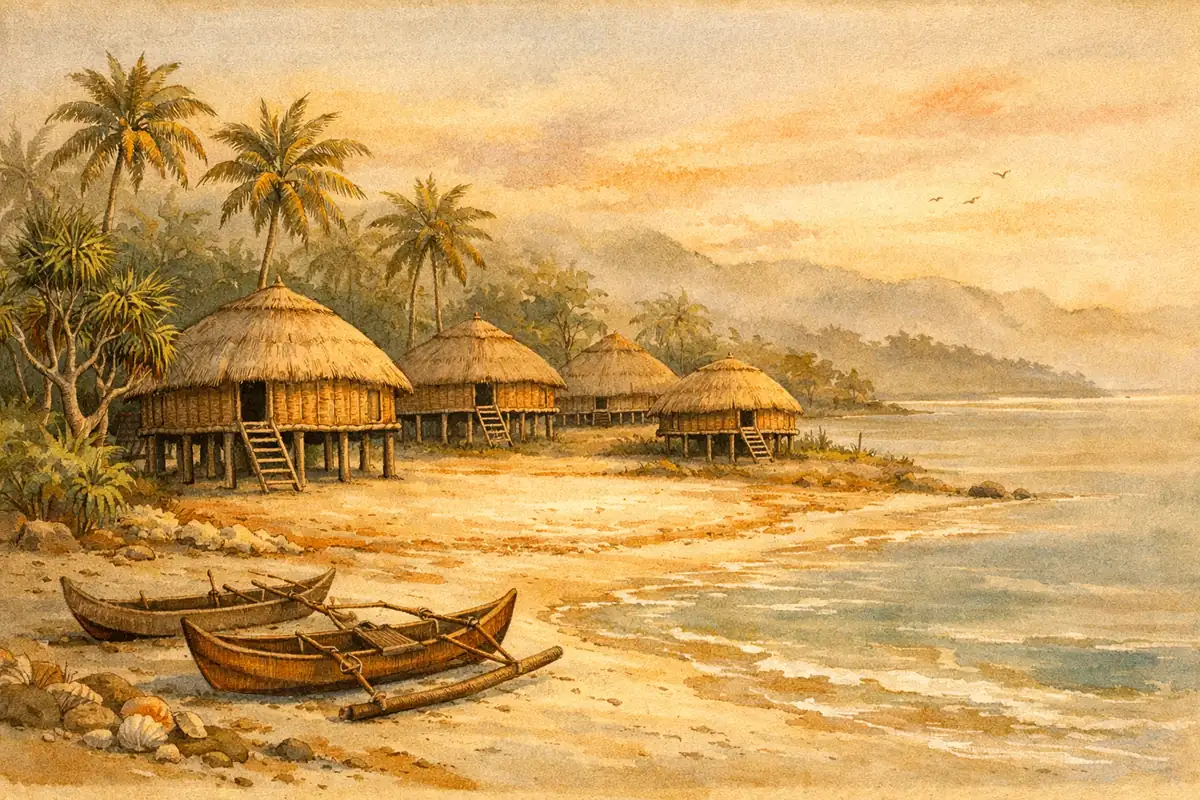
Nicobarese choose their own partners. Settlements stand on the coast, with houses on stilts around a sand-covered ground for dancing and sport. The largest ceremony, held every two or three years when the village heads agree there are pigs enough, is the ossuary feast honouring the dead, shared by several villages; canoe races are a favourite sport. Chowra islanders make the pottery and canoes used by all (Encyclopedia of World Cultures).
Festivals
Ossuary feast
Every two or three years
The largest Nicobarese ceremony, honouring the spirits of the dead and shared by several villages (Encyclopedia of World Cultures).
Sources
- Nancy E. Gratton, 'Nicobarese', Encyclopedia of World Cultures, vol. 3: South Asia (1992). Read with its sub-pages: Orientation, History, Settlements, Economy, Marriage and Family, Sociopolitical Organization, Religion
- Constitution (Scheduled Tribes) Order, 1950, and the companion orders, as amended: Parts for Andaman and Nicobar Islands (as compiled in Wikipedia's List of Scheduled Tribes)
- Census of India 2011, Table A-11: State Primary Census Abstract for individual Scheduled Tribes, Andaman and Nicobar Islands. censusindia.gov.in NADA catalog 42973 (Andaman and Nicobar Islands)
Practice differs by village and family. If something here does not match your family's tradition, trust your elders.