
Rajbanshi
রাজবংশী
At a glance
- Clan word
- Gotra
- Descent
- Not recorded in the sources used
- Lives in
- West Bengal, Assam, Bihar, Bangladesh, Nepal
- Languages
- Kamatapuri (Rajbanshi) (Indo-European (Indo-Aryan); Bengali script), Bengali (Indo-European (Indo-Aryan); Bengali script)
- Population
- 38,01,677 Census 2011, Table A-10 Appendix, West Bengal: the entry Rajbanshi (Rajbanshi families in Assam, Bihar and other states are not counted in any Scheduled Caste table)
- Region
- East
About
The Rajbanshi, also Rajbongshi or Koch-Rajbongshi, are a people of North Bengal, Lower Assam, eastern Bihar, the Rangpur region of Bangladesh and the Terai of eastern Nepal. They speak Kamatapuri, also called Rajbanshi. The name means 'of the royal line' and refers to the community's claimed tie to the Koch kings. In West Bengal they are a Scheduled Caste, the largest in the state.
Clans and Kinship
Risley (1891), in his entry on the Koch, found the community divided into sub-castes that married within themselves and differed from district to district, the Rajbansi being the main one in northern Bengal. Families had begun to adopt gotras, and all of them had taken the same one, Kasyapa, so the gotra could not decide whom a family might marry. Instead, marriage was barred in theory to seven generations from the paternal and maternal uncles and to three from the aunts, though Risley heard the rule was loosely kept; and because families disliked marrying anyone from far away, they married within small local circles that had no names or fixed limits. The sources used do not say how descent is reckoned. In the Kshatriya movement of the early twentieth century families wore the sacred thread, took gotra names and shortened the period of mourning impurity from thirty days to twelve.
What “Gotra” means
Risley (1891) recorded that the Rajbansis had begun to adopt gotras and that all had taken one, Kasyapa, which therefore did not govern marriage; degrees of kinship and distance did instead.
No list is given: Risley (1891) records a single gotra, Kasyapa, shared by the whole community, so there is no list of clans to give.
In the Official Lists
Scheduled Caste
West Bengal
Listed as: Rajbanshi
Checked in Census 2011 Table A-10 Appendix, West Bengal, and against Wikipedia's compilation of the Scheduled Castes order. Koch is a separate Scheduled Caste entry in West Bengal and Tripura (the same tables) and a Scheduled Tribe in Meghalaya (the compiled Scheduled Tribes order); whether families recorded as Koch count themselves Rajbanshi was not checked, so those entries are not shown. Wikipedia's account says that in Assam (where the community is classed as MOBC, a special OBC category) and Bihar it is in the Other Backward Classes; the central and state OBC lists could not be opened to confirm this.
Checked on 2026-11-07 against the sources below. The lists are amended from time to time and can differ by district; for a certificate, the current order or the state's list is what counts.
Name and Origin
Rajbanshi means 'of the royal line'. The community took the name in the late nineteenth century, linking itself with the Koch kings, who under Biswa Singha, founder of the Koch dynasty in the early 1500s, had called themselves Shiva-banshi or Rajbanshi; even in the census of 1901 the Rajbanshis were still grouped with the Koch. How far the Rajbanshi and the Koch are one people is debated, and scholars note that the community may have drawn in several groups over time.
History
From 1872 to 1911 the community changed its name in the census three times, from Koch to Rajbanshi, then to Bhanga Kshatriya in 1891 under Harimohan Ray Khajanchi, and then to Rajbanshi Kshatriya. Panchanan Barma (1866 to 1935), a lawyer at Rangpur, founded the Kshatriya Samiti at a conference in Rangpur on 1 May 1910; it asked the government to record the community as Kshatriya, held large ceremonies from 1913 on the Karatoya river at which men took the sacred thread, and the census later accepted the Kshatriya claim (one account dates this to the 1911 census report, another to 1921). After the Partition of 1947 the Samiti lost its centre at Rangpur, now in Bangladesh, and moved to Dinhata; in the 1950s and 1960s Rajbanshi bodies worked for recognition of their language as distinct from Bengali.
Faith and Worship
Most Rajbanshis are Hindu. From the seventeenth century Koch society came under growing Brahminical influence, and the Kshatriya movement of the early twentieth century took up the rites of the twice-born, such as the sacred thread.
Customs
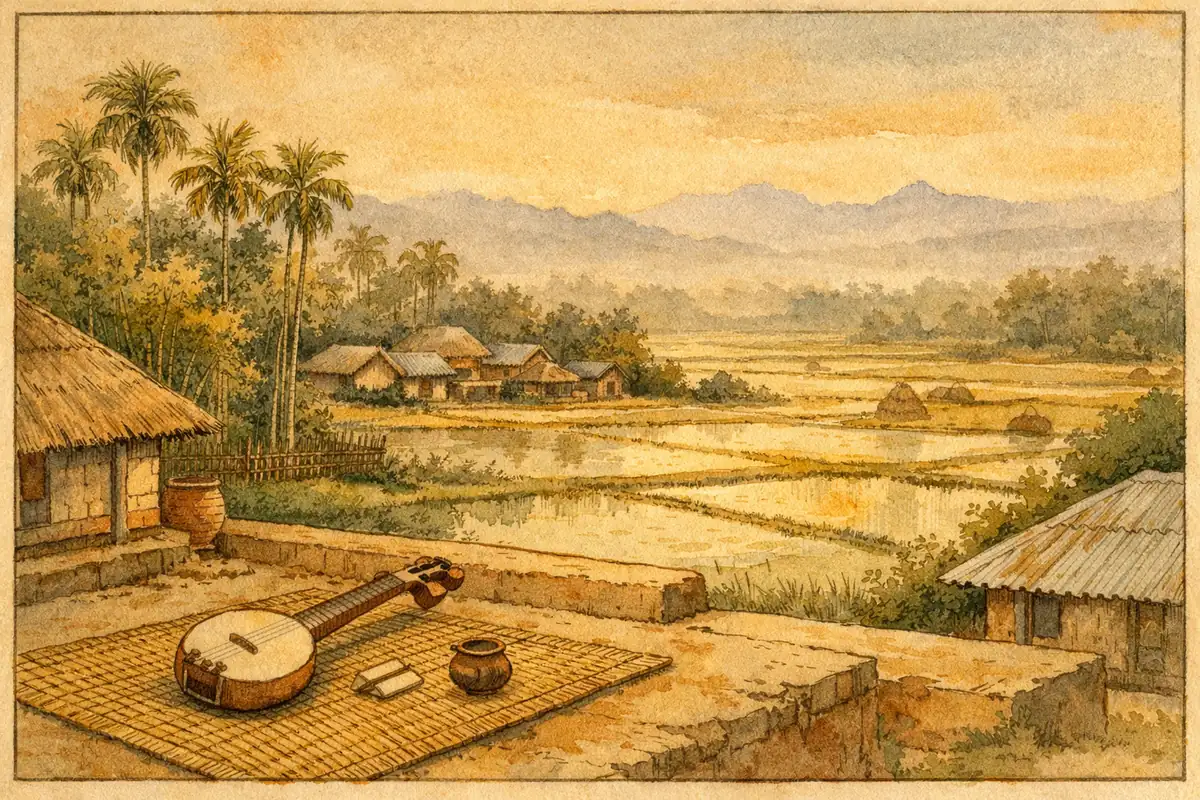
Music is central to Rajbanshi life: the bhawaiya and chatka songs and other forms are sung to string instruments such as the dotora, sarinda and bena, drums such as the dhak and khol, and wind instruments such as the sanai.
Notable Personalities
Panchanan Barma
1866 to 1935
Lawyer of Rangpur, born at Khalisamari in Cooch Behar, who founded the Kshatriya Samiti in 1910 and led the Rajbanshi movement for recognition and education.
Related communities
Sources
- H. H. Risley, The Tribes and Castes of Bengal: Ethnographic Glossary, vol. 1 (1891), entry on the Koch: internal structure, gotra and exogamy. Vol. 1, pp. 491-494
- Census of India 2011, Table A-10 Appendix: District wise scheduled caste population, West Bengal (and Tripura, catalog 42895)
- Wikipedia, 'Rajbanshi people' (pointer to the sources it cites; read 2026-11-06 and 2026-11-07)
- Wikipedia, 'Thakur Panchanan' (Panchanan Barma)
- Constitution (Scheduled Castes) Order, 1950, as amended, Part West Bengal (as compiled in Wikipedia's List of Scheduled Castes); Constitution (Scheduled Tribes) Order, 1950, Part Meghalaya, as compiled in Wikipedia's List of Scheduled Tribes
Practice differs by village and family. If something here does not match your family's tradition, trust your elders.