
Vanniyar
வன்னியர்
At a glance
- Clan word
- Clan
- Descent
- Not recorded in the sources used
- Lives in
- Tamil Nadu, Puducherry
- Language
- Tamil (Dravidian; Tamil script)
- Region
- South
About
Vanniyar is a community of northern Tamil Nadu and Puducherry, most numerous in the old Chengalpattu, North Arcot, South Arcot and Salem districts. Its associations, beginning with the Vanniyakula Kshatriya Maha Sangam founded in Madras in 1888, have presented it as Vanniya Kula Kshatriya, of the fire-born (Agnikula) line, and linked it with the Pallava kings. Vanniyars are closely tied to the worship of Draupadi Amman.
Clans and Kinship
Thurston (1909) records several kinds of division. In reply to the census of 1891 the community named five lines, the Rudra, Krishna, Sambhu, Brahma and Indra Vanniyar, after the sons of its founder; the census itself recorded sub-divisions such as Agni, Arasu, Kshatriya, Nagavadam, Olai and Pandamuttu, and in Salem some families were divided by the ear ornament their women wore (Olai or Nagavadam) or by the day on which they performed the final death rites. A priestly group, the Kovilar, served the community. Families carry titles such as Nayakar, Padaiyachi, Kandar, Udaiyar, Gounder and Varma. Social matters were decided by headmen called Perithanakkaran or Nattamaikkaran in a panchayat.
What “Clan” means
The sources checked do not name Vanniyar exogamous clans or the community's word for them; Thurston (1909) records the sub-divisions and titles described above but not the rules of exogamy.
No clan list is given: Thurston (1909) names sub-divisions and titles, but no exogamous clans, and no other source opened lists them.
In the Official Lists
No listing is shown: the central (NCBC) list and the Tamil Nadu state list could not be opened for this check. Secondary sources cited on Wikipedia say the Vanniyars, earlier in the state's Backward Class category, were placed among its Most Backward Classes in the 1980s. Check the current central and state lists.
Checked on 2026-11-07 against the sources below. The lists are amended from time to time and can differ by district; for a certificate, the current order or the state's list is what counts.
Name and Origin
Vanniyar tradition, as Edgar Thurston (1909) recorded it from H. A. Stuart, derives the name from the Sanskrit vahni, fire: when two demons, Vatapi and Mahi, darkened the world, the sage Jambava Mahamuni performed a fire sacrifice, armed horsemen sprang from the flames and destroyed them, and their leader, Rudra Vanniya Maharaja, had five sons, the ancestors of the Vanniyas. The story was said to be recorded at the Vaitheeswaran Koil temple in the Tanjore district. Thurston notes that Vanni is used in Tamil poems to mean king. Alf Hiltebeitel, cited on Wikipedia, also derives the name from vahni; other scholars have proposed the Dravidian val, strength, or the Sanskrit vana, forest. Colonial census records used the name Palli, which the community regards as derogatory.
History
Burton Stein describes Vanniyars as peasant-warriors who had risen to local prominence by the fourteenth century, some as the Sambuvaraya chiefs (cited on Wikipedia); an inscription of 1189 CE gives the title Vanniya Nayan to the local chief of Tiruchchuram near Chengalpattu (Thurston). Before the census of 1871 representatives of the community petitioned to be classified as Kshatriyas, and for the census of 1891 T. Aiyakannu Nayakar compiled Vannikula Vilakkam, a treatise in support of the claim; in 1907 T. Varadappa Nayakar published a Tamil history of the community's link with the Pallava kings. The Vanniyakula Kshatriya Maha Sangam appeared in Madras in 1888 and became state-wide in 1952, and by 1931 the Madras census used the name Vanniya Kula Kshatriya. Thurston records that the community claimed the Alvar Kulasekhara as one of its own and celebrated his anniversary at the Parthasarathi temple in Triplicane, and that it repaired the Palligopuram, a gateway tower of the Ekambaranatha temple at Kanchipuram.
Faith and Worship
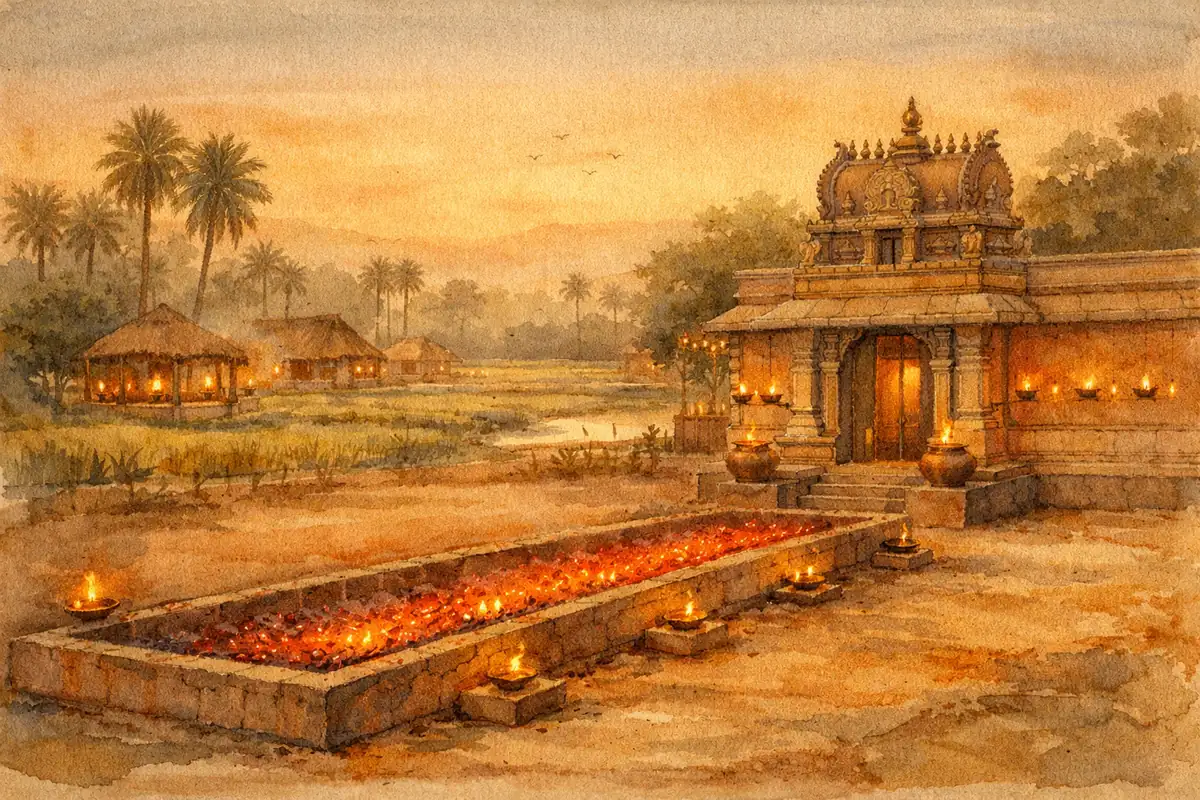
Vanniyars are Hindus. The community is closely linked with the worship of Draupadi Amman: in the South Arcot district, Thurston (1909) quotes the district gazetteer, Draupadi's temples were numerous, the priest was generally of the community, which took the leading part in the festival's recital of the Mahabharata and its fire-walk, and in Madras several Draupadi Amman temples belonged to the community. The community explained the link by its descent, like the Pandavas, from fire. Hiltebeitel suggests that the Vanniyars may have begun the cult.
Customs
Thurston records that adult marriage was the rule. At the betrothal the groom's side presented betel, flowers, the bride-price (pariyam) and the mulapal kuli, or milk money, a gift to the bride's mother for having nursed her, before the headmen of both families. At a Pandamuttu wedding the couple sat on a raised dais representing a throne, beside a pile of decorated marriage pots reaching to the roof of the wedding shed.
Festivals
Draupadi Amman festival
Yearly, at each temple's own festival
Includes a recital or enactment of the Mahabharata and a fire-walk, in which the community has long taken the leading part.
Sources
- E. Thurston and K. Rangachari, Castes and Tribes of Southern India, vol. 6 (1909), 'Palli or Vanniyan'. Vol. 6, pp. 1-20: census petitions of 1871 and 1891, origin legend, inscriptions, Draupadi worship, titles, sub-divisions, headmen, betrothal and marriage
- Wikipedia, 'Vanniyar' (pointer to the sources it cites, among them Alf Hiltebeitel, The Cult of Draupadi, Burton Stein, Lloyd and Susanne Rudolph, and M. S. S. Pandian; read 2026-11-07)
Practice differs by village and family. If something here does not match your family's tradition, trust your elders.