
Angami
At a glance
- Clan word
- Thino
- Descent
- Through the father
- Lives in
- Nagaland, Manipur
- Language
- Tenyidie (Angami) (Tibeto-Burman; Roman script)
- Part of
- Naga
- Region
- North-East
About
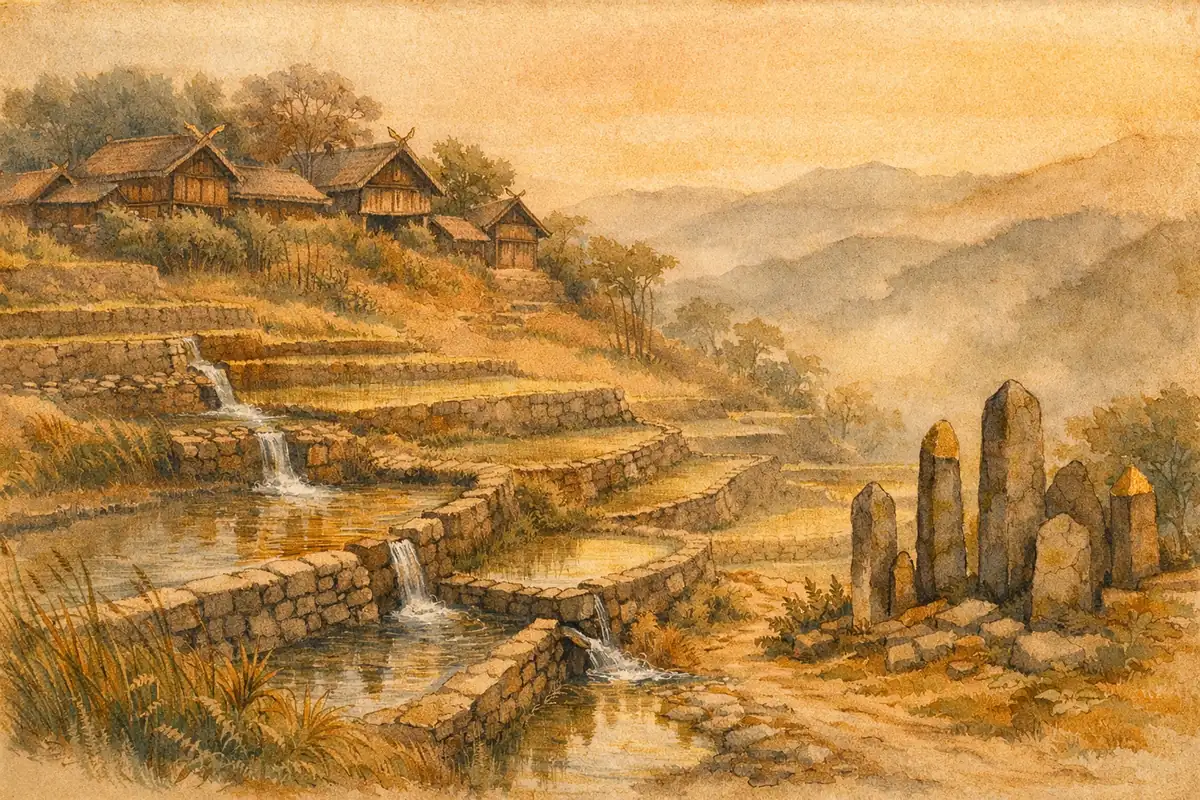
The Angami are a Naga people of the hills around Kohima in Nagaland, with some villages in Manipur. Hutton (1921) recorded that some of them call themselves Tengima. Their villages are known for terraced rice fields fed by channels, and each village is made up of clans (thino), patrilineal and grouped under two halves of the tribe (kelhu). Their language is Tenyidie. They are a Scheduled Tribe, within 'Naga' in Nagaland and by name in Manipur.
Clans and Kinship
Hutton (1921, pp. 110-117) describes three levels of descent group, all patrilineal and named after ancestors, with no totems. The tribe falls into two halves (kelhu): the Pezoma, descended from Thevo (with the small Satsuma), and the Pepfüma, descended from Thekrono and also called Thekronoma or Cherama; they are named from the words used for mother, and may once have married only each other. Each kelhu is made up of clans (thino), exogamous until shortly before 1921, and each thino of kindreds (putsa), which in Hutton's time were becoming the real exogamous unit; marriage inside the putsa was held to bring barren or sickly offspring. A village is divided into quarters, each the home of one or more thino. There were no real chiefs: the leaders (pehuma) had little authority outside war, and the hereditary kemovo, a descendant of the founder of the village or clan, directed public ceremonies, fixed their days and kept the genealogies. The young men's house (kichüki) was of little importance among the Angami proper.
What “Thino” means
Thino is the Angami word Hutton gives for the clan: a patrilineal group descended from one ancestor and, until shortly before 1921, exogamous. Each thino is divided into kindreds (putsa), and the thino are grouped under the two kelhu.
13 thinos
- Cherama
Pepfüma kelhu
Kohima; came straight from Kezakenoma (Hutton, p. 115).
- Hrepvoma
Pepfüma kelhu
Kohima; one of six clans that grew out of the older Pferonoma clan, which came from Kezakenoma by way of Kigwema.
- Horotsuma
Pepfüma kelhu
Kohima; from the Pferonoma clan.
- Chetonoma
Pepfüma kelhu
Kohima; from the Pferonoma clan.
- Dapetsuma
Pepfüma kelhu
Kohima; from the Pferonoma clan.
- Pfuchatsuma
Pepfüma kelhu
Kohima; from the Pferonoma clan.
- Rosuma
Pepfüma kelhu
Kohima; from the Pferonoma clan.
- Semoma
Pepfüma kelhu
Khonoma; divided into two septs, Chalitsuma and Kutsotsuma, and these into kindreds (Hutton, pp. 115-117, 127).
- Merhema
Khonoma; the clan of a gaonbura descended from the old Khonoma chief Pelhu (Hutton, p. 142).
- Toloma
Jotsoma (Hutton, p. 126).
- Tseyama
Jotsoma (Hutton, p. 126).
- Kwoma
Jotsoma (Hutton, p. 126).
- Thekronoma
Jotsoma (Hutton, p. 126); the name is also used for the Pepfüma kelhu as a whole.
Hutton (1921) gives no single list for the tribe: clans differ from village to village, and his Appendix X lists them village by village. These are the clans he names in the text for Kohima, Khonoma and Jotsoma, with the kelhu where he gives it.
In the Official Lists
Scheduled Tribe
Nagaland, Manipur
In Nagaland the Angami come within the single entry 'Naga'. In Manipur 'Angami' is an entry of its own.
Checked on 2026-11-06 against the sources below. The lists are amended from time to time and can differ by district; for a certificate, the current order or the state's list is what counts.
Name and Origin
Hutton (1921, p. 14) wrote that 'Angami' is apparently a corruption of Gnamei, the name the Manipuris gave them, and that some of them call themselves Tengima. In Angami tradition the people descend from two men, sometimes called brothers, who came up out of the earth: Thevo, ancestor of the Pezoma half of the tribe, and Thekrono, ancestor of the Pepfüma half; the Memi point to the great stone at Maikel in Manipur as the place. All Angami villages trace their origin to Kezakenoma (now written Khezhakeno), believed to be the first Angami village north of the Mao gap. The Angami are counted among the Tenyimi peoples, with the Chakhesang, Mao, Maram, Poumai, Rengma and Zeme.
History
Hutton divided the Angami of his day into the Tengima, or Western Angami, of the Khonoma, Kohima, Viswema and Chakroma groups of villages, and the Eastern Angami, by which he meant the Chakrima and Kezama and the Memi on their border. The Chakhesang of today were formerly known as the Eastern Angami, and the Angami now speak of four regional divisions: Northern, Southern, Western and Chakhro Angami. Kohima became the headquarters of the Naga Hills district in 1878 and is the capital of Nagaland, which became a state on 1 December 1963. J. H. Hutton, Deputy Commissioner of the Naga Hills, published The Angami Nagas in 1921, the standard early account of the tribe.
Faith and Worship
In the older religion, as Hutton recorded it (pp. 180-187), the chief of the spirits (terhoma) is Kepenopfü, usually called Ukepenopfü, 'birth spirit', the ancestress of men, sometimes spoken of as the creator of living beings. Rest days (genna) were kept by the whole village on days fixed by the kemovo. Most Angami are now Christian; a few still keep the older religion, now called Pfütsana.
Customs
Angami farming is known for its terraces: hillsides are built into wet-rice fields with stone retaining walls, and water is led by channels from terrace to terrace round a whole spur (Hutton, pp. 72-73). Sekrenyi, Hutton's Sekrengi, falls on the second day after the full moon of Keno (February) or of Kezi (March) and is held for the health of the community in the coming year: on its first day every man washes himself, his weapons, tools and clothes at the village spring (pp. 197, 203; details vary by village). Gennas that confer social standing on the giver are held at the Terhengi in the Kohima group and at the Sekrengi in the Viswema group.
Festivals
Sekrenyi
February (in Hutton's account, the month Keno or Kezi)
Rite for the health of the coming year; the men wash at the village spring on its first day.
Terhengi
At the end of the farming year
One of the two most important gennas of the year in the Kohima and Khonoma groups, Hutton writes.
Gnongi
At the start of the year's field work
The other of the two chief gennas in the Kohima and Khonoma groups, marking new work in the fields.
Stories and Legends
The stone of Kezakenoma
Hutton (1921, p. 19) gives the Angami story of the origin of the Naga tribes. An old couple at Kezakenoma had three sons, who took turns to dry their paddy on a great flat stone, where a load spread at dawn became two by dusk, for a spirit lived in it. The sons quarrelled over whose turn it was, and their parents, fearing bloodshed, broke eggs on the stone and burnt brushwood over it. It cracked with a noise like thunder, the spirit went up in smoke and the stone lost its power. The sons parted and became the ancestors of the Angami, Lotha and Sumi; the parents' descendants are the seven Kezami villages.
Related communities
Sources
- J. H. Hutton, The Angami Nagas (London: Macmillan, 1921). pp. 14-15 (name, groups of villages), 19 (the Kezakenoma stone), 49 (kichüki), 72-73 (terraces), 110-117 and 126-127 (kelhu, thino, putsa, pedigrees), 142 (pehuma, kemovo), 180-187 (Kepenopfü, kemovo), 196-203 (gennas, Sekrengi), 418-422 (Appendix X, clans by village)
- Constitution (Scheduled Tribes) Order, 1950, as amended, Part for Manipur, and the Constitution (Nagaland) Scheduled Tribes Order, 1970, as compiled from the Census of India list of notified Scheduled Tribes
- Angami Naga, Wikipedia (pointer: four regional divisions; Chakhesang formerly Eastern Angami; Tenyidie; Tenyimi peoples; Pfütsana)
- Nagaland, Wikipedia (pointer: Kohima headquarters 1878; statehood 1963; Sekrenyi in February)
Practice differs by village and family. If something here does not match your family's tradition, trust your elders.