
Naga
At a glance
- Clan word
- Clan
- Descent
- Through the father
- Lives in
- Nagaland, Manipur, Assam, Myanmar
- Languages
- Naga languages, one or more for each tribe (Tibeto-Burman; Roman script), Naga-Assamese (Nagamese) (Assamese-based contact language (Indo-Aryan); Roman script)
- Part of
- Naga
- Region
- North-East
About
Naga is the shared name of many related peoples of the hills between the Brahmaputra valley and the Chindwin, in Nagaland, Manipur and Assam and across the border in Myanmar. Each tribe has its own language, clans, customs and lands. In the Scheduled Tribe lists Nagaland names them together as 'Naga', Meghalaya, Mizoram and the hill districts of Assam as 'Any Naga tribes', and Manipur lists its Naga tribes by name. This page is an overview; each tribe has its own page.
Clans and Kinship
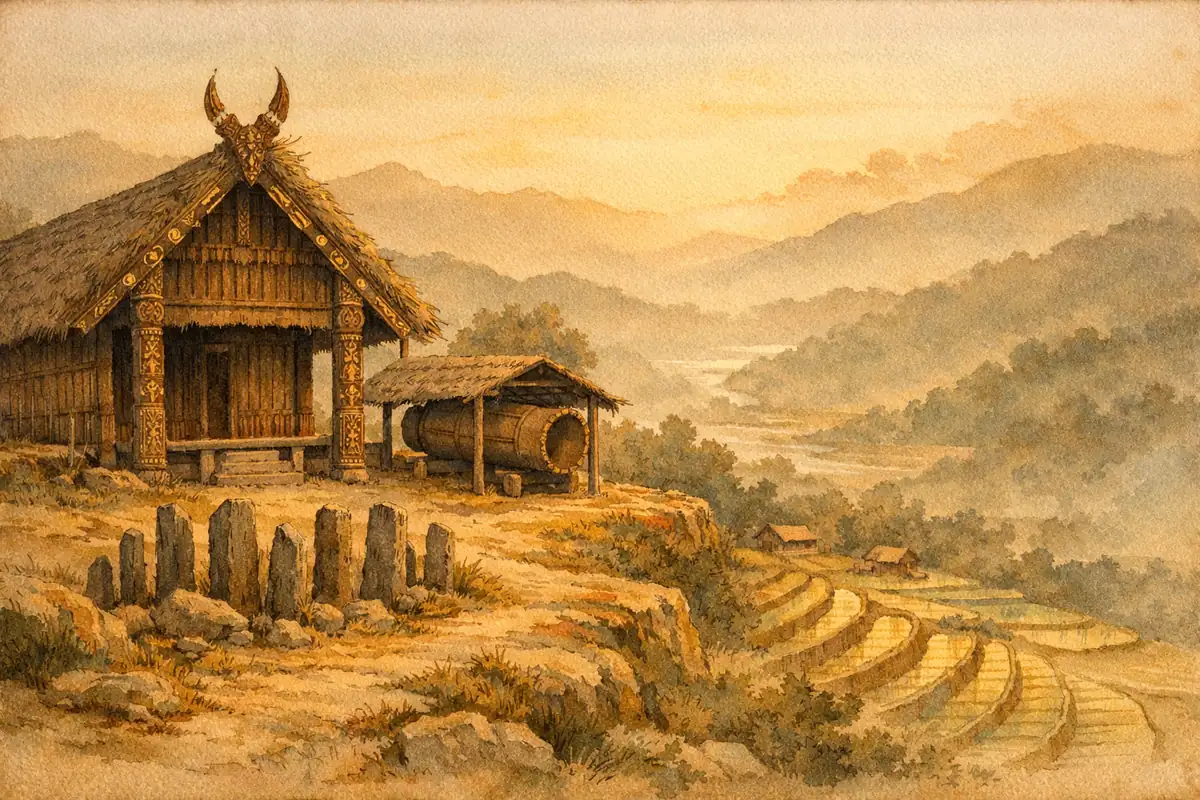
The village is the main unit of Naga life. Clans are patrilineal everywhere, and in many tribes they are grouped into larger divisions: the two kelhu of the Angami, the three phratries of the Ao and of the Lotha. Hodson (1911) found that a Naga village in Manipur had at least two clans, each holding its own part of the village, and that the clan was the unit of marriage, of the rites for a death and of blood feud. Village government differed by tribe: Angami villages had elders and a hereditary priest, the kemovo, but no real chief; Sumi villages were ruled by hereditary chiefs whose sons founded new villages; Ao villages were run by councils of elders that gave way to the next generation every twenty-five or thirty years. Young men slept in a morung, the young men's house, which was large and central among the Ao and the Lotha and of little importance among the Angami.
What “Clan” means
Each Naga tribe has its own word for the clan and for the larger and smaller groups around it: thino, kelhu and putsa among the Angami, ayeh among the Sumi, chibo and mhitso among the Lotha. The words and the clan lists are on the tribe pages.
Naga clans belong to each tribe, not to the Naga as a whole, so none are listed here. See the tribe pages: Angami, Ao, Sumi, Lotha and Tangkhul.
In the Official Lists
Scheduled Tribe
Nagaland, Manipur, Assam, Meghalaya, Mizoram
Nagaland's list has the single entry 'Naga'. Meghalaya, Mizoram and the list for Assam's autonomous hill districts have 'Any Naga tribes'. Manipur has no 'Any Naga tribes' entry and lists its Naga tribes by name, among them Angami, Mao, Maram, Poumai Naga, Sema and Tangkhul.
How a Naga family is listed depends on the state. Arunachal Pradesh's list, as compiled, has no 'Any Naga tribes' entry; it names Nocte, Tangsa, Tutsa and Wancho together as one entry. The compilation used may not show amendments made between 2022 and 2024.
Checked on 2026-11-06 against the sources below. The lists are amended from time to time and can differ by district; for a certificate, the current order or the state's list is what counts.
Name and Origin
Naga is not one tribe's own word. It was the name used by the Assamese and other neighbours and by the British, while each tribe has its own name for itself: Aor among the Ao, Kyon among the Lotha, Tengima among some Angami. Where the word comes from is not settled: Hutton, in a note to Mills (1926), gave up his earlier derivation from Sanskrit nag and, reluctantly, preferred nagna, 'naked', because Ptolemy and the later writer Shihabuddin Talish speak of them as naked. Several western tribes, the Angami, Lotha, Sumi, Rengma and Memi among them, tell of the stone at Kezakenoma (Khezhakeno) on which paddy spread to dry doubled, and of brothers who parted there; the Ao trace their beginning to the six stones of Lungterok.
History
The British set up a post at Samaguting in 1866 and moved the headquarters of the Naga Hills district to Kohima in 1878; the Ao country was annexed in April 1889. The American Baptist mission worked among the Ao from the 1870s: E. W. Clark moved up to Molungyimchen in 1876 and founded the Christian village of Molungyimsen that year. Christianity spread to most tribes in the twentieth century. The monographs of Hodson (The Naga Tribes of Manipur, 1911), Hutton (The Angami Nagas and The Sema Nagas, 1921) and Mills (The Lhota Nagas, 1922; The Ao Nagas, 1926) are the standard early accounts. Nagaland became a state on 1 December 1963. Since December 2000 the Nagaland government has held the Hornbill Festival at the Kisama Heritage Village near Kohima, where all the state's peoples take part.
Faith and Worship
Each tribe had its own religion, with a creator or chief spirit (Kepenopfü of the Angami, Alhou of the Sumi, Lichaba of the Ao), many spirits of the land, forest and household, and rest days (genna) on which the village or household kept from work. Baptist missions from the 1870s, and later other churches, brought Christianity; about 88 per cent of Nagaland's people are now Christian, most of them Baptists. Among the Angami a few still keep the older religion, Pfütsana.
Customs
Feasts given to the whole village brought the giver standing and the right to certain ornaments or dress, and clans and phratries kept careful rights in shares of meat, in ornaments and in dress (Hutton, Mills). Village and household rest days (genna) mark the farming year, and each tribe's festivals follow its own round of clearing, sowing and harvest.
Festivals
Hornbill Festival
December
Held by the Nagaland government at the Kisama Heritage Village near Kohima since 2000, with all the state's peoples taking part.
Sekrenyi
February
The Angami festival of purification for the health of the coming year.
Moatsü
May
The Ao festival held when the sowing is finished.
Tuluni
July
A Sumi festival in the Nagaland government's calendar.
Aoleang
April
A Konyak festival in the Nagaland government's calendar.
Tokhü Emong
November
The Lotha festival in the Nagaland government's calendar.
Related communities
Sources
- Constitution (Scheduled Tribes) Order, 1950, as amended, Parts for Manipur, Meghalaya, Mizoram, Assam (autonomous districts) and Arunachal Pradesh, and the Constitution (Nagaland) Scheduled Tribes Order, 1970, as compiled from the Census of India list of notified Scheduled Tribes
- J. P. Mills, The Ao Nagas (London: Macmillan, 1926), with notes by J. H. Hutton. pp. 1-2 and note (the name Aor; Hutton on the word Naga), 6 (Lungterok), 13 (annexation, 1889), 73 (morung), 181-182 (councillors), 220-221 (Lichaba), 411 (the Baptist mission, 1876)
- J. H. Hutton, The Angami Nagas (London: Macmillan, 1921). pp. 19 (the Kezakenoma stone), 49 (morung), 110-117 (kelhu, thino, putsa), 142 (no chiefs), 180-181 (Kepenopfü), 186-187 (kemovo); Part VI (Naga-Assamese)
- J. H. Hutton, The Sema Nagas (London: Macmillan, 1921). pp. 8 (chiefs' sons found new villages), 121 (ayeh), 192-194 (Alhou)
- J. P. Mills, The Lhota Nagas (London: Macmillan, 1922). pp. 1 (Kyon), 24 (champo), 86 (chibo, mhitso)
- T. C. Hodson, The Naga Tribes of Manipur (London: Macmillan, 1911). pp. 71-74 (the clan and the village)
- Nagaland, Wikipedia (pointer: Samaguting 1866, Kohima 1878, statehood 1963, Christian 88 per cent and Baptists, Hornbill Festival, festival calendar)
- Angami Naga, Wikipedia (pointer: Pfütsana)
Practice differs by village and family. If something here does not match your family's tradition, trust your elders.