
Ao
At a glance
- Clan word
- Clan
- Descent
- Through the father
- Lives in
- Nagaland
- Language
- Ao (Chungli and Mongsen) (Tibeto-Burman; Roman script)
- Part of
- Naga
- Region
- North-East
About
The Ao are a Naga people whose country lies around Mokokchung in Nagaland. Mills (1926) recorded their name for themselves as Aor. They are divided into language groups, the Chongli and Mongsen and the smaller Changki, each with its own clans, and every clan belongs to one of three exogamous phratries. Each ward of a village was governed by councillors who handed over to the next generation together. They are a Scheduled Tribe within the entry 'Naga' in Nagaland.
Clans and Kinship
Each language group has its own clans, grouped in three phratries. Among the Chongli these are the Pongen, regarded as the senior, the Lungkam and the Chami; the Mongsen have no names of their own for theirs and use the Chongli terms (Mills, pp. 13-21). The phratries are strictly exogamous: a man may not marry a woman of a clan that local opinion counts in his own phratry or in the corresponding phratry of the other group, though some clans are assigned to different phratries in different villages. Phratries and clans keep their own rights in shares of meat, ornaments and dress. Each village ward (khel) has its councillors (tatar), organised in bodies called minden; at the end of every generation, usually twenty-five to thirty years, all the councillors of a ward leave office together and a new body takes their place, and the Chongli name the generations in a cycle of five (pp. 181-182). Near each village gate stood a morung (arichu), a guard house and club house of the young men (p. 73).
What “Clan” means
Mills (1926) writes of clans and phratries. He took the ending -char of many clan names to mean 'clan' and calls the clan priests pachar patir, but gives no single Ao word as the name for a clan. Clans are patrilineal, and marriage within one's phratry is barred.
49 clans
- Pongenr
Pongen phratry (Chongli)
- Yimsungr
Pongen phratry (Chongli)
- Aotang
Pongen phratry (Chongli)
- Wozukamr
Pongen phratry (Chongli)
The 'bird clan'; its members may not kill a hornbill (Mills, Lhota Nagas, p. 89).
- Lungkungr
Pongen phratry (Chongli)
- Tsitir
Pongen phratry (Chongli)
Named 'terrifying people' in the story Mills tells of the clan's near destruction and refounding.
- Charir
Pongen phratry (Chongli)
Regarded by the Yimsungr as their adopted children.
- Chongli Aiyir
Pongen phratry (Chongli)
Said to have come over from the Mongsen.
- Yongpur
Pongen phratry (Chongli)
- Lungkamr
Lungkam phratry (Chongli)
Senior clan of its phratry.
- Azupongr
Lungkam phratry (Chongli)
- Makampongr
Lungkam phratry (Chongli)
- Mangkotsungmen
Lungkam phratry (Chongli)
- Mozur
Lungkam phratry (Chongli)
- Saiyichang
Lungkam phratry (Chongli)
- Ratuchang
Lungkam phratry (Chongli)
- Shompuchang
Lungkam phratry (Chongli)
- Lamtur
Lungkam phratry (Chongli)
- Azukamr
Lungkam phratry (Chongli)
- Chamir
Chami phratry (Chongli)
- Chamitsur
Chami phratry (Chongli)
Also called Tsuwar.
- Chamichang
Chami phratry (Chongli)
- Mongkamchang
Chami phratry (Chongli)
- Tamachang
Chami phratry (Chongli)
- Sampur
Chami phratry (Chongli)
- Amang
Chami phratry (Chongli)
- Merang
Chami phratry (Chongli)
- Lamtu-ungr
Chami phratry (Chongli)
- Yatenr
Chami phratry (Chongli)
- Chichir
Chami phratry (Chongli)
Also called Michipar.
- Chaochir
Chami phratry (Chongli)
- Aiyir
First phratry (Mongsen), matching the Pongen
- Yimchenchar
First phratry (Mongsen), matching the Pongen
- Alapachar
First phratry (Mongsen), matching the Pongen
Regarded as closely connected with the Yimchenchar.
- Walingr
First phratry (Mongsen), matching the Pongen
- Longtangr
First phratry (Mongsen), matching the Pongen
- Atsungchangr
First phratry (Mongsen), matching the Pongen
- Mulir
Second phratry (Mongsen)
Descended from Mozur who rejoined the Mongsen; muli is the Mongsen word for medicine.
- Mongsentsungr
Second phratry (Mongsen)
- Mongsen Lamtur
Second phratry (Mongsen)
- Mongsen Sampur
Second phratry (Mongsen)
- Lungchar
Second phratry (Mongsen)
Also Lungchachar.
- Ochichar
Third phratry (Mongsen)
- Langwar
Third phratry (Mongsen)
- Nungsachar
Third phratry (Mongsen)
- Kichuchar
Third phratry (Mongsen)
- Asampachar
Third phratry (Mongsen)
- Ningsangchar
Third phratry (Mongsen)
- Amchar
Third phratry (Mongsen)
The principal clans in Mills (1926, pp. 13-14 for the Chongli and 20-21 for the Mongsen), in his order and under his phratries. He writes the names with the final -r that Ao adds to names of persons and groups (Sangtamr, 'a Sangtam'), so the forms used as surnames today may differ. A few names in his lists could not be read reliably in the scan used and are left out, and Mills notes that some clans are assigned to different phratries in different villages.
In the Official Lists
Scheduled Tribe
Nagaland
Within the single entry 'Naga' in Nagaland's list.
Checked on 2026-11-06 against the sources below. The lists are amended from time to time and can differ by district; for a certificate, the current order or the state's list is what counts.
Name and Origin
Mills (1926, pp. 1-2) wrote that Ao is a current mispronunciation of Aor, the people's own word for themselves, which they explained as 'those who came', that is across the Dikhu, as against their name for the Sangtam, Chang, Phom and Konyak; Hutton, in a note, doubted this and read Aor as 'those who are'. Ao tradition holds that the ancestors came out of the earth at Lungterok, 'six stones', on a spur on the right bank of the Dikhu above the present Sangtam village of Chongliyimti; one stone is pointed out as the source of the Pongen and Lungkam phratries and another as that of the Chami (p. 6). Chongliyimti is the scene of nearly all Ao miracles in their stories.
History
Mills held charge of the Mokokchung subdivision from 1917 to 1924 and published The Ao Nagas in 1926, with notes by J. H. Hutton. The Ao country was formally annexed in April 1889, after an outpost had been set up at Mongsenyimti, and the subdivisional headquarters were soon established at Mokokchung (p. 13). The American Baptist mission had taught for some years in the plains when Dr E. W. Clark moved up to Molungyimchen in the spring of 1876; in the autumn he and his converts founded a new village, Molungyimsen, and in 1894 the mission station moved to Impur (p. 411). Mrs Clark wrote an Ao grammar and Dr Clark an Ao dictionary.
Faith and Worship
In the older Ao religion, as Mills recorded it (pp. 215-221), the many spirits are tsüngrem, and the greatest of them, Lichaba, is credited with making the world: he worked carefully on the plains but was hurried before he could finish, so the hills are a jumble. A yearly rite for him, Lichabamung, was held about June to keep the land from slipping, and the Tsüngremmung, in July or August, honoured all the tsüngrem. Most Ao, like most people of Nagaland, are now Christian, chiefly Baptist.
Customs
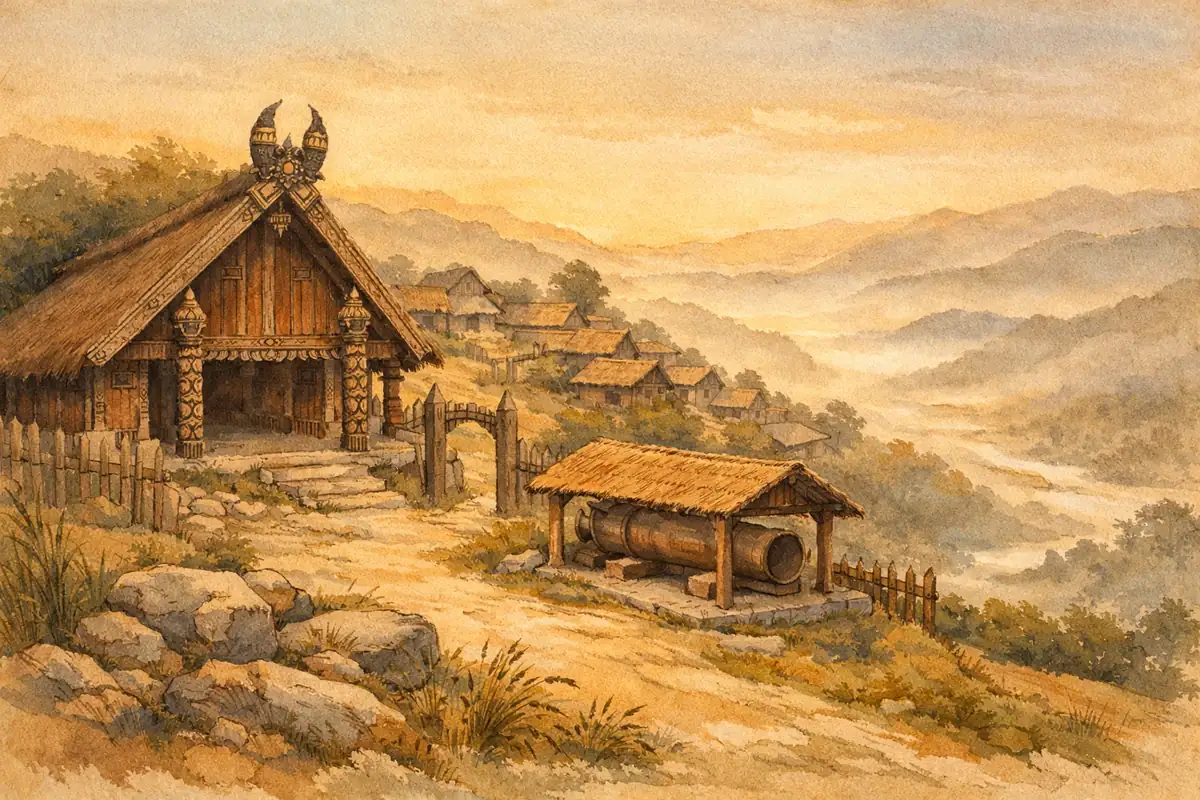
Marriage is outside one's phratry and the corresponding phratry of the other language group. Moatsü, held immediately after the sowing is finished, was in Mills's words the most popular ceremony of the Ao year (p. 115). Village councillors received shares of meat according to their standing, and phratries and clans had their own rights in dress and ornaments. The Ao laid out their dead on platforms, and made great xylophone-like drums hewn from single logs, which Mills lists among the things that set them apart from their Sumi and Lotha neighbours.
Festivals
Moatsü
May, when the sowing is finished
The most popular ceremony of the Ao year in Mills's account; May in the Nagaland calendar.
Tsüngremong
August
Mills's Tsüngremmung, in honour of all the tsüngrem spirits, held in July or August.
Related communities
Sources
- J. P. Mills, The Ao Nagas (London: Macmillan, 1926), with notes by J. H. Hutton. Preface; pp. 1-2 (name, language groups), 6 (Lungterok), 13-21 (annexation, phratries and clans), 73 (morung), 115 (Moatsü), 181-182 (councillors), 215-221 (tsüngrem, Lichaba), 337 (the -r suffix), 411 (the Baptist mission)
- Constitution (Nagaland) Scheduled Tribes Order, 1970, as compiled from the Census of India list of notified Scheduled Tribes
- J. P. Mills, The Lhota Nagas (London: Macmillan, 1922). p. 89 (the Ao bird clan and the hornbill)
- Nagaland, Wikipedia (pointer: festival calendar, Christian and Baptist share of the population)
Practice differs by village and family. If something here does not match your family's tradition, trust your elders.