
Apatani
At a glance
- Clan word
- Halu
- Descent
- Through the father
- Lives in
- Arunachal Pradesh
- Language
- Apatani (Tibeto-Burman (Tani))
- Population
- 43,777 Census 2011, Table A-11, Arunachal Pradesh: Apatani; 33,636 of them in Lower Subansiri district, which then included the Ziro valley (A-11 Appendix).
- Part of
- Tani
- Region
- North-East
About
The Apatani are a people of a single high valley, the Ziro or Apatani valley of Arunachal Pradesh, whose level floor they have turned into irrigated rice fields. They lived in seven large, closely built villages within an hour's walk of each other, and their clans are patrilineal and exogamous. Their language is spoken only in the valley. They are a Scheduled Tribe of Arunachal Pradesh, and Census 2011 counted 43,777 Apatani.
Clans and Kinship
Apatani clans (halu) are patrilineal and exogamous, though some 'brother clans' may not intermarry while sub-clans with separate sitting-platforms sometimes do (Fürer-Haimendorf, 1962, pp. 68-69). Each village is made of quarters held by particular clans. A group of clans shares a small shrine hut, the nago, and most clans have their own large open sitting-platform, the lapang, where the men meet for talk, work and rites; the founding of a new lapang can mark the birth of a new exogamous unit (pp. 64-69). Village affairs were managed not by a chief but by clan representatives called buliang, of three grades: the akha buliang, senior leaders who must be consulted on every important matter; the yapa buliang, middle-aged men who settled disputes day to day; and the ajang buliang, young men who served as their messengers and spoke for the young (pp. 66-67). Fürer-Haimendorf also describes two hereditary classes, mite and mura, which did not intermarry, as the order he found in the 1940s.
What “Halu” means
Halu is the Apatani word for the clan in Fürer-Haimendorf's account (1962): a patrilineal and exogamous group living in its own quarter of a village, usually with its own sitting-platform (lapang).
15 halus
- Kimle
Haja village; Kimle nago and lapang.
- Dusu
Haja village; of the Kimle group.
- Dora
Haja village; of the Kimle group.
- Nada
Haja village; Nada nago; sub-clans Dumpr and Plagang.
- Miri
Haja village; of the Nada group.
- Hidu
Haja village; of the Nada group.
- Taru
Haja village; Taru nago.
- Taro
Haja village; of the Taru group.
- Taku
Haja village; of the Taru group.
- Pemu
Haja village; of the Taru group.
- Kago
Haja village; of the Taru group.
- Haj
Haja village; of the Puna nago.
- Puna
Haja village; the nago is named after it.
- Dani
Haja village; of the Puna nago.
- Pura
Haja village; Nendin nago; sections Nendin and Nemko.
The clans of Haja village as Fürer-Haimendorf recorded them in 1945, in his order and under their shrine groups (1962, pp. 65-66). It is one village of seven; clans differ from village to village. He also marks each clan as mite or mura, which is not repeated here.
In the Official Lists
Scheduled Tribe
Arunachal Pradesh
Listed as: Apatani
The compilation used may not show amendments made between 2022 and 2024.
Checked on 2026-11-07 against the sources below. The lists are amended from time to time and can differ by district; for a certificate, the current order or the state's list is what counts.
Name and Origin
In Apatani tradition the ancestors came into the valley when it was a swamp full of creatures called buru; when the swamps had been drained and the buru destroyed, the people left their first settlement and founded the seven villages, Hang, Hari, Bela, Haja, Duta, Mudang-Tage and Michi-Bamin (Fürer-Haimendorf, 1962, pp. 62-63). Another tradition has three bands of migrants arriving by three routes across the Khru and Kamla rivers, all passing the peak of Pij Cholo; Ursula Graham Bower was told yet another order of arrival. The Daflas' own tradition, as Shukla records it, makes Abo Teni the ancestor of the Apatani as well as of the Dafla and other neighbouring peoples (1959, p. 4).
History
Christoph von Fürer-Haimendorf worked in the valley in 1944 and 1945 and returned briefly in March and April 1962, when his book The Apa Tanis and their Neighbours was already in press; it describes Apatani life as it was before the valley came under outside administration (Epilogue, p. 154). The valley is about six and a half miles long and two wide, and in the 1961 census its seven villages had 2,520 houses and 10,745 people, all living from some twenty square miles of cultivated land (pp. 3, 12); he knew of no other people in India of comparable size living within so small a territory. The Apatani have since spread beyond the valley, and Census 2011 counted 43,777, most of them in the then Lower Subansiri district and some in Papum Pare.
Faith and Worship
In the older religion as Fürer-Haimendorf recorded it (1962, pp. 132-133), Apatani gods and spirits are thought of in pairs and never called on singly. The most powerful are Kilo and Kiru, husband and wife, who live in the earth and are honoured at the Mloko, the greatest festival of the year; Chandun made the earth and his counterpart Didun the sky. Many Apatani keep the older faith, now organised as Donyi-Polo, and many are Christian.
Customs
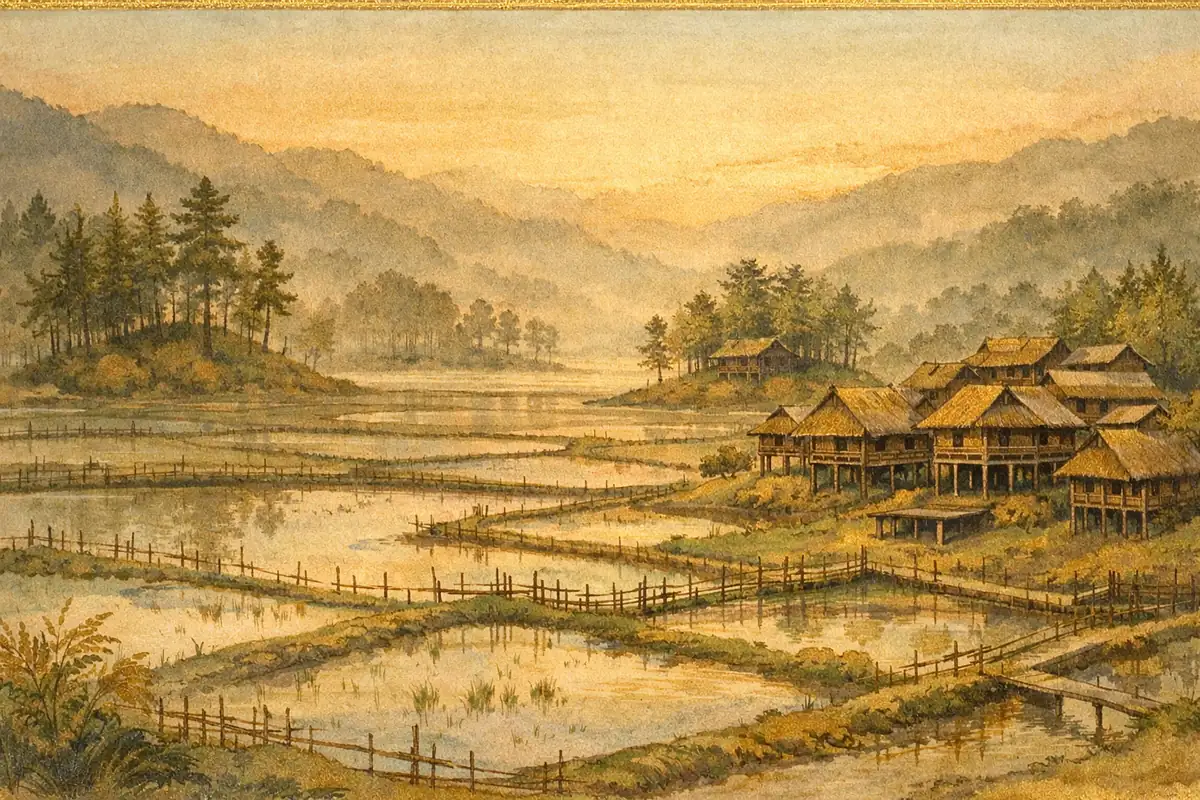
The valley floor is a single expanse of irrigated rice fields, with groves of pine, bamboo and fruit trees on the islands of higher ground; an average family owns at least one fenced bamboo grove, which can change hands for one to three mithan, and the forests on the surrounding hills belong to clans (Fürer-Haimendorf, 1962, pp. 12, 18-19). The Mloko rotates in a three-year cycle between the three village groups: Hang alone, Hari and Bela together, and the four villages of the north-west rim together (p. 63). Apatani sold rice to their Dafla (Nyishi) neighbours, usually for mithan, and a man could raise his standing by sacrificing mithan at the Morom festival (pp. 47-48).
Festivals
Myoko
Mid-March; its rites begin in February and end in April
Fürer-Haimendorf's Mloko, for Kilo and Kiru, hosted in turn by the three village groups in a three-year cycle.
Dree
July
An agricultural festival with prayers for a good harvest, now the valley's main summer festival.
Morom
Yearly
A festival at which a man could raise his standing by sacrificing mithan (Fürer-Haimendorf).
Related communities
Sources
- C. von Fürer-Haimendorf, The Apa Tanis and their Neighbours (London: Routledge and Kegan Paul, 1962). pp. 3 and 12 (the valley; 1961 census of the seven villages), 18-19 (bamboo and pine groves), 47-48 (trade with the Daflas; Morom), 62-69 (traditions of origin; the seven villages and their groups; Mloko cycle; nago, lapang, halu; Haja clans; buliang; clan exogamy), 132-133 (Kilo and Kiru, Chandun and Didun), 154 (Epilogue: the 1962 visit)
- B. K. Shukla, The Daflas of Subansiri Region (Shillong: North-East Frontier Agency, 1959). p. 4 note (Abo Teni ancestor of the Daflas and Apa Tanis)
- Census of India 2011, Table A-11: State primary census abstract for individual Scheduled Tribes, Arunachal Pradesh
- Census of India 2011, Table A-11 Appendix: District wise Scheduled Tribe population, Arunachal Pradesh
- Constitution (Scheduled Tribes) Order, 1950, as amended, Part for Arunachal Pradesh, as compiled from the Census of India list of notified Scheduled Tribes
- Apatani people, Wikipedia (pointer: Ziro valley; Dree in July; Myoko in mid-March with rites from February to April; Donyi-Polo and Christianity; council called bulyañ)
Practice differs by village and family. If something here does not match your family's tradition, trust your elders.