
Nyishi
At a glance
- Clan word
- Clan
- Descent
- Through the father
- Lives in
- Arunachal Pradesh
- Language
- Nyishi (Tibeto-Burman (Tani))
- Population
- 2,49,824 Census 2011, Table A-11, Arunachal Pradesh: the entry 'Nyishi', the largest Scheduled Tribe entry in the state. People returned as 'Nissi' (32,479) and 'Nishang' (2,849) are not included.
- Part of
- Tani
- Region
- North-East
About
The Nyishi are the most numerous people of Arunachal Pradesh, living in the hills between the Kameng and the Subansiri, in what are now the Papum Pare, Kurung Kumey, East Kameng and Lower Subansiri country. They trace their descent from Abo Teni and are divided into three main lines, which split into exogamous phratries and patrilineal clans. Older books call them Dafla, a name since replaced in the official list. They are a Scheduled Tribe of Arunachal Pradesh.
Clans and Kinship
Shukla (1959, pp. 53-56) gives the line of descent from Abo Teni through Atu Nyah, Herin and Ringdo, whose three sons, Dodum, Dol and Dopum, founded the three main divisions of the tribe; the Dodum and Dol are the large majority and the Dopum now few. These divisions do not govern marriage. Each is divided into exogamous phratries made of patrilineal clans, and each clan is named after an ancestor held to be real; clan members regard one another as brothers and sisters, so marriage within the clan and within the phratry is barred. The clan is not a territorial or political unit: kin and neighbours act together. The family is polygynous, and an extended family of several hearths may share one long house, which can run to more than fifty yards (pp. 11-13, 56). Shukla found no recognised chiefs or councils of elders with power to compel in the old order: a man settled a grievance with the support of his kin (p. 81). The Government later gave an influential man of each village a red coat as a mark of authority (p. 81, note).
What “Clan” means
Shukla (1959) writes of major divisions, exogamous phratries and patrilineal clans, each clan named after an ancestor. A Nyishi word for the clan was not found in the sources used.
55 clans
- Tasu
Dol, Durum-Dui phratry
- Likha
Dol, Durum-Dui phratry
- Chuhu
Dol, Durum-Dui phratry
- Hijang
Dol, Durum-Dui phratry
- Harku
Dol, Durum-Dui phratry
- Takyang
Dol, Durum-Dui phratry
- Chonyu
Dol, Durum-Dui phratry
- Yowa
Dol, Durum-Dui phratry
- Tade
Dol, Durum-Dui phratry
- Tajing
Dol, Durum-Dui phratry
- Byabang
Dol, Durum-Dui phratry
- Byajang
Dol, Durum-Dui phratry
Also called Nengbia.
- Byari
Dol, Durum-Dui phratry
- Ganku
Dol, Durum-Dui phratry
- Gami
Dol, Durum-Dui phratry
- Dohu
Dol, Durum-Dui phratry
- Dolang
Dol, Durum-Dui phratry
- Tari
Dol, Dukum-Duri phratry
- Hora
Dol, Dukum-Duri phratry
- Takyo
Dol, Dukum-Duri phratry
- Tame
Dol, Dukum-Duri phratry
- Tadang
Dol, Dukum-Duri phratry
- Tali
Dol, Dukum-Duri phratry
- Lindum
Dol, Dukum-Duri phratry
- Gida
Dol, Dukum-Duri phratry
- Biri
Dol, Dukum-Duri phratry
- Damang
Dol, Dukum-Duri phratry
- Khyoda
Dol, Dukum-Duri phratry
- Joram
Dol, Dukum-Duri phratry
- Pei
Dodum, Kemdir phratry
- Pochu
Dodum, Kemdir phratry
- Nara
Dodum, Kemdir phratry
- Ralo
Dodum, Kemdir phratry
- Toku
Dodum, Kemdir phratry
- Taha
Dodum, Kemdir phratry
- Yumri
Dodum, Dumchi-Chili phratry
- Yumdo
Dodum, Dumchi-Chili phratry
- Khasang
Dodum, Dumchi-Chili phratry
- Rengu
Dodum, Dumchi-Chili phratry
- Nabom
Dodum, Dumchi-Chili phratry
Shukla's spelling.
- Hidu
Dodum, Dumchi-Chili phratry
- Hibu
Dodum, Dumchi-Chili phratry
- Gyamar
Dodum, Dumchi-Chili phratry
- Sodu
Dodum, Pekhi-Devya phratry
- Sobum
Dodum, Pekhi-Devya phratry
- Niri
Dodum, Pekhi-Devya phratry
- Tao
Dodum, Pekhi-Devya phratry
- Techi
Dodum, Pekhi-Devya phratry
- Tana
Dodum, Pekhi-Devya phratry
- Gnuri
Dopum
- Hilang
Dopum
- Teder
Riku line (Nyapin area)
- Tayer
Riku line (Nyapin area)
- Take
Riku line (Nyapin area)
- Gollo
Riku line (Nyapin area)
Shukla places it here; Fürer-Haimendorf had placed it in the Dol group.
A partial list from Shukla (1959, pp. 54-55), who recorded only the clans of the Panior, Palin and Khru valleys and the country round Nyapin, in his order and under his phratries; he refers to Fürer-Haimendorf's Ethnographic Notes on the Tribes of the Subansiri Region (1947) for a fuller account. A few names that could not be read reliably in the scan are left out. Spellings are Shukla's and may differ from the forms used as surnames today (his Nabom is now usually written Nabam).
In the Official Lists
Scheduled Tribe
Arunachal Pradesh
Listed as: Nyishi
The entry was formerly 'Dafla'; the Constitution (Scheduled Tribes) Order (Amendment) Act, 2008 replaced it with 'Nyishi'.
Census 2011 also counted 32,479 people under 'Nissi' and 2,849 under 'Nishang' in Arunachal Pradesh, apart from the 249,824 under 'Nyishi'. No listing in Assam was confirmed. The compilation used may not show amendments made between 2022 and 2024.
Checked on 2026-11-07 against the sources below. The lists are amended from time to time and can differ by district; for a certificate, the current order or the state's list is what counts.
Name and Origin
In Nyishi tradition, as Shukla recorded it (1959, pp. 4-5), all the people descend from Abo Teni, who lived at a place called Supuny in the far eastern Himalayas; his descendants came to Narba and, leaving village after village, crossed the Subansiri and then the Kamla, spread over the hills between the Kamla and the Khru, and later moved into the Palin and Panior hills, bringing mithun, pigs, Tibetan bells and metal plates. The same tradition makes Abo Teni the ancestor of the Apatani and other neighbours too. Priests and many others can recite their genealogies back to him. The name is usually explained from nyi, 'person', and shi, 'being'.
History
The Nyishi appear as Daflas in Ahom records and in British writing, and Dunbar (1915, p. 2) used Dafla for the tribes between the Subansiri and the Bhareli (Kameng). B. K. Shukla, of the North-East Frontier Agency's research staff, described the Daflas of the Panior, Palin and Khru valleys in 1959, as administration was being extended into their hills. The official name was changed from Dafla to Nyishi by an amendment of the Scheduled Tribes order in 2008, and Census 2011 enumerated them as Nyishi. In 2011 the largest numbers lived in the Papum Pare, Kurung Kumey and East Kameng districts.
Faith and Worship
Shukla (1959) describes a world full of spirits, wiyu, which live in great trees, water and the forest and may help or harm; the priest, nyub (Shukla writes nube), divines which spirit is at work and makes the offerings. A child is held to be a gift of the wiyu, and offerings are made at birth, illness and death. The Nyokum festival calls on the goddess of the land with all the spirits for good harvests and protection from famine and epidemic. Many Nyishi now follow Christianity, and others keep the older faith, now organised as Donyi-Polo.
Customs
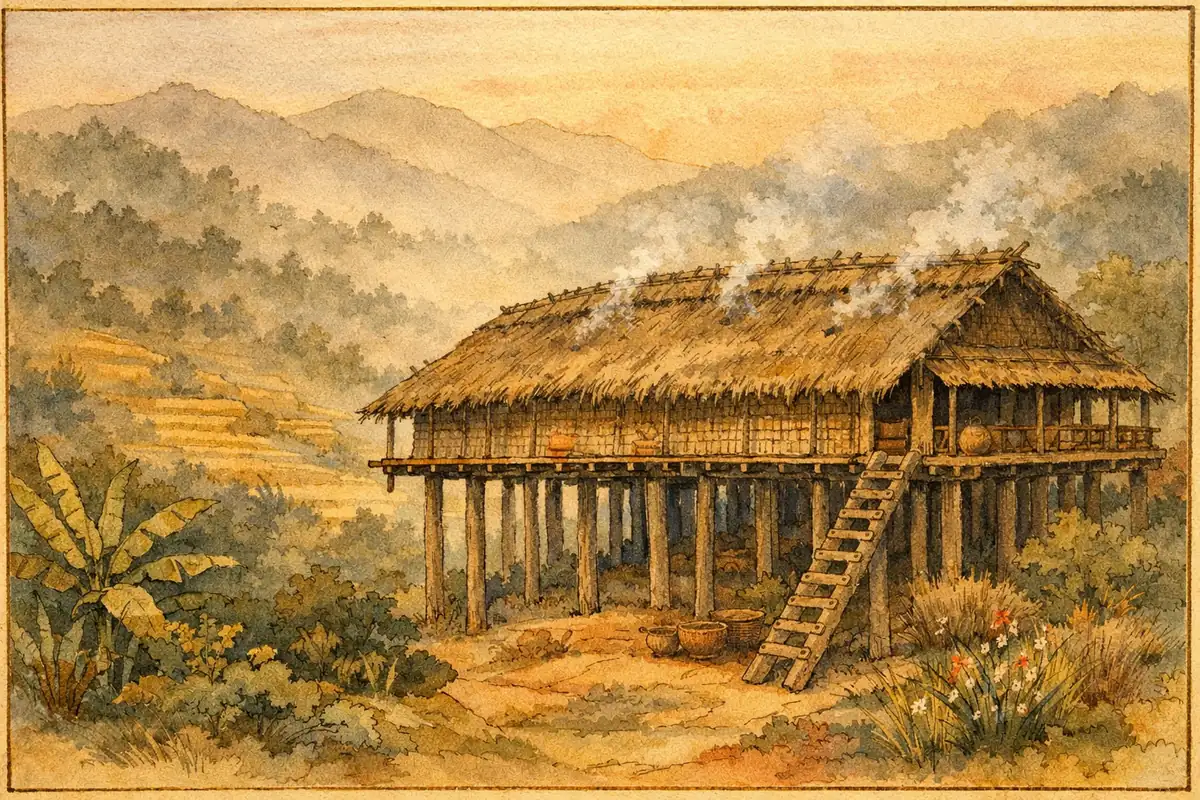
The long house is the centre of life: a hall raised on posts, eighteen to twenty feet wide and as long as its number of hearths requires, with walls of twilled mats, a bamboo floor, a platform at the back where a small shrine of the hunting spirit Yobu Wiyu stands, and a low porch at the front with mortars for pounding grain (Shukla, 1959, pp. 11-13). A primary loyalty, Shukla writes, is to one's long house and its members, then to the lineage and other kin (p. 11). In the migration story the ancestors already wore their hair in a knot called podum and knew weaving and farming (p. 5); men traditionally wore a cane helmet topped with a hornbill's beak.
Festivals
Nyokum
Yearly
From nyok, 'land', and kum, 'together'; the goddess of the land is invoked with all the spirits for good harvests and well-being.
Related communities
Sources
- B. K. Shukla, The Daflas of Subansiri Region (Shillong: North-East Frontier Agency, 1959). pp. 4-5 (Abo Teni, origin and migration), 11-13 (village and long house), 53-56 (divisions, phratries and clans; the family), 81 (absence of chiefs and councils), ch. 5 (religion, wiyu, priests)
- G. D-S. Dunbar, 'Abors and Galongs', Memoirs of the Asiatic Society of Bengal, vol. 5, extra number (Calcutta, 1915). p. 2 (Dafla for the tribes between the Subansiri and the Borheli)
- Census of India 2011, Table A-11: State primary census abstract for individual Scheduled Tribes, Arunachal Pradesh
- Census of India 2011, Table A-11 Appendix: District wise Scheduled Tribe population, Arunachal Pradesh
- Constitution (Scheduled Tribes) Order, 1950, as amended, Part for Arunachal Pradesh, as compiled from the Census of India list of notified Scheduled Tribes
- Nyishi people, Wikipedia (pointer: meaning of the name; Dafla replaced by Nyishi in the 2008 amendment; Ahom records; nyub priests; Christian and Donyi-Polo followers; hornbill helmets)
- Nyokum, Wikipedia (pointer: meaning of the name and purpose of the festival)
Practice differs by village and family. If something here does not match your family's tradition, trust your elders.