
Baiga
बैगा
At a glance
- Clan word
- Garh
- Descent
- Through the father
- Lives in
- Madhya Pradesh, Chhattisgarh, Uttar Pradesh, West Bengal, Jharkhand, Bihar, Odisha, Maharashtra
- Languages
- Baigani (Indo-Aryan), Chhattisgarhi (Indo-Aryan)
- Population
- 5,69,882 Census 2011: Table A-11 (Scheduled Tribes), Baiga entries added together, 552,495 (Madhya Pradesh 414,526; Chhattisgarh 89,744; Uttar Pradesh, Sonbhadra, 30,006; West Bengal 13,423; Jharkhand 3,582; Bihar 543; Odisha 338; Maharashtra 333); and Table A-10 (Scheduled Castes), Uttar Pradesh outside Sonbhadra, 17,387.
- Region
- Central
About
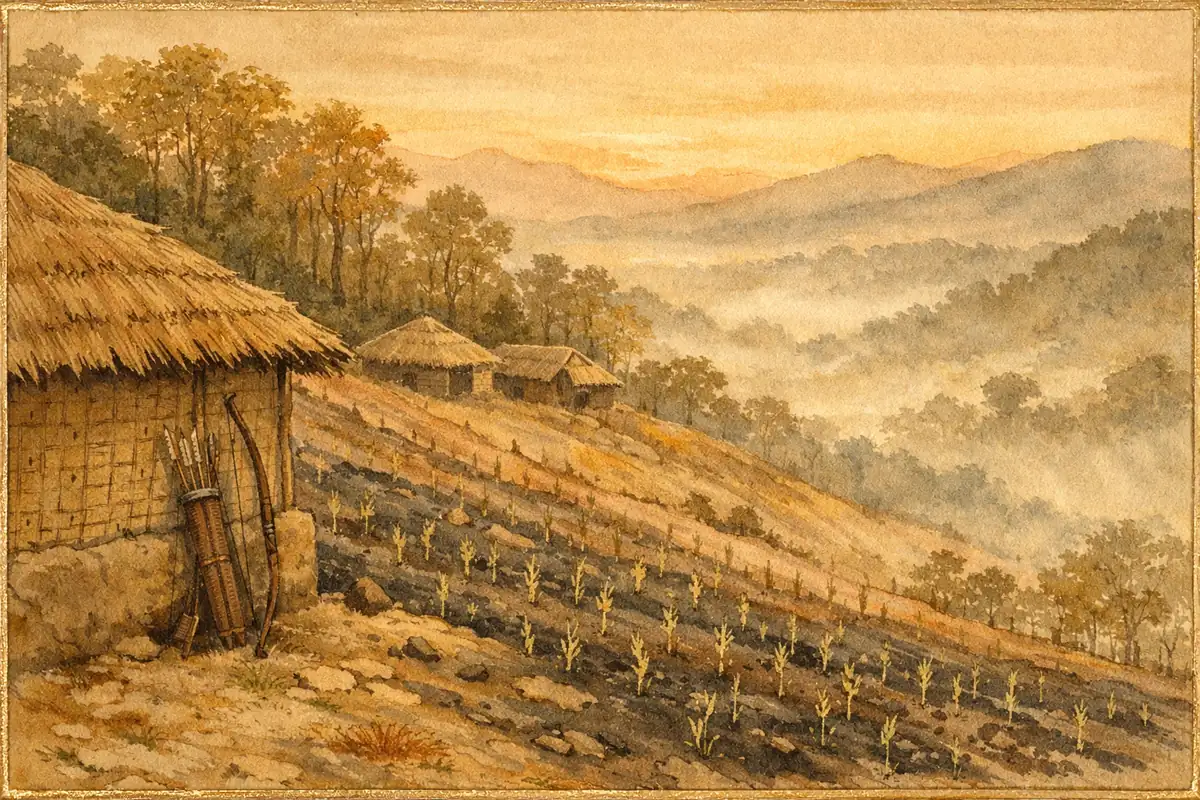
The Baiga are a people of the forested Maikal hills on the eastern Satpuras, in the Mandla, Dindori, Balaghat and Bilaspur country of Madhya Pradesh and Chhattisgarh, with smaller numbers in Uttar Pradesh, West Bengal and Jharkhand. They long lived by shifting cultivation, called bewar, and served their neighbours as priests of the local gods. They speak Baigani and the regional languages. They are a Scheduled Tribe, and a particularly vulnerable tribal group (PVTG) in Madhya Pradesh and Chhattisgarh; in Uttar Pradesh outside Sonbhadra they are listed as a Scheduled Caste. The 2011 census counted 569,882.
Clans and Kinship
Elwin (1939) describes three levels. The tribe is endogamous, though a woman of another tribe who marries a Baiga can be admitted after rites. It is divided into jat, more or less endogamous divisions that live apart: Russell (1916) names Binjhwar, Bharotia, Narotia or Nahar, Raibhaina, Kathbhaina, Kondwan or Kundi and Gondwaina, and Elwin adds the Bhumia, the Muria, the Kurka, the Sawat and the Dudh-bhaina. Each jat is divided into exogamous garh and goti. The garh, the more important, is territorial and not totemic: the idea is that every Baiga originally belonged to a particular hill or forest and must marry his daughters to men of another. Tradition holds that the first twelve garh were the twelve sons of Nanga Baigin. The goti, Elwin found, were borrowed from the Gond clans, carry Gond names, and are lightly kept: marrying inside one's goti is a fault atoned for with liquor, while the garh rule is kept more strictly, though Elwin found that it too was loosening. Descent is patrilineal and residence after marriage patrilocal (Encyclopedia of World Cultures). Villages have a headman, the mukaddam, and a panch of five.
What “Garh” means
The garh is the Baiga exogamous division, named for the hill or forest the line is held to belong to. Elwin (1939) treats it as the older and more important unit, above the goti, which are clan names borrowed from the Gond.
31 garhs
- Binjhwar
garh
One of the first twelve garh, the sons of Nanga Baigin; Binjhwar is also the name of a jat.
- Sawat
garh
One of the first twelve garh; Sawat is also the name of a jat.
- Chituria
garh
- Damgharia
garh
- Ghangaria
garh
- Dawaria
garh
- Pachgaiha
garh
- Salgaia
garh
- Kumaria
garh
- Massania
garh
- Chanania
garh
- Chandgaria
garh
- Telasia
garh
Named by a Bhumia Baiga of the Durwa goti in one of Elwin's life histories.
- Saradia
garh
Named in one of Elwin's life histories.
- Morabi
goti
Borrowed from the Gond; one of the five goti the Bharotia of Baihar call real.
- Durwa
goti
Among the Muria Baiga of Amtera, Elwin found Durwa goti with tree totems: Belgaria Durwa (bel), Karraiya Durwa (karra), Tiljaria Durwa and Bartaria Durwa (bar).
- Markam
goti
Some Dudh-bhaina told Elwin the Markam never kill the tortoise; at Amtera, Sachera Markam honour the saj tree.
- Parteti
goti
Elwin writes Parteti and Parted; some Dudh-bhaina said the Parteti never kill the crocodile.
- Potta
goti
- Baghel
goti
Found in Kawardha; some Dudh-bhaina said the Baghel never kill the tiger.
- Nangbansi
goti
Found in Kawardha; some Nangbansi revered the snake.
- Tekam
goti
- Netam
goti
- Syam
goti
- Kusro
goti
- Sindram
goti
- Uika
goti
- Udde
goti
- Chicham
goti
- Pendo
goti
- Maravi
goti
Named by Russell (1916) with Markam, Netam and Tekam as septs that worship seven gods; Elwin found no example of that rule.
Garh and goti as Verrier Elwin gives them in The Baiga (1939), chapter on exogamous divisions (pp. 172-175): first the twelve garh said to descend from the sons of Nanga Baigin, then two more garh named in his life histories, then the goti he recorded in Baihar, Kawardha and Niwas. Elwin's book has an appendix listing many more garh, not reproduced here. Maravi is added from Russell and Hira Lal (1916). In parts of Mandla Elwin found no goti at all, only garh.
In the Official Lists
Scheduled Tribe
Madhya Pradesh, Chhattisgarh, Uttar Pradesh, West Bengal, Jharkhand, Bihar, Odisha, Maharashtra
Listed as: Baiga
In Uttar Pradesh in Sonbhadra district only ('Baiga (in the district of Sonbhadra)' in the 2011 census table).
Scheduled Caste
Uttar Pradesh
Listed as: Baiga
In Uttar Pradesh outside Sonbhadra district ('Baiga (excluding Sonbhadra district)' in the 2011 census table of Scheduled Castes).
The Baiga are also a particularly vulnerable tribal group (PVTG), a group within the Scheduled Tribes given special attention, in Madhya Pradesh and Chhattisgarh, in the government list reproduced on Wikipedia from a 2019 press release; the category has had that name since 2006. In Uttar Pradesh the Baiga are a Scheduled Tribe in Sonbhadra district and a Scheduled Caste in the rest of the state. The listings were checked against the 2011 census table of each state and Wikipedia's compilation of the order; amendments after 2011 were not checked.
Checked on 2026-11-07 against the sources below. The lists are amended from time to time and can differ by district; for a certificate, the current order or the state's list is what counts.
Name and Origin
Baiga is the word for a village priest or medicine man in this country, and Russell and Hira Lal (1916) note that the Gonds and Hindus around them treated the Baiga as the oldest residents and the priests of the local gods, whose word on a village boundary was taken as final. Bhumia, lord of the soil, is the name of that office and is used by one division of the tribe. Russell records the tribe's own story: in the beginning God made Nanga Baiga and his wife, the first people, who chose to live by felling trees in the forest; of their two sons one stayed a Baiga and the other became a Gond and a tiller of the soil. In another version the first Baiga cut down a stretch of sal forest in a day and was told to sow kutki millet in the ashes, the origin of bewar. Russell guessed that the Baiga were a branch of the Bhuiya of Chota Nagpur; that view was his and is not settled.
History
Russell and Hira Lal (1916) counted about 30,000 Baiga proper in 1911, in Mandla, Balaghat and Bilaspur, and thought the Binjhwar and Bhaina of Chhattisgarh were offshoots of the tribe. Under colonial forest rules bewar was stopped in most places. Verrier Elwin (1939), who lived among the Baiga of Mandla, records that a letter of 13 May 1890 confined all bewar-cutting Baigas of Mandla to a tract of 23,920 acres in the Ramgarh tehsil, the Baiga Chak or Baiga Reserve, where seven Baiga villages and 1,551 people already lived; Baigas outside it had to give up bewar or move in. Elwin wrote that the Chak was meant to wean the Baiga from bewar, not to preserve their way of life. In later lists the government counts the Baiga among the particularly vulnerable tribal groups.
Faith and Worship
Elwin (1939) found the Baiga pantheon varied from village to village and open to the gods of neighbours. Bara Deo, Thakur Deo and Dharti Mata, the earth mother, are among the deities most often named in his account, and the Baiga Dewar or priest serves the gods of other communities as well as his own. Elwin notes that the census stopped calling this religion 'animistic' in 1921 and called it 'tribal religion' instead. He found that they kept the days of Hindu festivals with meanings of their own.
Deities named in the sources: Bara Deo, Thakur Deo, Dharti Mata
Customs
Marriage is outside one's garh, and Russell records that a bride-price of five to twenty rupees was paid or the groom served the bride's father for about two years. The Encyclopedia of World Cultures, summarising Elwin, describes a full wedding over several days with a marriage booth (marua) and two old kinsmen (dosi) who conduct the rites, and a simpler haldi-pani or churi-pairana marriage that carries no stigma. Elwin records that the Baiga keep festivals at Holi, Dasahra and Diwali but with their own meanings: Dasahra is the time of the Baiga Bida rite. Elwin also records the Karma dance and the Dadaria and Karma songs.
Festivals
Cherta
January
The children's feast that opens the Baiga year in Elwin's account; boys go round the village begging grain with a song, and the girls cook by the river. Elwin thought it was taken from the Gond.
Dasahra (Baiga Bida)
Ashvin, September or October
Elwin records that Dasahra matters to the Baiga as the occasion of the Baiga Bida rite, not for the Hindu story.
Stories and Legends
Nanga Baiga and the first bewar
In the story Russell and Hira Lal took down, God made Nanga Baiga and his wife as the first people and asked how they would live. They chose to fell trees in the forest. In one version the first Baiga cut down a great stretch of sal trees in a single day; God told him to scatter a few grains of kutki millet on the ashes and go away and sleep, and when he came back months later there was a harvest for his children. Russell notes that the story gives bewar, shifting cultivation, a divine sanction.
Related communities
+ 1 moreShow fewer
Sources
- R. V. Russell and Hira Lal, The Tribes and Castes of the Central Provinces of India, vol. 2 (1916), 'Baiga'. Vol. 2, pp. 77-92: the tribe and its offshoots pp. 77-79; legends p. 79; subdivisions and septs pp. 80-81; marriage pp. 81-82
- Verrier Elwin, The Baiga (1939). Tribal divisions (ch. I, pp. 5-6); the Baiga Chak and the letter of 13 May 1890 (ch. on bewar); the Baiga pantheon (ch. XVIII); festivals (ch. XIX); exogamous divisions, the garh and the goti (pp. 172-175)
- 'Baiga', Encyclopedia of World Cultures, vol. 3: South Asia (Orientation, Kinship, Marriage and Family, Sociopolitical Organization)
- Census of India 2011, Table A-11, State Primary Census Abstract for individual Scheduled Tribes (Madhya Pradesh; also the tables for Chhattisgarh, Uttar Pradesh, West Bengal, Jharkhand, Bihar, Odisha and Maharashtra). NADA catalog 42962 (Madhya Pradesh), 42961 (Chhattisgarh), 42948 (Uttar Pradesh), 42958 (West Bengal), 42959 (Jharkhand), 42949 (Bihar), 42960 (Odisha), 42966 (Maharashtra)
- Census of India 2011, Table A-10 (Individual Scheduled Caste Primary Census Abstract), Uttar Pradesh
- Constitution (Scheduled Tribes) Order, 1950, as amended, Parts for the states named (as compiled in Wikipedia's List of Scheduled Tribes)
- Wikipedia, 'Particularly vulnerable tribal group' (list reproduced from a Press Information Bureau release of 2019; read 2026-11-07)
Practice differs by village and family. If something here does not match your family's tradition, trust your elders.