
Birhor
At a glance
- Clan word
- Gotra
- Descent
- Through the father
- Lives in
- Jharkhand, Chhattisgarh, West Bengal, Odisha, Bihar, Maharashtra, Madhya Pradesh
- Language
- Birhor (Austroasiatic (Munda))
- Population
- 17,241 Census 2011, Table A-11 (State Primary Census Abstract for individual Scheduled Tribes), Birhor entries added together: Jharkhand 10,726; Chhattisgarh 3,104; West Bengal 2,241; Odisha 596; Bihar 377; Maharashtra 145; Madhya Pradesh 52.
- Part of
- Munda
- Region
- East
About
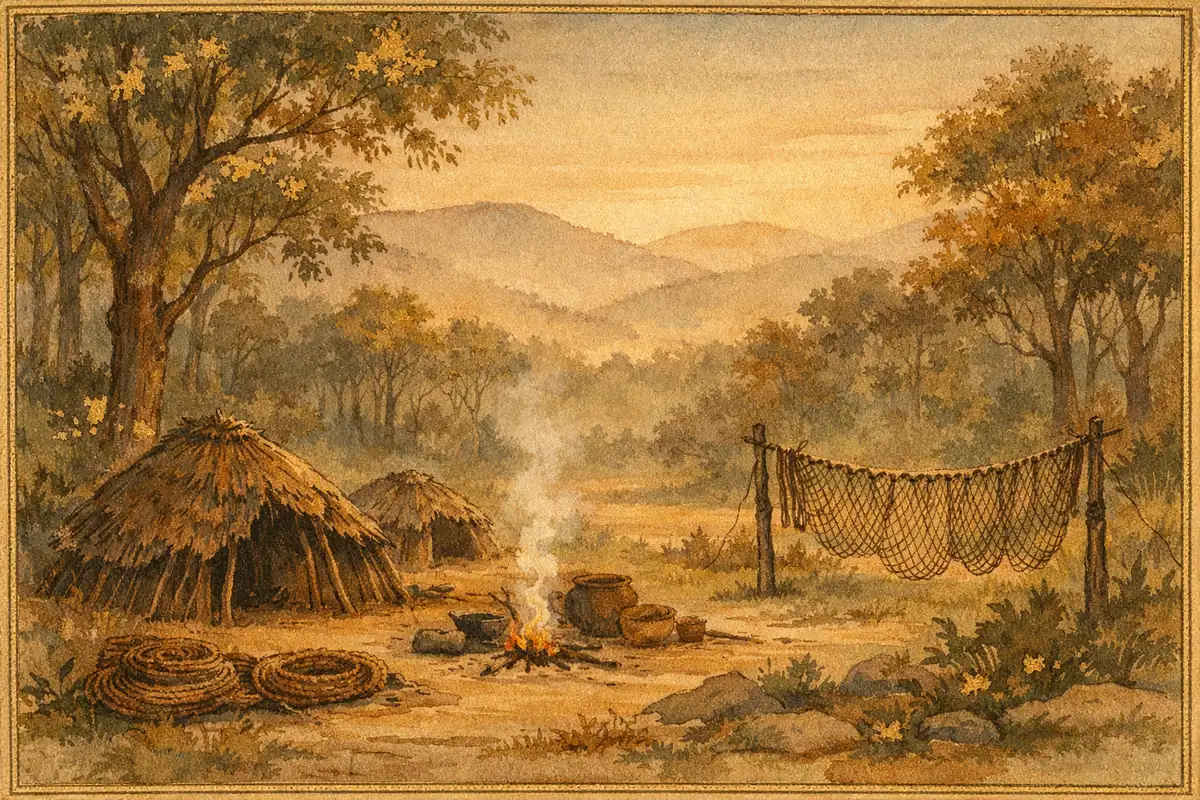
The Birhor, the 'jungle folk' (bir, forest, and hor, man), are a small Munda-speaking people of the forests of Chota Nagpur, most of them in Jharkhand, with others in Chhattisgarh, West Bengal, Odisha, Bihar, Madhya Pradesh and Maharashtra. Roy (1925) found them living in tandas, bands of a few families, some moving from forest to forest and some settled, who hunted, gathered honey and made rope from the chop creeper. Their exogamous clans are called gotras. They are a Scheduled Tribe and a particularly vulnerable tribal group (PVTG); the 2011 census counted 17,241.
Clans and Kinship
Roy (1925) describes two kinds of grouping. For the food-quest the Birhors live in tandas, bands of three or four to about ten families who hunt and move together or settle for a time near a forest. The families of a tanda usually belong to different clans, and a family may leave one tanda for another. Each tanda has a naya, its priest and headman, held to be chosen by the spirits and in practice usually the son of the last naya, with a diguar who serves him at sacrifices. Tandas join for the great hunt (disum sendra), and men from several tandas meet at weddings and at panchayats on breaches of tribal rules. For marriage the tribe is divided into exogamous clans called gotras, mostly named after an animal, plant or object; there is no organisation of a clan as a whole, though members of a clan in nearby tandas meet for sacrifices to their clan spirits. Roy divides the tribe by way of life into the Uthlu or Bhuliya, who wander, and the Jaghi or Thania, who are settled.
What “Gotra” means
Roy (1925) writes of Birhor 'exogamous clans called gotras'. Here gotra is a borrowed word for an exogamous totemic clan, inherited and not acquired; it does not mean a Vedic gotra traced to a rishi.
37 gotras
- Andi
Totem: wild cat
- Bonga Sauri
Totem: a kind of wild grass
- Bhat
Roy takes the name from that of a caste.
- Bhont
Totem: a kite
Roy writes 'Bhont or Bhuntil'.
- Bhuiya
Roy takes the name from that of a tribe; its ancestor, it is said, bought a brass bell from a Bhuiya (p. 96).
- Chauli Hembrom
Totem: betel-palm (hembrom); chauli is rice
Said to be the original Birhor clan: its ancestor rose out of the ground with rice on his head, and its families carry stones believed to have risen from the earth in the same way (p. 96).
- Ganda Garua
Totem: a large vulture
- Geroa
Totem: a small bird
Its ancestor, it is said, was born under the wings of a geroa bird (p. 95).
- Gidhi
Totem: vulture
As its ancestor was born, a vulture's egg fell on his head from a nest above (p. 95).
- Goar
Roy takes the name from that of a caste.
- Guleria
Totem: pellet-bow
Roy writes 'Guleria or Galaoria'.
- Gundri
Totem: a kind of bird
- Hembrom
Totem: betel-palm
Men of this clan are believed to have better luck in hunting than others (p. 96). Risley also lists it.
- Here Hembrom
Totem: betel-palm (hembrom); here is rice-husk
- Induar
Totem: eel
- Jegseria Latha
Totem: latha, a cake made of mahua flowers
Risley lists Jegseria.
- Kauch
Totem: tortoise
Roy writes 'Kauch or Horo'.
- Kawan Hembrom
- Keonduar
Totem: a kind of fruit
- Khangar
Roy takes the name from that of a section of the Munda (p. 96).
- Kharea
Roy takes the name, with a question mark, from that of the Kharia.
- Khudi Hembrom
Totem: betel-palm (hembrom); khudi is broken rice
- Ludamba
Totem: a kind of flower
- Lundi Jal
Roy's gloss is not legible in the scan.
- Lupung
Totem: myrobalan
Called Beherwar in Hindi. Its ancestor, it is said, was born in the shade of a lupung tree (p. 95).
- Maghaia Hembrom
Totem: betel-palm (hembrom); maghaia means 'of Magadha (Bihar)'
- Mahali
Roy takes the name from that of a tribe (p. 96). Risley also lists it.
- Modi
Roy takes the name from that of a caste or a section of a tribe.
- Murum
Totem: nilgai
When its ancestor was born a nilgai stood beside him and carried him off through the woods (p. 97).
- Nag
Totem: cobra
Roy writes 'Nag or Nagpuria', the second meaning 'of Chota Nagpur'. Risley lists Nag and Nagpuria.
- Sada
Totem: white
- Samduar
Totem: horse (sadom)
- Saunria
Totem: a kind of wild grass
- Sham-jhakoa
Totem: a composition used in whetting weapons
Its ancestor, it is said, was born where weapons were being sharpened (p. 95).
- Singpuria
Totem: singhara fruit (Trapa bispinosa)
Risley also lists it.
- Suia
Totem: a kind of bird
- Toriar
From Pargana Tori in the Palamau district, Roy says.
The 37 clans Roy (1925, pp. 90-92) had been able to find, in his order and with his glosses; he says the list is not complete, and that Risley gave only eight (Hembrom, Jegseria, Mahali, Nagpuria, Singpuria, Liluai, Nag and Siruar). A few names are of places (Nagpuria, Toriar) and a few are names of other tribes or castes (Bhat, Bhuiya, Goar, Khangar, Kharea, Mahali, Modi); for these Roy's explanation is given in the note, not as a totem. Members of a clan do not wear badges of the totem, but an emblem of it is set beside the sacrificer when the clan spirits are worshipped.
In the Official Lists
Scheduled Tribe
Jharkhand, Chhattisgarh, West Bengal, Odisha, Bihar, Maharashtra, Madhya Pradesh
Listed as: Birhor
Entered as 'Birhul, Birhor' in Chhattisgarh, Madhya Pradesh and Maharashtra (Census 2011 tables).
The Birhor are also a particularly vulnerable tribal group (PVTG), a group within the Scheduled Tribes given special attention, in Bihar, Jharkhand, Madhya Pradesh, Chhattisgarh, Odisha and West Bengal, by the government list reproduced on Wikipedia from a 2019 press release; the category has had that name since 2006. The ST listings were checked against the 2011 census table of each state and Wikipedia's compilation of the order; amendments after 2011 were not checked.
Checked on 2026-11-06 against the sources below. The lists are amended from time to time and can differ by district; for a certificate, the current order or the state's list is what counts.
Name and Origin
Roy (1925) found that the Birhors could tell little of their past beyond that they had always been Birhors, 'jungle men', as an earlier account by W. H. P. Driver (1888) put it. Some call themselves Bir Mundas, 'jungle Mundas'; others told Roy they were nearer kin to the Santals, and Roy found their speech closer to Mundari but with some Santali features, among them hor for 'man'. Clan legends tell of the ancestor of each clan rather than of the tribe: the Chauli Hembrom are said to be the first clan, their ancestor having risen from under the ground with rice on his head, and the Murum say a nilgai carried their newborn ancestor through the woods until his head-dress caught in a chop creeper, and that since then the Birhors have gathered chop and made rope.
History
Roy (1925) places the Birhors in the jungles of the Palamau, Hazaribagh, Ranchi and Singhbhum districts, and quotes Driver's account of 1888 and the district gazetteers, by which the 1911 census counted 2,340 Birhors in the province, 1,024 of them in Hazaribagh and 927 in Ranchi. Majumdar (1937) describes their country as the hills and jungles on the eastern and north-eastern edge of the Chota Nagpur plateau. He found their numbers falling, and put this down in part to the clearing of the forests of Chota Nagpur and the loss of game and forest produce. In later lists the government counts the Birhor among the particularly vulnerable tribal groups, a category that took its present name in 2006.
Faith and Worship
Roy (1925) describes Singbonga as the creator and the head of the Birhor spirits, identified with the Sun though not with its body, who is asked for game or honey before a hunt and is offered a white goat or fowl to avert danger. The mother-goddesses Devi Mai and Burhi Mai bring luck in health, children and food; with them are hill spirits, the spirits of the ancestors and some beast-gods. When an Uthlu band moves, the spirits, kept in stones and pegs, are carried in a basket by a young man walking ahead of the party, and the clan spirits (ora bongas or buru bongas) receive sacrifices with an emblem of the clan's totem beside them.
Customs
Hunting is the most valued work of Birhor men. Hunters drive game, especially monkeys, into long nets of chop fibre stretched between trees, and the naya's share of the game and the order of a hunt are fixed by custom; women may join the everyday hunts but not the great hunt (Roy 1925). Families make rope of chop fibre for sale or barter in the villages and markets, and gather honey and wax. Uthlu bands move from forest to forest for about two years before returning to where they began, and stay in one place only in the rains.
Stories and Legends
The nilgai and the chop creeper
The Murum clan of the Birhors, Roy (1925) records, say that when their first ancestor was born a nilgai came and stood beside him. The baby jumped on its back and the nilgai carried him off through the woods, until his head-dress caught in a chop creeper and he got down to cut the creeper. Since then, it is said, gathering chop and making rope have been the main work of the Birhors.
The vulture's egg
The ancestor of the Gidhi (vulture) clan, Roy (1925) was told, was born under a wide-spreading tree, and at the moment of his birth the egg of a vulture nesting in the branches above fell on his head. So he and his descendants came to be the Gidhi clan. Roy notes that such stories speak of a chance link with the totem at an ancestor's birth, never of descent from it.
Related communities
Sources
- Sarat Chandra Roy, The Birhors: A Little-Known Jungle Tribe of Chota Nagpur (Ranchi, 1925). Ch. I (with Driver's account of 1888, pp. 25-27); pp. 43-45 (Uthlus and Jaghis); pp. 60-61 (speech); ch. III, pp. 62-88 (tanda, naya, hunts, councils); ch. IV, pp. 89-97 (clans and totems); pp. 294-298 (Singbonga and the mother-goddesses)
- D. N. Majumdar, A Tribe in Transition: A Study in Culture Pattern (Calcutta, 1937). Introduction, pp. v-vii (Birhor country; clans of the Munda-speaking tribes patrilineal and exogamous)
- Census of India 2011, Table A-11: State Primary Census Abstract for individual Scheduled Tribes (one table for each state). Jharkhand (catalog 42959); Chhattisgarh (catalog 42961); West Bengal (catalog 42958); Odisha (catalog 42960); Bihar (catalog 42949); Maharashtra (catalog 42966); Madhya Pradesh (catalog 42962)
- Constitution (Scheduled Tribes) Order, 1950, as amended, Parts for Jharkhand, Chhattisgarh, West Bengal, Odisha, Bihar, Maharashtra and Madhya Pradesh, as compiled in Wikipedia's List of Scheduled Tribes from the Census of India list of notified Scheduled Tribes
- Particularly vulnerable tribal group, Wikipedia (pointer only: PVTG list from the PIB release 'Welfare of particularly vulnerable Tribal groups', 2019; the 2006 renaming)
Practice differs by village and family. If something here does not match your family's tradition, trust your elders.