
Munda
At a glance
- Clan word
- Killi
- Descent
- Through the father
- Lives in
- Jharkhand, Odisha, West Bengal, Chhattisgarh, Bihar, Tripura, Madhya Pradesh, Assam
- Language
- Mundari (Austroasiatic (Munda))
- Population
- 22,03,006 Census 2011, Table A-11 (State Primary Census Abstract for individual Scheduled Tribes), Munda entries added together: Jharkhand ('Munda, Patar') 1,229,221; Odisha ('Munda, Munda Lohara, Munda Mahalis, Nagabanshi Munda, Oriya Munda') 558,691; West Bengal 366,386; Chhattisgarh 15,095; Tripura ('Munda, Kaur') 14,544; Bihar ('Munda, Patar') 14,028; Madhya Pradesh 5,041. Odisha's separate 'Mundari' entry (25,655) is not included.
- Part of
- Munda
- Region
- East
About
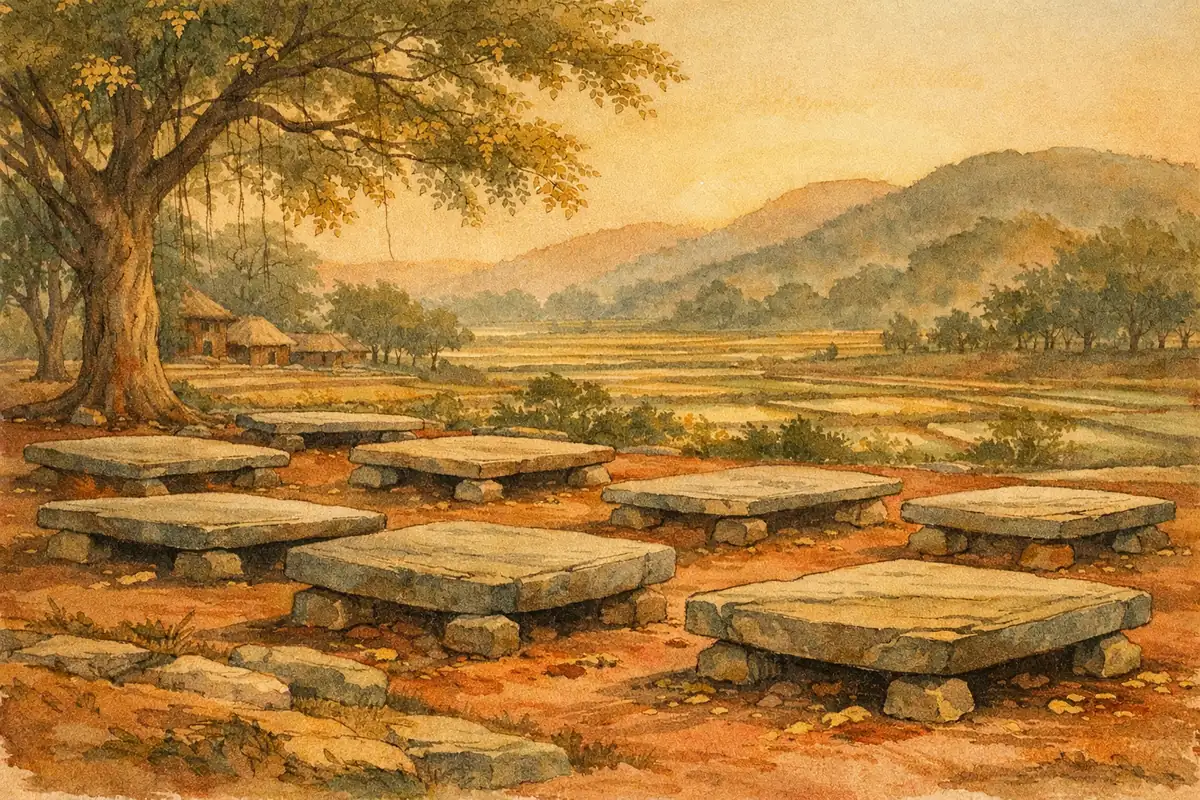
The Munda are a people of the Chota Nagpur plateau, most of them in Jharkhand, with others in Odisha, West Bengal, Chhattisgarh, Bihar, Madhya Pradesh and Tripura. They speak Mundari and call themselves Horoko, 'men'. Every Munda belongs to his father's killi (clan) and marries outside it. A village belongs to the descendants of the family that cleared it, the khuntkattidars, whose dead lie under the flat sasandiri stones of the village sasan, and related villages form a parha. The Munda are a Scheduled Tribe in seven states; the 2011 census counted 2,203,006.
Clans and Kinship
The Munda clan is the killi (Roy writes kili). Killis are patrilineal and exogamous, and most are totemic: members are held to descend from one ancestor, marry outside the killi, and will not eat or harm the totem. As killis grew they split, so that the Soe and Purthi killis, for example, have several branches. A village (hatu) was founded by one family and its kin; their descendants, the khuntkattidars or bhuinhars, held the village land in common, and only they may bury their dead in the village sasan, under stone slabs (sasandiri) that Roy calls their title-deeds. Others who came to live in the village, the parja horoko, had no such right. The secular headman is the munda and the priest the pahan. Villages that grew from one parent village form a parha with its own council (panch). In the older Bhuinhari country west of the Ranchi-Chaibassa road a parha is all of one killi and its panch has a standing Raja and officers; in the khuntkatti country to the south and south-east a parha may hold several killis, and its head is a hereditary Pat Munda. There, groups of villages formed manki pattis under a manki, who collected the villages' dues for the overlord. Some families in the east have turned killi names into gotras, so that Sandi became Sandil.
What “Killi” means
Killi (Roy writes kili, and also 'sept') is the Munda word for an exogamous patrilineal clan, usually named after an animal, plant or object that its members must not eat or harm.
47 killis
Totem: tortoise · one of the 21 original kilis
Also called Horo (Roy, p. 233): a tortoise carried the ancestor and his family across a flooded river, and no member of the kili kills a tortoise or eats its flesh.
one of the 21 original kilis
The Kharia also have a Topno clan (Roy and Roy 1937).
- Bhengra
one of the 21 original kilis
Risley (1891) glosses it 'horse'.
- Sandigura
one of the 21 original kilis
Risley lists Sandiguria, 'black monkey'.
- Dungdung
one of the 21 original kilis
Risley glosses it 'a river-fish'. The Kharia have a Dungdung (eel) clan.
- Lipi
one of the 21 original kilis
- Honre
one of the 21 original kilis
- Hau
one of the 21 original kilis
- Kandir
one of the 21 original kilis
Risley: 'a bird'.
- Kerketa
one of the 21 original kilis
Risley: 'a bird'. Roy and Roy (1937) spell it Kerketta; the Oraon and Kharia also have the clan.
one of the 21 original kilis
Risley: 'a fruit'.
- Tuti
Totem: the tuti plant · one of the 21 original kilis
Kinsmen on a cold river bank were sent burning charcoal across the water in a fork of tuti twig, and they vowed never to eat the plant again (pp. 231-232). Risley: 'a kind of vegetable'.
one of the 21 original kilis
One of the few kili names the Mundas share with the Santals (Roy, p. 231).
- Kongari
one of the 21 original kilis
one of the 21 original kilis
Roy notes that sanga is the Mundari name for the pith of a plant; Risley glosses Sanga 'sweet potato'.
- Kujur
one of the 21 original kilis
Roy writes 'Kujri or Kujur'. Risley: Kujri, 'a fruit from which oil is made'. The Oraon also have a Kujur clan.
Totem: the Soe fish · one of the 21 original kilis
Roy spells it Soe in his story (pp. 232-233): a great Soe fish was shot and shared out, and the branches Tuing, Jang, Til, Or, Patra and Gamcha Soe take their names from the sharing; there are also Mandi, Chiki, Tula, Adoa, Rura Mandi and Banda Soe. No Soe Munda eats the fish. Risley glosses Soi 'spring'.
- Tiru
one of the 21 original kilis
Risley: 'a kind of bird'.
- Tuyu
one of the 21 original kilis
- Orea
one of the 21 original kilis
Risley: 'basket-maker'.
Totem: crocodile · one of the 21 original kilis
Roy and Roy (1937, p. 132) give the crocodile as the Munda Purti totem. Since divided into Chutu, Huni, Sarukad, Hasa, Enga and Sandi Purthi (Roy 1912, pp. 72, 235). The Ho have a Purty killi.
- Mundu
other kilis Roy names
Named, Roy says, from a straw torch that burnt down to its end (mundu) on a night journey (p. 232).
- Nag
Totem: white cobra · other kilis Roy names
Also called Pandu Bing: a tame white cobra carried its dead master home, and no member of the kili harms a cobra (pp. 233-234).
- Bando
Totem: wild cat · other kilis Roy names
Roy tells of a Bando family admitted to the Herenj kili, whose descendants may now marry into neither (pp. 234-235).
- Herenj
other kilis Roy names
The kili of the Patra Mochia parha (p. 235).
- Tau
Totem: sparrow · other kilis Roy names
Found in Sondhatu thana; Roy notes it is the same as the Tessa gotra of the Bhumij (p. 234).
- Sandi
other kilis Roy names
Sandi means a bullock in Mundari; among the eastern Mundas it has become the Sandil gotra (p. 234).
- Jom Tuti
other kilis Roy names
Became the Bhoj-Roj gotra in Tamar pargana (p. 234).
- Runda
other kilis Roy names
In the Hahab parha, with Jom Tuti and Patra Kukuri (p. 238).
- Patra Kukuri
other kilis Roy names
In the Hahab parha (p. 238).
- Ored
other kilis Roy names
- Bodra
other kilis Roy names
- Surin
other kilis Roy names
- Langchere
other kilis Roy names
- Hurumsuku
other kilis Roy names
- Bodoso
other kilis Roy names
- Mundri
other kilis Roy names
- Gomi Bum
other kilis Roy names
- Sankura
other kilis Roy names
Risley glosses it 'king crow'.
- Champi
other kilis Roy names
- Hans
other kilis Roy names
- Baba
other kilis Roy names
- Kula
other kilis Roy names
- Dere Sanga
other kilis Roy names
- Barlanga
other kilis Roy names
- Sal
other kilis Roy names
Roy calls it the Sal gotra (p. 235).
- Kamal
other kilis Roy names
A name coined under Hindu influence, Roy says, found in several villages of Tamar pargana (p. 72).
The first 21 are the original kilis in the order Roy gives them (1912, pp. 71-72, note), as printed except for plain OCR errors in the scan (Dmgdung read as Dungdung, Hemromt as Hemrom, and Kujur and Tuyu restored). Roy gives a totem only where he tells a kili's story; Risley's glosses (1891, Appendix I) are added in the notes as his. The rest are other kilis Roy names on pp. 231-238, which he says is not a full list. Roy's Appendix I also gives another list of 21 founders' kilis (among them Barwa, Lugun, Budu, Kaua, Dhechua, Jojobar, Bagsuria and Dahang) from a modern version of the legend told by a Munda Christian, which he calls less authentic.
In the Official Lists
Scheduled Tribe
Jharkhand, Odisha, West Bengal, Chhattisgarh, Tripura, Bihar, Madhya Pradesh
Listed as: Munda
Entered as 'Munda, Patar' in Jharkhand and Bihar, 'Munda, Kaur' in Tripura, and 'Munda, Munda Lohara, Munda Mahalis, Nagabanshi Munda, Oriya Munda' in Odisha, which also has a separate entry 'Mundari' (Census 2011 tables).
Checked against the 2011 census table of each state, which names the notified tribes, and Wikipedia's compilation of the order; amendments after 2011 were not checked. Mundas who went to work in Assam and the Duars from the late nineteenth century (Roy 1912; Majumdar 1937) are not in Assam's list: the Assam table has no Munda entry.
Checked on 2026-11-06 against the sources below. The lists are amended from time to time and can differ by district; for a certificate, the current order or the state's list is what counts.
Name and Origin
Risley (1891) took the name Munda to be a Sanskrit word for a village headman, used by the tribe as its own name; among themselves the Mundas are Horoko, from horo, 'man'. Munda tradition, as Roy (1912) collected it, tells how Sing Bonga made the first pair from a bird's egg and later destroyed mankind with fire, how one pair, hidden by the spirit Nage Era, survived as Lutkum Haram and Lutkum Buria, and how their descendants wandered from the north-west until a leader named Risa Munda brought the Mundas of the 21 kilis up the valley of the North Koel to Muruma, on the Chota Nagpur plateau. Roy read the story as a slow migration over generations, and traced its route by Mundari village names and old burial stones along the river. The Hos, he thought, had parted from the Mundas before this.
History
Roy (1912) records a long series of Munda risings against outside landlords' encroachment on their land rights: in Tamar in 1789, under Bishun Manki in 1797, under Dukan Shahi Manki in 1807, under Rudu and Konta Munda in 1819-20, and the rising of the Sonepur Mundas in 1831-32, after which the government set up the South-Western Frontier Agency. In 1895 Birsa Munda, a young man of Chalkad in Tamar, began to preach a new faith and drew great crowds; he was jailed that year, and in 1899-1900 his followers rose and attacked the police station at Khunti on 7 January 1900. Birsa was captured and died in Ranchi jail while his case was pending. The government then ordered a survey and settlement of the Munda country, begun in 1902, which recorded the khuntkatti rights of founding families where descent could be traced, and a new tenancy law for Chota Nagpur followed in 1908 (Bengal Act VI of 1908).
Faith and Worship
Roy (1912) describes Sing Bonga, the Sun, as the supreme deity of the Mundas, named with the panch in the oath 'Sing Bonga on high and the Panch on earth'. Below him are Marang Buru and the spirits of the sacred grove (sarna), the village boundaries, the hills, streams and fields, whom the pahan propitiates, and the spirits of the family's dead, whom each householder worships in the ading, the sacred inner room of the house. By Roy's time many Mundas had become Christians, and a small number followed the teaching of Birsa.
Deities named in the sources: Sing Bonga, Marang Buru
Customs
A Munda marries outside his killi, and the maternal uncles of bride and groom have important parts in the wedding (Roy 1912). The bones of the dead are laid under the family's sasandiri in the sasan of the killi's village, and the bones of a Munda who dies away from home are carried back there where possible. The akhra, an open ground under an old tree in the middle of the village with stone slabs for seats, is where the panch sits and the young people dance on moonlit nights. The parha panch hears breaches of the marriage rules, disputes over burial in a sasan, inheritance and partition, and boundary disputes between villages.
Festivals
Mage Porob
Full moon of Pus (January)
After the winter harvest the householder worships the ancestor spirits at the ading; servants' yearly terms end and are renewed (Roy 1912, p. 270).
Phagu
Eve of the full moon of Phalgun
The young men burn and cut down a castor plant and later a semal tree, the pahan prays for success in hunting, and a hunt follows (pp. 271-272).
Ba Porob (Sarhul)
Chait, when the sal trees flower
Sal flowers are taken to the sarna, the pahan sacrifices fowls, every house is hung with sal blossom, and no Munda ploughs that day (p. 272).
Batauli (Kadleta)
Beginning of Asarh (June), before transplanting
The pahan sacrifices fowls at the sarna and the men of the village feast there (p. 273).
Karam
Eleventh day of the moon in Bhado (August-September)
Kept, Roy notes, only by some families, after their Hindu neighbours: two karam branches are planted in the courtyard and the night is spent dancing (p. 273).
Stories and Legends
The tortoise at the river
Roy (1912) tells how the ancestor of the Horo or Kachua kili, on a journey, could not cross a swollen river that his kinsmen had crossed. He called out that whoever carried him over would be his kin for ever, and a tortoise carried him, his family and his baggage safely to the far bank. He took the tortoise's name, and no member of the kili kills a tortoise or eats its flesh.
The Soe fish
A Munda found that a huge Soe fish was coming up a tunnel from the river at night to eat his cotton. He shot it, and it was so heavy that all his kinsmen had to help carry it home. The man who shot it, the man who chopped the bones, the man who divided the meat, the man who handed out the shares and the man who brought the leaf plates each gave his name to a branch of the Soe kili, Roy (1912) records, and none of them eats the fish.
Notable Personalities
Birsa Munda
1895 to 1900
Munda leader from Chalkad in Tamar who preached a new faith from 1895 and whose followers rose in 1899-1900; he died in Ranchi jail in 1900 while his case was pending (Roy 1912, pp. 188-197).
Related communities
Sources
- Sarat Chandra Roy, The Mundas and Their Country (Calcutta, 1912). Pp. 63-65 (khuntkatti village); pp. 70-72 and note (migration, Hos, the 21 original kilis); pp. 188-197 (Birsa); pp. 226-227 (akhra, sasan); pp. 228-240 (kilis, parhas, pattis, panch); pp. 270-273 (festivals); App. I-II, pp. 325-336 (legends); App. III, pp. 357-358 (land tenures); App. IV, pp. 375-380 (chronology)
- S. C. Roy and R. C. Roy, The Kharias (Ranchi, 1937). P. 132 (Munda clan names in Risley's Kharia list: Purti, crocodile)
- H. H. Risley, The Tribes and Castes of Bengal: Ethnographic Glossary, vol. II (Calcutta, 1891). s.v. Munda, pp. 101-104; Appendix I, pp. 102-109 (Munda septs with glosses). Second scan read: https://archive.org/details/tribes-and-castes-of-bengal-volume-2
- D. N. Majumdar, A Tribe in Transition: A Study in Culture Pattern (Calcutta, 1937). Introduction, pp. v-vii (Munda-speaking tribes; khuntkattidars; migration to the tea gardens of Assam)
- Census of India 2011, Table A-11: State Primary Census Abstract for individual Scheduled Tribes (one table for each state). Jharkhand (catalog 42959); Odisha (catalog 42960); West Bengal (catalog 42958); Chhattisgarh (catalog 42961); Tripura (catalog 42955); Bihar (catalog 42949); Madhya Pradesh (catalog 42962); Assam (catalog 42957). The Assam table has no Munda entry.
- Constitution (Scheduled Tribes) Order, 1950, as amended, Parts for Jharkhand, Odisha, West Bengal, Chhattisgarh, Tripura, Bihar and Madhya Pradesh, as compiled in Wikipedia's List of Scheduled Tribes from the Census of India list of notified Scheduled Tribes
Practice differs by village and family. If something here does not match your family's tradition, trust your elders.