
Bru
At a glance
- Clan word
- Panji
- Descent
- Through the father
- Lives in
- Tripura, Mizoram, Bangladesh
- Language
- Kak Bru (Reang) (Tibeto-Burman (Bodo-Garo))
- Population
- 1,88,220 Census 2011, Table A-11, Tripura: the entry 'Riang'. Bru counted in other states under 'Any Kuki tribes' are not included.
- Region
- North-East
About
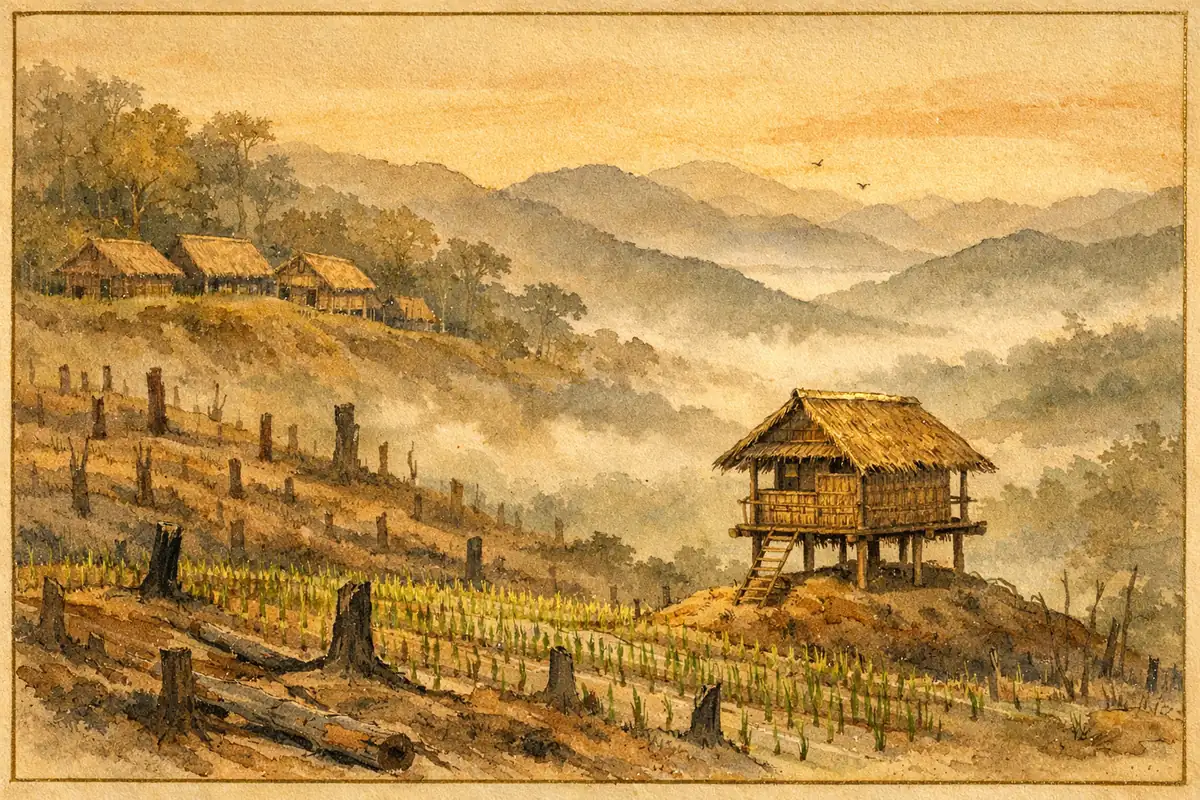
The Bru, called Reang or Riang by their neighbours and in the official list, are the second largest Scheduled Tribe of Tripura, with smaller numbers in Mizoram and the Chittagong Hill Tracts of Bangladesh. Their language, which Gan Chaudhuri calls Kak Bru, belongs to the Kokborok group of Tripura. Long shifting cultivators of the hills, they had their own chiefs and councils under a Bru raja. Bru families belong to named groups called panji or dapha, and to patrilineal lineages called sandai. They are a Scheduled Tribe in Tripura as Riang.
Clans and Kinship
Gan Chaudhuri (1983) describes three levels. The tribe marries within itself and is divided into groups called panji or dapha, twelve in his list. A panji, as the Bru understand it, joins people who once lived in the same hamlet; members once lived together and resisted outsiders settling among them. Within each panji are lineages, sandai, which are patrilineal, and within these the family, noukhung. None of the panji is totemic, and they are no longer exogamous: marriage within the panji is allowed, the sandai too has ceased to be exogamous as it has grown, and the only bar now is between brother and sister; cousins may marry. Mukherjee (1970) described the Bru as divided into two halves, Molsoi and Meska, but Gan Chaudhuri found no such division. The family is headed by the father, who owns its property; married sons usually stay with the father while he lives, and married daughters with their husbands often live in the parents' house for some years, for marriage by service is common.
What “Panji” means
Panji, also dapha, is the Bru name for the large named groups within the tribe (Gan Chaudhuri 1983). It began as a group from one hamlet and is no longer exogamous; the patrilineal lineage within it is the sandai.
12 panjis
- Apeta
From a, fish: an ancestress swelled like a fish after drinking from the Karnaphuli; said to be skilled in magic and spells.
- Changpreng
A stringed instrument; members are said to be good musicians.
- Charkhi
A spinning wheel; members are said to be fine weavers.
- Molsoi
Malsoi in Gan Chaudhuri's list. One of Mukherjee's two halves.
- Meska
An old and large group, whose ancestor was killed by a tiger. One of Mukherjee's two halves.
- Musa
An ancestor was left in the forest as a baby and protected by a tigress or leopard.
- Noukham
'Burnt house': an ancestor burnt down a kitchen while visiting the court of the Tripura king.
- Oairem
- Raikchak
Named after a soldier of the past.
- Tamyakcha
Tam-Yak-cha, 'injured leg', after an ancestor's wound.
- Tuimoiafa
Tooimo-iafa, 'offspring of the tortoise', after a legend of the founding ancestress.
- Yakstam
A hand ornament that members were fond of.
The twelve panji in Gan Chaudhuri's list (1983), with the meanings Bru elders gave him; he writes that their explanations were vague and that none of the groups is totemic. Mukherjee (1970) added Dalbang and Saggarai, which the Bru of Kanthali Chhara did not accept.
In the Official Lists
Scheduled Tribe
Tripura
Listed as: Riang
That the 'Riang' named under 'Any Kuki tribes' in the lists for Assam's hill districts, Meghalaya and Mizoram are the Bru is taken from the name; no source opened says so, and there is no separate count for them. Checked against the Census 2011 tables for Tripura, Assam, Meghalaya and Mizoram, whose notes give the names under 'Any Kuki tribes', and a compilation of the Order; amendments of 2022 to 2024 were not checked. Outside Tripura, the 'Any Kuki tribes' entries of Assam's hill districts, Meghalaya and Mizoram include a 'Riang' in census notes, but no source opened for this page says that entry covers the Bru, so those states are not listed here.
Checked on 2026-11-07 against the sources below. The lists are amended from time to time and can differ by district; for a certificate, the current order or the state's list is what counts.
Name and Origin
Bru, their own name, means 'man' (Gan Chaudhuri 1983). The meaning of Reang is not known to most Bru. Elders at Kanthali Chhara told Gan Chaudhuri that they descend from a boy and a girl hatched from a stone by the divine bird Garuda, Biangma in their speech, from which came the name Reang; the Uchai told him instead that in the migration from Burma and Arakan the Reang went first and the Uchai, the rear party, followed. Gan Chaudhuri traces their route from Burma through Arakan and the Chittagong Hill Tracts into Tripura, where they first settled around Amarpur and southern Kailashahar. Lewin (1869) counted the Reang among four clans of the Tipperah people in the Chittagong Hill Tracts; Gan Chaudhuri argues that they have all the marks of a separate tribe.
History
In the 1931 census most Bru lived in South Tripura. After unrest in the south in the 1940s, many moved from Amarpur, Udaipur and Belonia north to Dharmanagar, and later censuses found most Bru in North Tripura; after 1947 some came in from the Chittagong Hill Tracts, and some moved to the Mizo hills in search of jhum land (Gan Chaudhuri 1983). The Bru had a three-tier self-government: in each village a chief, the kamifang or chaudhuri, with a store-keeper (kerpang or karbari), a priest (akcai), a guard and a messenger; three zonal chiefs, the huklai chaudhuri, for the country of the Muhuri, Gomati and Khowai rivers, who held a yearly river rite; and at the top the council of the kami kachkao, the Bru raja, with a chapia khan as chief minister, a chapia, priests, a physician, musicians and many other officers, chosen by discussion among the people.
Faith and Worship
The Bru worship many gods and goddesses, some kindly and some dangerous, and believe firmly in dreams and divination (Gan Chaudhuri 1983). For rain the goddess of water and her attendants are worshipped; Mainokma for rice, Khonaukma for cotton, and Songrongma, worshipped above all by village chiefs, for wealth and standing; Buraha, lord of the forest, and his wife Haicukma for the health of domestic animals. Rites are led by priests, akcai or ojhai, who also divine by the entrails of a sacrificed fowl or pig, or in trance. The Bru also keep Hindu observances, among them Kali puja and the worship of Shani and Mangal Chandi, and some elders call themselves descendants of the sage Kashyapa.
Customs
Gan Chaudhuri (1983) lists the ways of taking a wife: by service, by mutual consent, by bride price, by love, by elopement, by exchange and by capture. The commonest is chamarai, in which the groom lives and works in the bride's house for some years; a man who will not serve may pay a fixed sum, dafa, instead (Akhanda 1995). A field hut, the kaireng, is built on a mound in the jhum to watch the crop. The traditional family is large, the father heading a house that may hold his married sons and their children, though such families are now breaking up.
Festivals
Garia Puja
First week of Baisakh (April), lasting a week
The great occasion for dancing, when men and women, young and old, dance in a circle or in two lines to drums and song (Gan Chaudhuri 1983).
Ker Puja
Phalgun to Chaitra (February to March)
Held to protect the village from evil spirits (Gan Chaudhuri 1983).
Maikhlum
Asar (June to July)
The worship of the deities of the crops (Gan Chaudhuri 1983).
Stories and Legends
The stone on Sibrang Khoong
Bru elders told Gan Chaudhuri that when Parashurama destroyed the Kshatriyas, the souls of a last surviving boy and girl were kept by Mahadeva inside a stone at the hermitage of the sage Kashyapa. The bird Garuda carried the stone off with an elephant and a tortoise it had seized, and on Kashyapa's advice ate the animals and hatched the stone on Sibrang Khoong, a peak near the Jampui range. A girl and a boy, Devalakshmi and Deva Tarani, came out of it and became the ancestors of the Bru. Garuda is Biangma in their speech, and the elders say Reang comes from that name.
Notable Personalities
Arnania Ojhai
about 1837 to 1932
Bru priest, named by Gan Chaudhuri (1983) among the most popular and famous priests the community remembers.
Birbhadur Ojhai
about 1901 to 1975
Bru priest, named by Gan Chaudhuri (1983) among the most popular and famous priests the community remembers.
Related communities
Sources
- The Constitution (Scheduled Tribes) Order, 1950, as amended, Parts for Tripura, Assam, Meghalaya and Mizoram, as compiled in Wikipedia's List of Scheduled Tribes. Sections Tripura; Assam (autonomous districts), Meghalaya and Mizoram ('Any Kuki tribes')
- Census of India 2011, Table A-11, State Primary Census Abstract for individual Scheduled Tribes: Tripura. State total for 'Riang'. The tables for Assam (catalog/42957), Meghalaya (catalog/42956) and Mizoram (catalog/42954) list Riang among the names under 'Any Kuki tribes' in their notes.
- Jagadis Gan Chaudhuri, The Reang of Tripura (Tribal Research and Cultural Institute, Government of Tripura, 1983; 2nd edition 2011). Ch. II, introducing the Reang (name, legends, numbers, distribution, language); ch. IV, social structure (tribe, clans, lineages, family, marriage); ch. V, religious beliefs and practices; ch. VI, administration
- Anugatamani Akhanda, Marriage System of the Tribal Societies of Tripura (Tribal Research Institute, Government of Tripura, 1995). Reang marriage: chamaroikami and dafa
- Wikipedia, Bru people (pointer only)
Practice differs by village and family. If something here does not match your family's tradition, trust your elders.