
Jamatia
At a glance
- Clan word
- Santay
- Descent
- Through the father
- Lives in
- Tripura
- Language
- Kokborok (Jamatia dialect) (Tibeto-Burman (Bodo-Garo))
- Population
- 83,347 Census 2011, Table A-11, Tripura: the entry 'Jamatia'.
- Region
- North-East
About
The Jamatia are a Kokborok-speaking people of Tripura, living mainly in the Amarpur and Udaipur areas of the south and around Khowai in the west. Their name is usually linked with service in the army of the Tripura kings. They are known for the hada, their own three-tier council under an elected chief, the hada akra, which still governs the community's affairs and decides where the yearly Garia puja is held. Descent is through the father, and they have no exogamous clans. Most are Hindu and keep their own pujas with their own priests. They are a Scheduled Tribe in Tripura.
Clans and Kinship
The Jamatia marry within the community and are patrilineal in descent, inheritance and succession (Bhattacharjee 1995). They have no exogamous clans: they say all of them belong to the Kashyapa gotra, but marry within it, so that the gotra has no practical meaning. Relatives in the father's line, those who may perform the sraddha and offer the funeral cake, are santay; other kin are more distant. The community is governed by the hada, the supreme council, through three levels: the luku, the village council of the Jamatia households of a village, headed by the chakdiri; the mayal, the regional council, headed by the mayal panchay; and the hada itself under the hada akra, with an advisory committee of eight members (upadesta) drawn from the whole community. Officials must be married and of settled means, can be removed by the members, and are chosen without the votes of women, whom custom keeps out of the councils. The hada settles disputes, including divorce, and its annual meeting fixes the village for the Garia puja. Adoption of children by childless couples and ceremonial friendship are both common.
What “Santay” means
Bhattacharjee (1995) found no exogamous clans among the Jamatia; santay is their word for relatives in the father's line, those who may perform the funeral rites. The neighbouring Tripuri and Bru use sandai for the patrilineal lineage.
No clan list is given because the Jamatia have no exogamous clans (Bhattacharjee 1995): they all claim the Kashyapa gotra and marry within it. Older lists placed the Jamatia themselves among the septs or dafa of the wider Tipperah people (Hutchinson 1906; Das, Choudhury and Tripura 2011).
In the Official Lists
Scheduled Tribe
Tripura
Checked against a compilation of the Order and the Census 2011 table for Tripura; amendments of 2022 to 2024 were not checked.
Checked on 2026-11-07 against the sources below. The lists are amended from time to time and can differ by district; for a certificate, the current order or the state's list is what counts.
Name and Origin
Bhattacharjee (1995) sets out the explanations of the name. The most common derives it from jamat, an Arabic word for an assembly: the Jamatia were soldiers of the Tripura kings, drawn from several hill peoples, above all the Tripuri, who lived in camps and in time became a tribe of their own; Somendra Chandra Debbarma and Omesh Saigal took this view. The Jamatia themselves explain it from jama, tax, and a Kokborok word meaning 'not to bear': people freed from tax for their military service, which Bhattacharjee doubts, since nineteenth-century records show them paying the same house tax as the Tripuri. Some elders tell that their hero Pubnarayan brought the image of Garia from the Kukis of Thanangchi and gave it to the king, who ordered it to be worshipped by an assembly, a jamayet. Bhattacharjee concludes that the Jamatia took shape as a separate people in the fifteenth or sixteenth century, when Arabic words entered Tripura through contact with the sultans of Bengal and Dhanya Manikya (1490 to 1515) organised his army on their model.
History
Hutchinson (1906) described the Tipperahs of the Chittagong Hill Tracts as of two classes, the Puran and the Jamatia. Bhattacharjee (1995) records that, by the account of Jamatia elders, the hada changed under Maharaja Birchandra Manikya (1862 to 1897): from then the akras, its chiefs, were nominated by the king's brothers, and the hada akra received from the king a rope and a cane as signs of his authority, which the office still keeps. Nomination later gave way to indirect election by the community. Ploughing has largely replaced jhum, and the Jamatia weave most of their own cloth. The 1981 census made them the third largest tribe of Tripura, 7.63 per cent of its tribal people.
Faith and Worship
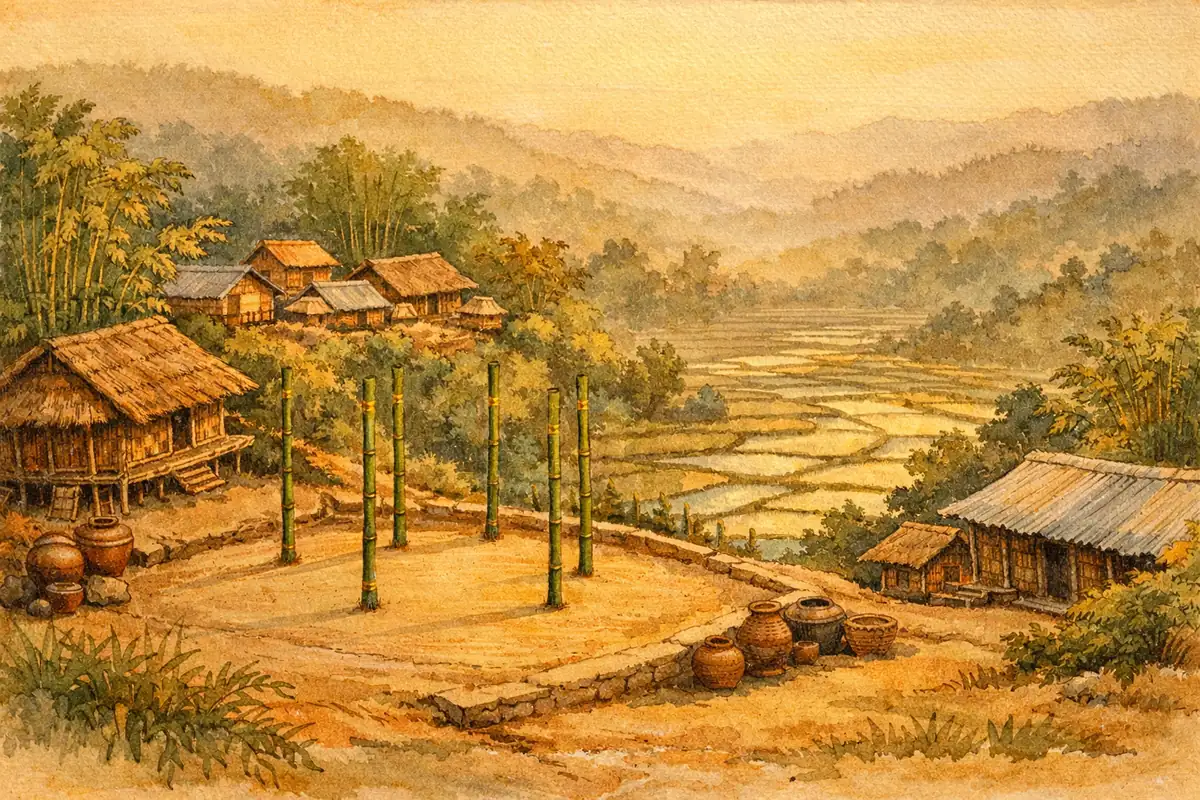
Bhattacharjee (1995) describes the Jamatia as Hindus who revere the tulsi plant, wear the sacred thread and go on pilgrimage, and who also worship local deities such as Shani, Sitala and Saraswati. They keep their own pujas, Garia, Lampra, Ker, Gang, Naksu and Maylwngma among them, led by their own priests, the ochai, of several grades. The images of the deities are made of green bamboo, set out in particular ways for each deity. Garia has two images, the Biyakwrwy and the Biyagwnang, each kept all year by a hereditary keeper, the kherfang, from its own lineage, in whose courtyard the puja is held; the Biyagwnang lineage is traced to the Kukis of Thanangchi. The chief priest of the Garia puja, the ochai, is not a hereditary office.
Deities named in the sources: Garia
Customs
Marriages are usually arranged by the parents. Bhattacharjee (1995) records three forms: the oldest, in which the groom lives and works in the bride's house for a time before the wedding; one in which the bride is brought to the groom's house and married there; and a newer one, in which the groom goes to the bride's house for the wedding and returns with her. The bride is often older than the groom. The dharmagola, a traditional co-operative, plays a large part in village economic life, and households exchange labour (yagul) and share-crop land (baga).
Festivals
Garia Puja
From the last day of Chaitra (mid-April), for seven days and nights
The largest yearly festival of the Jamatia. There is no temple: the puja is held in an open courtyard, at the house of the kherfang, in a village chosen by the hada at its annual meeting, and paid for by a subscription from every household. The day it begins is called Buisa (Bhattacharjee 1995).
Stories and Legends
Pubnarayan and the image of Garia
Some Jamatia elders told Bhattacharjee (1995) that their name comes from the worship of Garia. Pubnarayan, a hero of the Jamatias, brought the image of Garia from the Kukis of Thanangchi by great courage and presented it to the king of Tripura. The king ordered that the deity be worshipped by an assembly of the people, a jamayet, and those who worshipped together came to be called Jamatia. The keepers of one of the two images of Garia still come from a lineage traced to the Kukis of Thanangchi.
Related communities
Sources
- The Constitution (Scheduled Tribes) Order, 1950, as amended, Part for Tripura, as compiled in Wikipedia's List of Scheduled Tribes. Section Tripura
- Census of India 2011, Table A-11, State Primary Census Abstract for individual Scheduled Tribes: Tripura. State total for 'Jamatia'
- Pradip Nath Bhattacharjee, Jamatia Folklore: A Sociological Study (Tripura State Tribal Cultural Research Institute and Museum, 1995). Introduction and abstract; ch. I, numerical strength, origin and name; ch. II, social structure, kinship (santay), marriage, economy, traditional administrative system (hada, mayal, luku); ch. III, religion and the Garia puja
- R. H. Sneyd Hutchinson, An Account of the Chittagong Hill Tracts (1906). Ch. IV, the tribes: the Tipperahs (Puran and Jamatia)
- Manoshi Das, Jayanta Choudhury and Rebati Tripura, Tripura Tribe: A Status Analysis (Tribal Research and Cultural Institute, Government of Tripura, 2011). Clan (dafa) lists
Practice differs by village and family. If something here does not match your family's tradition, trust your elders.