
Chenchu
చెంచు
At a glance
- Clan word
- Kulam
- Descent
- Through the father
- Lives in
- Telangana, Andhra Pradesh, Karnataka, Odisha
- Language
- Telugu (Dravidian; Telugu script)
- Population
- 65,194 Census 2011, Table A-11: Chenchu in undivided Andhra Pradesh, including Telangana (64,227), Karnataka (954, 'Chenchu, Chenchwar') and Odisha (13)
- Region
- South
About
The Chenchu are a people of the Nallamala hills on both sides of the Krishna river in Telangana and Andhra Pradesh, many of whom still live in the forests of the Amrabad plateau and around Srisailam. They lived mainly by gathering wild foods, collecting honey and hunting with the bow, and speak Telugu. Christoph von Fürer-Haimendorf's study of 1943, based on fieldwork in 1940, is the classic account. Their clans, kulam, are patrilineal and exogamous. They are a Scheduled Tribe in Telangana, Andhra Pradesh, Karnataka and Odisha, and a PVTG in Telangana and Andhra Pradesh.
Clans and Kinship
A Chenchu belongs to the clan, kulam, of his father and of all his father's kin, while his mother belongs to another; he may not marry within his own clan or a clan counted as related, and he often gives the clan name before his own, as in Tokal Lingaru, a man of the Tokal clan (Fürer-Haimendorf). Fürer-Haimendorf found twelve clans among the Chenchus of the upper plateau and the nearby villages, and worked out from marriages that the ten found on the plateau formed four larger exogamous groups. The clans are not evenly spread: each tract of the plateau is held mainly by one or two clans, such as the 'Tokal-Nimal land' south of Malapur. The local group and the family are the other units: a man living in his wife's village is a 'guest', while in his home village he is co-heir to the land. Husband and wife are partners who own property jointly, and couples may live with either spouse's people.
What “Kulam” means
Kulam is the Chenchu exogamous, patrilineal clan (in ordinary Telugu kulam means caste); the clan names are also called house names (Fürer-Haimendorf).
12 kulams
- Menlur
Group with Daserolu
- Tokal
Group with Nallapoteru and Katraj
With Nimal holds the 'Tokal-Nimal land' between the Krishna and Malapur.
- Nimal
Group with Eravalu and Pulsaru
Once the clan of the south-western villages of the plateau.
- Sigarlu
Group with Urtalu
Holds the ridge of Vatellapalli, Sarlapalli and Timmareddipalli.
- Nallapoteru
Group with Tokal and Katraj
- Eravalu
Group with Nimal and Pulsaru
Centred on Pulajelma; near extinction in 1940.
- Pulsaru
Group with Nimal and Eravalu
- Urtalu
Group with Sigarlu
- Daserolu
Group with Menlur
- Mamedi
- Katraj
Group with Tokal and Nallapoteru
- Balmor
The twelve clans Fürer-Haimendorf recorded in 1940 (The Chenchus, 1943, ch. 11), in his order; the first seven were numerous and the rest small. The four exogamous groups are those he worked out for the ten clans of the upper plateau; Mamedi and Balmor are not placed in a group.
In the Official Lists
Scheduled Tribe
Telangana, Andhra Pradesh, Karnataka, Odisha
Listed as: Chenchu
Andhra Pradesh and Karnataka: 'Chenchu, Chenchwar'.
The Chenchu are one of the Particularly Vulnerable Tribal Groups (PVTGs) in Telangana and Andhra Pradesh. Census 2011 counted the Chenchu of undivided Andhra Pradesh, which then included Telangana, together. Checked against the census tables and Wikipedia's compilation of the order.
Checked on 2026-11-07 against the sources below. The lists are amended from time to time and can differ by district; for a certificate, the current order or the state's list is what counts.
Name and Origin
Fürer-Haimendorf found that the Chenchus kept few traditions about their own past. He wrote of them as for long the only inhabitants of the upper Amrabad plateau, through whose forests pilgrims passed to the Shiva temple at Srisailam, a shrine he dated to no later than the seventh century; stone circles and dolmens on the lower ledge showed that a megalithic people had once reached the plateau too. Thurston (1909) records a tradition that some Yanadi groups were once Chenchus, and notes that both worship Chenchu Devudu.
History
When Fürer-Haimendorf lived on the Amrabad plateau, then in Hyderabad State, from January to July 1940, most Chenchu families of the upper plateau still lived by collecting wild foods and honey and by hunting, moving between village sites and hot-weather camps with the seasons, while the Village Chenchus near Amrabad, Mananur and Lingal farmed and worked for others. In 1941 the upper plateau was declared a game sanctuary (Encyclopedia of World Cultures). The Chenchu were later placed among the communities now called Particularly Vulnerable Tribal Groups.
Faith and Worship
Fürer-Haimendorf describes Garelamaisama as the deity of the forest and the chase, addressed as mother and sometimes as father, who makes the forest fruits ripen; hunters pray to her and give her part of the kill at a few flat and upright stones under a large tree near the village. Bhagavantaru is the god of the sky, from whom each person's soul (jiv) comes and to whom it returns at death. The cult of Lingamaya, linked with the Shiva of Srisailam, he judged to be more recent. Many Chenchus have taken up the worship of the Hindu deities of their Telugu neighbours.
Deities named in the sources: Garelamaisama, Bhagavantaru, Lingamaya
Customs
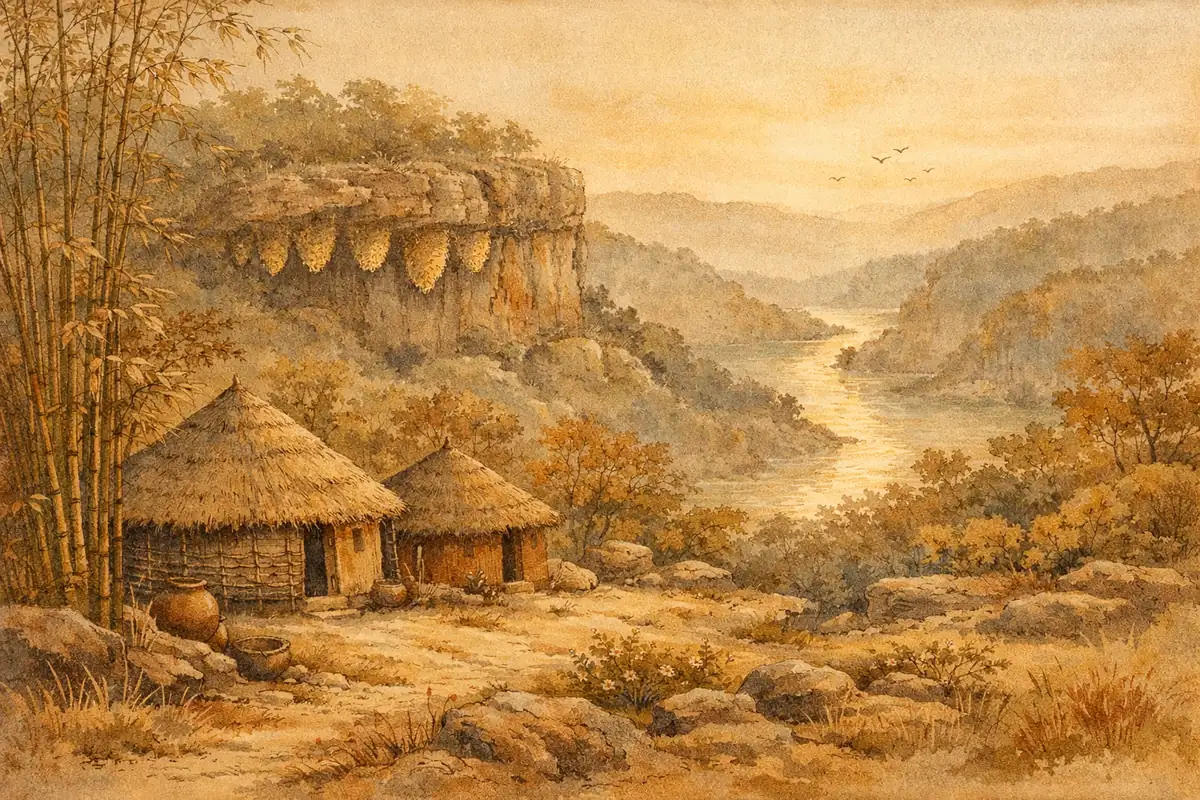
Gathering honey from cliffs and tall trees is a Chenchu skill: before climbing, the gatherer prays to Garelamaisama or Lingamaya, and after success offers a small piece of the comb (Fürer-Haimendorf). A village of three to thirteen houses is occupied for ten to fifteen years; the permanent house (gada illu) has a circular wattle wall and a conical thatched roof, and in the hot weather families move to sites with water and food.
Related communities
Sources
- C. von Fürer-Haimendorf, The Chenchus: Jungle Folk of the Deccan (The Aboriginal Tribes of Hyderabad, vol. 1, 1943). Ch. 1 (the Amrabad plateau, Srisailam, prehistoric remains); honey-collecting; ch. 11 (clans and their distribution); religion (Garelamaisama, Bhagavantaru, Lingamaya)
- Sara J. Dick, 'Chenchu', Encyclopedia of World Cultures, vol. 3: South Asia (1992). Read with its sub-pages
- E. Thurston and K. Rangachari, Castes and Tribes of Southern India, vol. 7 (1909), 'Yanadi'. Vol. 7, 'Yanadi'
- Constitution (Scheduled Tribes) Order, 1950, and the companion orders, as amended: Parts for Telangana, Andhra Pradesh, Karnataka, Odisha (as compiled in Wikipedia's List of Scheduled Tribes)
- Census of India 2011, Table A-11: State Primary Census Abstract for individual Scheduled Tribes, Andhra Pradesh, Karnataka, Odisha. censusindia.gov.in NADA catalog 42967 (Andhra Pradesh), 42968 (Karnataka), 42960 (Odisha)
- Ministry of Tribal Affairs list of 75 Particularly Vulnerable Tribal Groups (PIB release 1577166), as compiled in Wikipedia's 'Particularly vulnerable tribal group' (read 2026-11-07)
Practice differs by village and family. If something here does not match your family's tradition, trust your elders.