
Gaddi
गद्दी
At a glance
- Clan word
- Al
- Descent
- Not recorded in the sources used
- Lives in
- Himachal Pradesh, Jammu and Kashmir
- Language
- Gaddi (Gadi) (Indo-European (Indo-Aryan))
- Population
- 2,24,619 Census 2011, Table A-11: Gaddi in Himachal Pradesh (178,130) and in Jammu and Kashmir, then including Ladakh (46,489)
- Region
- North
About
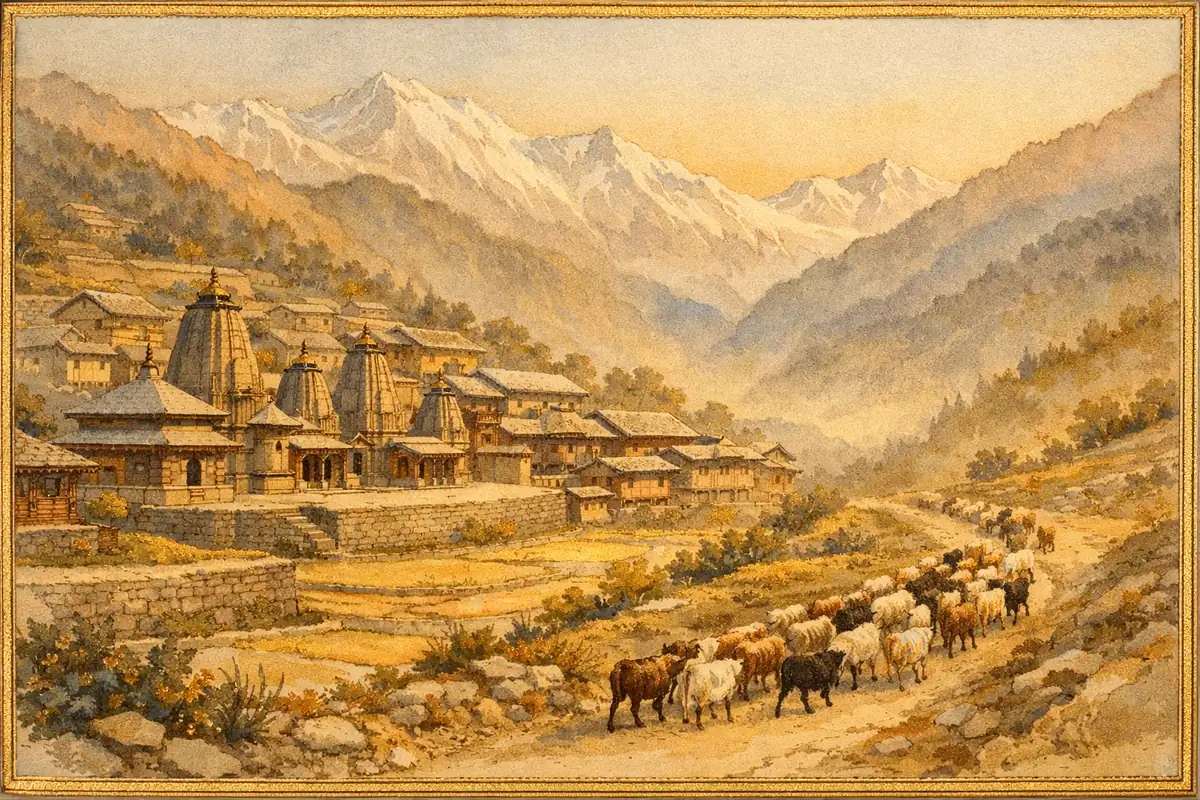
The Gaddi are a pastoral and farming people of the Dhauladhar range in Himachal Pradesh. Their home is Brahmaur in Chamba district and the hill country on both sides of the range called Gaderan, and they have settled widely in Kangra and in Jammu and Kashmir. Many families move their flocks of sheep and goats between high summer pastures and winter grazing in the low hills. They speak Gaddi (Gadi), call Brahmaur Shiv-bhumi, the land of Shiva, and make the pilgrimage to Manimahesh. They are a Scheduled Tribe in Himachal Pradesh, Jammu and Kashmir and Ladakh.
Clans and Kinship
Rose (1911) describes Gaddi society as made up of Brahman, Khatri and Rajput, and Thakur and Rathi sections, each divided into gotras or exogamous sections, while the sections themselves are not strictly closed: in Kangra, for instance, the Jhunu got of the Khatris intermarries with Brahmans. Each section keeps the Brahmanical gotra of its original group, and these gotras are divided into countless als, septs that are also called gotras or gots. Many al names come from an ancestor's nickname, his trade or his place, or from some event at his birth. Marriages were arranged through the family priest, with betrothal either by gift (dharma puna) or by exchange (tola).
What “Al” means
An al is a Gaddi sept, a division of one of the Brahmanical gotras; Rose (1911) notes that als are themselves often called gotras or gots.
17 als
- Kaundal
Brahman
A gotra whose als include the Bhats and Ghungaintu (Rose).
- Paunkhnu
Brahman
A got of Kangra said to supply family priests to all other Brahman Gaddis.
- Jhunu
Khatri
A got of Kangra that intermarries with Brahmans.
- Bachar
Rajput
A gotra whose als include the Ordian, Rauyan and Misan.
- Dewal
Rajput
A gotra whose als include the Kurralu and Ghoknu.
- Uttam
Rajput
A gotra; one of its als is the Dinran.
- Bhardwaj
Rajput
A gotra whose als include the Phagan and Kadan.
- Sunkhyal
Rajput
A gotra; one of its als is the Khuddu.
- Atar
Rajput
A gotra whose als include the Rikhantu and Garhaigu.
- Ambak
Rajput
A gotra; one of its als is the Chaker.
- Bisistpal
Rajput
A gotra; one of its als is the Pakhru.
- Agasni
Rajput
A got of Kangra said to be an offshoot of the Jarial Rajputs.
- Barau
Thakur
An al of the Thakurs of Kangra.
- Harelu
Thakur
An al of the Thakurs of Kangra.
- Janwar
Thakur
An al of the Thakurs of Kangra.
- Marthan
Thakur
An al of the Thakurs of Kangra.
- Siuri
Thakur
An al of the Thakurs of Kangra.
A selection of the gotras and als that Rose (1911) names as examples, grouped by section as he gives them. He names many more als, mostly from Chamba, and glosses their meanings, many of them nicknames; the glosses are not repeated here. Spellings are Rose's, from a scanned copy, and families today may write the names differently.
In the Official Lists
Scheduled Tribe
Himachal Pradesh, Jammu and Kashmir, Ladakh
Listed as: Gaddi
Census 2011 counted the Gaddi of the then state of Jammu and Kashmir, which included Ladakh, together.
Checked against the Census 2011 tables and Wikipedia's compilation of the orders, which may not show amendments of 2022 to 2024. The Muslim Gaddis of the Delhi and Karnal country whom Rose also describes are a different community and are not covered here.
Checked on 2026-11-07 against the sources below. The lists are amended from time to time and can differ by district; for a certificate, the current order or the state's list is what counts.
Name and Origin
Rose (1911) records traditions that the Gaddis came from the plains: Chauhan Rajput and Brahman Gaddis are said to have come to Chamba with Raja Ajia Varma in 850-70, and some Rajput and Khatri families to have fled to the hills to escape Aurangzeb's persecutions. He found these consistent with the tradition that Brahmaur, the ancient Brahmapura, is the home of the Gaddis, the Dhaula Dhar having long given refuge to people from the plains. The Gaddis say that they took up the dress of Shiva and Parvati when they settled in Brahmaur.
History
In Rose's day the Gaddis of Chamba numbered 11,507, not counting Brahman and Rajput sections returned under their caste names. Many held land on both sides of the Dhauladhar: they reaped the winter crop in Kangra and returned in spring to cut the summer crop in Brahmaur. The men of a family took turns with the flocks, spending the summer in the high country of Pangi and Lahul and the winter in the low hills along the plains, with the move to Kangra in October and November and the return in April and May (Rose).
Faith and Worship
The Gaddis are Hindus and hold Brahmaur to be Shiva's land. Rose records pilgrimages in Bhadon and Asauj to the shrines of Narsingh, Hari-har, Lakshmi Devi, Ganesh and Kailung in Brahmaur, and, as a rule in Bhadon only, to Mani Mahesh; and in Chet to Jawalaji in Kangra. Godlings are linked with particular crops, Shiva and the Devis receive offerings at Shivratri, and some local beings, such as Kailu, are peculiar to the Gaddis or to Chamba.
Customs
The traditional dress of a Gaddi man is the chola, a knee-length coat of homespun wool with a deep collar, tied at the waist with a long black rope of sheep's wool, the dora; on the march a shepherd may carry four or five lambs in its fold. Women wear a long woollen gown tied with the same dora, with ornaments of their own such as heavy brass anklets (Rose). Ploughing, sowing and reaping are begun on a Sunday, Tuesday or Thursday, and the dead are cremated.
Festivals
Basua
1st Baisakh (mid-April)
One of the seven chief fairs in Rose's list, kept with games and dances and flour cakes eaten with ghee and honey.
Patroru
1st Bhadon (mid-August)
A cake of a vegetable called siul is eaten, and only young girls dance (Rose).
Sair
1st Asauj (mid-September)
Kept with games and dances (Rose).
Lohri
1st Magh (mid-January)
Kept with games and dances; khichri of rice and dal is eaten (Rose).
Manimahesh pilgrimage
Bhadon (August-September)
Rose records the pilgrimage to Mani Mahesh, as a rule in Bhadon only.
Related communities
Sources
- H. A. Rose (from the census reports of D. Ibbetson and E. D. Maclagan), A Glossary of the Tribes and Castes of the Punjab and North-West Frontier Province, vol. 2 (1911), 'Gaddi'. Vol. 2, 'Gaddi', from p. 256: the hill Gaddis, classes and gotras, als, dress, migrations, weddings, godlings, fairs and pilgrimages
- Constitution (Scheduled Tribes) Order, 1950, and the companion orders, as amended: Parts for Himachal Pradesh, Jammu and Kashmir, Ladakh (as compiled in Wikipedia's List of Scheduled Tribes)
- Census of India 2011, Table A-11: State Primary Census Abstract for individual Scheduled Tribes, Himachal Pradesh, Jammu and Kashmir. censusindia.gov.in NADA catalog 42945 (Himachal Pradesh), 42944 (Jammu and Kashmir)
Practice differs by village and family. If something here does not match your family's tradition, trust your elders.