
Hajong
At a glance
- Clan word
- Nikni
- Descent
- Through the father
- Lives in
- Meghalaya, Assam, West Bengal, Bangladesh
- Language
- Hajong (Indo-Aryan (close to Assamese and Bengali))
- Population
- 73,937 Census 2011, Table A-11: Meghalaya 38,576; Assam 34,689 (34,253 in the list for the plains, 436 in the autonomous districts); West Bengal 621 (as Hajang); Mizoram 51.
- Region
- North-East
About
The Hajong are a farming people of the plains along the southern and western foot of the Garo Hills, most of them in Meghalaya, with villages in the South Salmara and Lakhipur areas of Goalpara in Assam, in West Bengal, and in Mymensingh, Netrokona, Sherpur and Sunamganj in Bangladesh. They are wet-rice cultivators, and their language is close to Assamese and Bengali. Hajong families are patrilineal and belong to exogamous clans called nikni, now little used. Most are Hindu, keeping rites of their own. They are a Scheduled Tribe in Meghalaya, Assam, Mizoram and West Bengal.
Clans and Kinship
The Hajong are patrilineal: the father heads the family and sons inherit, though a daughter may now inherit from a father without sons (Bordoloi 1991; Jengcham). Families belong to exogamous clans called nikni; a man may not marry a girl of his own nikni, who counts as his sister. Bordoloi found the nikni passed through the father, and people he met could name only three; D. N. Majumdar believed the Hajong once had matrilineal clans, and Hamlet Bareh (2001), as cited in Wikipedia, describes the nikni as matrilineal and the daidi, the father's line, as also closed to marriage. Jengcham writes that the niknis are dying out and that many families now give Hindu gotra names such as Kashyap, Bharadwaj and Shandilya and use surnames such as Roy, Das and Sarkar. The Hajong marry within the community. Endle (1911) recorded two sections, the Byabchari, mostly Shakta, and the Paramarthi, Vaishnava and abstaining from pork and liquor, who intermarried; Jengcham names them Hajong and Khatal. In Bangladesh, villages are grouped into chaklas and parganas; the village chief, the gaobura, is chosen by the villagers and the chief of a chakla, the sorey morol, by the gaoburas (Jengcham). Bordoloi found the houses of a village clustered round the courtyard of the adhikari, the village priest.
What “Nikni” means
Nikni is the Hajong word for the exogamous clan (Bordoloi 1991; Jengcham in Banglapedia). Sources differ on whether it passed through the father or the mother; daidi is the father's line of kin.
17 niknis
- Porachunga
- Chondi
One of the three nikni Bordoloi (1991) heard named.
- Batajore
- Balihata
Probably Bordoloi's Baliati.
- Kendagao
Probably Bordoloi's Kendagaiya.
- Taragao
- Jignigao
- Katleygao
- Boligao
- Kamakha
- Kharugao
- Sonamoi
- Chatigao
- Komligao
- Ghorabali
- Poroshmoni
- Akhigao
The seventeen niknis as Subhash Jengcham lists them in Banglapedia, who adds that they are now falling out of use. Wikipedia gives the same names after B. Hajong (2002), with a second, shorter list. Bordoloi (1991) was told there were seven, of which people could name only Chondi, Kendagaiya and Baliati, and cites a count of twenty-one. Spellings differ.
In the Official Lists
Scheduled Tribe
Assam, Meghalaya, Mizoram
In Assam the entry is in both parts of the list, for the plains and for the autonomous districts.
Scheduled Tribe
West Bengal
Listed as: Hajang
Bordoloi (1991) wrote that in Assam the Hajong were then listed only in the two autonomous hill districts; the compilation checked and the Census 2011 table show them in Assam's list for the plains as well, where most of Assam's Hajong were counted in 2011. Checked against a compilation of the Order and the Census 2011 tables; amendments of 2022 to 2024 were not checked.
Checked on 2026-11-07 against the sources below. The lists are amended from time to time and can differ by district; for a certificate, the current order or the state's list is what counts.
Name and Origin
Hajong writers give several accounts of the name, as Bordoloi (1991) records. Paresh Hajong tells a tradition that the Hajong descend from the line of an ancient king whose widow took refuge in Kamrup, and lived in the township of Hajo until it was overrun, when some twelve thousand people fled into the Garo Hills and were named after the place they came from. Ratan Kumar Rai Hajong derives the word from harajan, a people who left their old calling for a new one. Most scholars Bordoloi cites take it from the Garo ha, land, and jong, worm or ant, a name for people skilled at the plough, and Jengcham in Banglapedia records the Hajong saying 'the Garos named us Hajong'. Endle (1911) thought the name might come from the Kachari word for hill, and that the Hajong might be the people of the old kingdom of Koch Hajo who took refuge in the Garo Hills when Muslim armies overran it between 1600 and 1700. Writers differ on their kinship with the Garo and the Kachari, and Bordoloi notes that the Hajong introduce themselves as Kshatriyas.
History
Endle (1911) put the Hajong at about 8,000, living on the plains below the southern slope of the Garo Hills. Their villages spread along the foot of the hills on both sides of what is now the border between India and Bangladesh. In north Mymensingh, Hajong and Garo tenants were at the centre of the tonk movement of 1946 to 1950 against rent paid in paddy, which ended when the East Bengal State Acquisition and Tenancy Act of 1950 made the tonk tenants owners of their land (Banglapedia); Jengcham also records the Hatikheda uprising of the Hajong against the zamindars. In 1971 the census counted 386 Hajong in Assam's two hill districts, the only part of Assam where they were then listed.
Faith and Worship
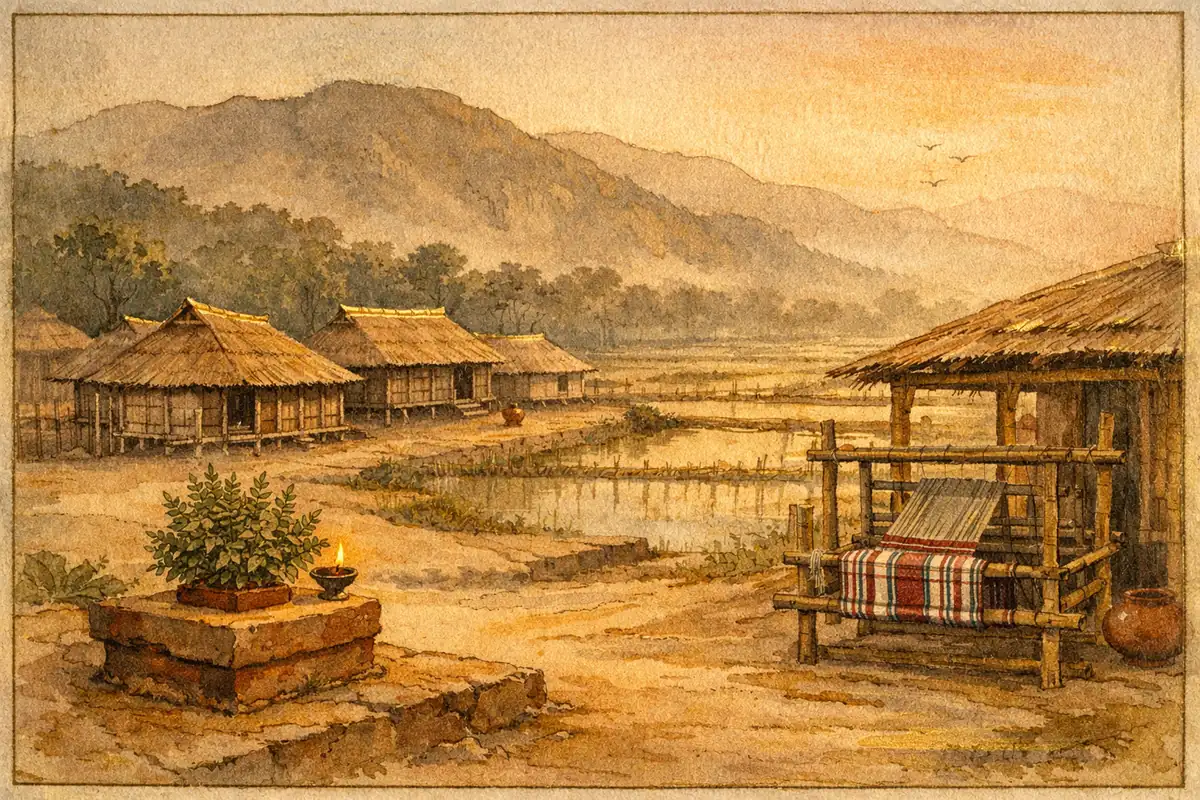
Most Hajong count themselves Hindu while keeping older rites (Bordoloi 1991). Most are Shakta and some Vaishnava; every house has a basil (tulsi) plant on its east side, where the women sing devotional songs in the evening, and in Bangladesh every homestead keeps a small shrine, the deo-ghar (Jengcham). The village priest, the adhikari, leads the main rites. Manasa, called Padma, is worshipped on the last day of Shravan, and by every family before a wedding. Spirits such as Jarang deo and Machang deo are appeased with offerings. Jengcham names household deities of their own, among them Khangkhangi-deo, worshipped for protection from enemies, Moila-deo for the health of new-born children, Haowa-deo for prosperity, and Pitha-deo and Gang-deo for cures. Pilgrimage to Chandranath and Langalbanda is common.
Customs
Bordoloi (1991) names three forms of marriage: the negotiated subha vivah, arranged through a go-between (jasu), held at the groom's house; the hango, between a widow or divorcee and a widower; and dai para, by elopement. Monogamy is the rule, divorce rare, and child marriage unknown; a bride price (khalti) is now nominal. Endle (1911) described a wedding in which the bride walked seven times round the groom inside a square of plantain trees, sixteen lamps and sixteen water pots, and a village elder sprinkled the couple with water. The dead are cremated, and the sraddha follows on the eleventh or thirteenth day; for a year after a parent's death the sons keep certain abstentions. Hajong women weave on a loom called bana and wear the pathin, a wrap-around cloth with coloured stripes.
Festivals
Bash Puja
Baisakh (April to May), three days
Three newly cut bamboos, decorated with cloth, are set up and worshipped while young men dance to the songs of professional singers (gitals); accounts differ on which gods the bamboos stand for (Bordoloi 1991).
Kartik Puja
End of the month of Kati
Held by women alone through the night, with songs and dances; Kartik is worshipped as the giver of sons and crops (Bordoloi 1991).
Pushna
Magh Bihu, mid-January
The Hajong form of Magh Bihu, with a community feast of newly harvested rice (Bordoloi 1991).
Stories and Legends
The twelve thousand from Hajo
Bordoloi (1991) records the tradition told by the Hajong writer Paresh Hajong. Their forebears lived in the old township of Hajo in Kamrup. When it was overrun in war, some twelve thousand of them crossed into the Garo Hills and made their first settlement there, and from there they spread over the plains at the foot of the hills. Because they came from Hajo, their neighbours called them Haj, and in time the name became Hajong.
Related communities
Sources
- The Constitution (Scheduled Tribes) Order, 1950, as amended, Parts for Assam, Meghalaya, Mizoram and West Bengal, as compiled in Wikipedia's List of Scheduled Tribes. Sections Assam (general areas; autonomous districts), Meghalaya, Mizoram, West Bengal
- Census of India 2011, Table A-11, State Primary Census Abstract for individual Scheduled Tribes: Assam. State totals for 'Hajong' in both parts of the list. Companion tables for Meghalaya (catalog/42956), Mizoram (catalog/42954) and West Bengal (catalog/42958, 'Hajang').
- B. N. Bordoloi, 'The Hajongs', in Tribes of Assam, Part III (Assam Institute of Research for Tribals and Scheduled Castes, 1991). Introduction and name, affinity, demography, clans, family structure, marriage, death rites, religion, village structure, language, festivals, dress
- Subhash Jengcham, 'Hajongs', Banglapedia (National Encyclopedia of Bangladesh)
- Sirajul Islam, 'Tonk Movement', Banglapedia
- Sidney Endle, The Kacharis (1911). Appendix I, the Hajongs (pp. 85-87): name, habitat, subdivisions, marriage
- Wikipedia, Hajong people (pointer: nikni lists after B. Hajong 2002; Hamlet Bareh on matrilineal nikni and daidi)
Practice differs by village and family. If something here does not match your family's tradition, trust your elders.