
Hmar
At a glance
- Clan word
- Hnam
- Descent
- Through the father
- Lives in
- Manipur, Mizoram, Assam, Meghalaya, Tripura
- Language
- Hmar (Tibeto-Burman (Kuki-Chin); Roman script)
- Population
- 95,504 Census 2011, Table A-11: the Hmar entries of Manipur (48,375), Mizoram (29,587), Assam (15,745) and Meghalaya (1,797), added together.
- Region
- North-East
About
The Hmar are a people of the hills where Manipur, Mizoram and Assam meet: the Churachandpur district of Manipur, the north of Mizoram, and the Dima Hasao (North Cachar Hills) and Cachar districts of Assam, with smaller numbers in Meghalaya and Tripura. They speak Hmar, a Kuki-Chin language written in Roman letters, and call themselves the children of Manmasi. They are a Scheduled Tribe, listed by the name Hmar, in Manipur, Mizoram, Meghalaya and the hill districts of Assam.
Clans and Kinship
The Hmar are divided into many sub-tribes and clans, called hnam, which split into sub-clans; each takes the name of an ancestor, and at times the name of a prominent man in the line replaced the older name and a new clan was born (Assam Institute, 2017, pp. 37-39). Descent and inheritance pass through the father. Many clans leave the family property to the youngest son, who looks after the parents until their death, though in some clans the eldest inherits and property may be shared among the sons (p. 40). Each village was a state under its own chief (lal), who ruled with a council of elders, chosen from the different clans of the village; under them were the crier (tlangva), the blacksmith (thirsu), the youth leaders (val upa) and the priest (thiempu), whose office was hereditary. The young men slept in the bachelors' house, the buonzawl or zawlbuk, where they were trained in work, hunting, wrestling and courtesy (pp. 92-94).
What “Hnam” means
Hnam is the Hmar word for a clan or sub-tribe (Assam Institute, 2017). A hnam is named after its ancestor and divides into sub-clans, which in turn name families.
18 hnams
- Thiek
Shakespear's Thiak; sub-clans include Amaw, Buhril, Hmante, Hnamte, Lalum, Saibung, Tuolte and Vankal.
- Zote
- Vangsie
- Sakum
- Tlau
- Rawite
- Pautu
- Ngurte
- Ngente
- Lungtau
Shakespear's Lungthau, a minor family in his account; sub-clans include Keivom, Songate and Sielhnam.
- Leiri
Sub-clans include Pudaite, Neingaite and Thlandar.
- Lawitlang
Grouped with the Hrangchal in the report; Shakespear's Loitlang, then subdivided into six families.
- Khuolhring
- Khiengte
- Khawbung
- Faihriem
- Darngawn
- Changsan
A selection, in its order, of the sub-tribes and clans listed by the Assam Institute of Research for Tribals and Scheduled Castes (2017, pp. 37-39), which gives sub-clans under each. The report's list also names groups that are listed as tribes of their own in some states or counted among other peoples, such as the Chothe, Chiru, Aimol, Biete, Darlong, Bawm, Hrangkhol and Kawm, and names that also head Mizo clans, such as Chawngthu and Chawte; those are left out here. Spellings follow the report.
In the Official Lists
Scheduled Tribe
Manipur, Mizoram, Assam, Meghalaya
Listed as: Hmar
An entry of its own in each of these lists; in Assam the entry is in the list for the autonomous hill districts.
Census 2011 counted 48,375 Hmar in Manipur, 29,587 in Mizoram, 15,745 in Assam and 1,797 in Meghalaya. Hmar living in Tripura are not listed under that name there. The compilation used may not show amendments made between 2022 and 2024.
Checked on 2026-11-07 against the sources below. The lists are amended from time to time and can differ by district; for a certificate, the current order or the state's list is what counts.
Name and Origin
Two accounts of the name are given. Shakespear (1912, p. 185) wrote that the Lushai called a number of clans Hmar, 'north', from where their villages lay in relation to their own, while the clans called themselves Khawtlang and Khawchhak, western and eastern villages. The Assam Institute of Research for Tribals and Scheduled Castes (2017) gives the Hmar account instead: the name comes from hmer, tying the hair in a knot at the nape, as the descendants of Tukbemsawm did, while those of his elder brother Hrumsawm tied it on the forehead. In Hmar tradition the first home was Sinlung, and the people are the children of Manmasi, whose three sons were Miachal, Niachal and Nelachal; the Hmar descend from Nelachal, the youngest.
History
Shakespear (1912, pp. 185-186) found representatives of sixteen of these clans in the Lushai Hills and the neighbouring hills of Manipur, the most important being the Loitlang, Hrangchal, Thiak and Biate. He recorded that when the Thangur chiefs of the Lushai pressed on them, one section went through the hills into Cachar, another moved into the southern Manipur hills, and some joined the Thangur villages. The Assam Institute's report links later moves west and north, into Assam, Tripura and Meghalaya, to the same rise of the Sailo chiefs. Grierson recorded the Hmar language in the Linguistic Survey of India, and the first book printed in Hmar, the Gospel of Mark, came out in 1907; most Hmar are now Christian.
Faith and Worship
In the older religion, as the Assam Institute report describes it (pp. 41-42), the Hmar believed in a supreme god above, but most rites were for the spirits that could dwell in great trees, rocks, rivers, cliffs and forests. The priest (thiempu) performed the sacrifices; some clans and families had priests of their own. The souls of the rich, the brave and great hunters, called thangsuo, went to Pielral, a paradise, and the ancestors were honoured in a rite called Pi-Pu-Rau-Biek. Most Hmar are now Christian.
Customs
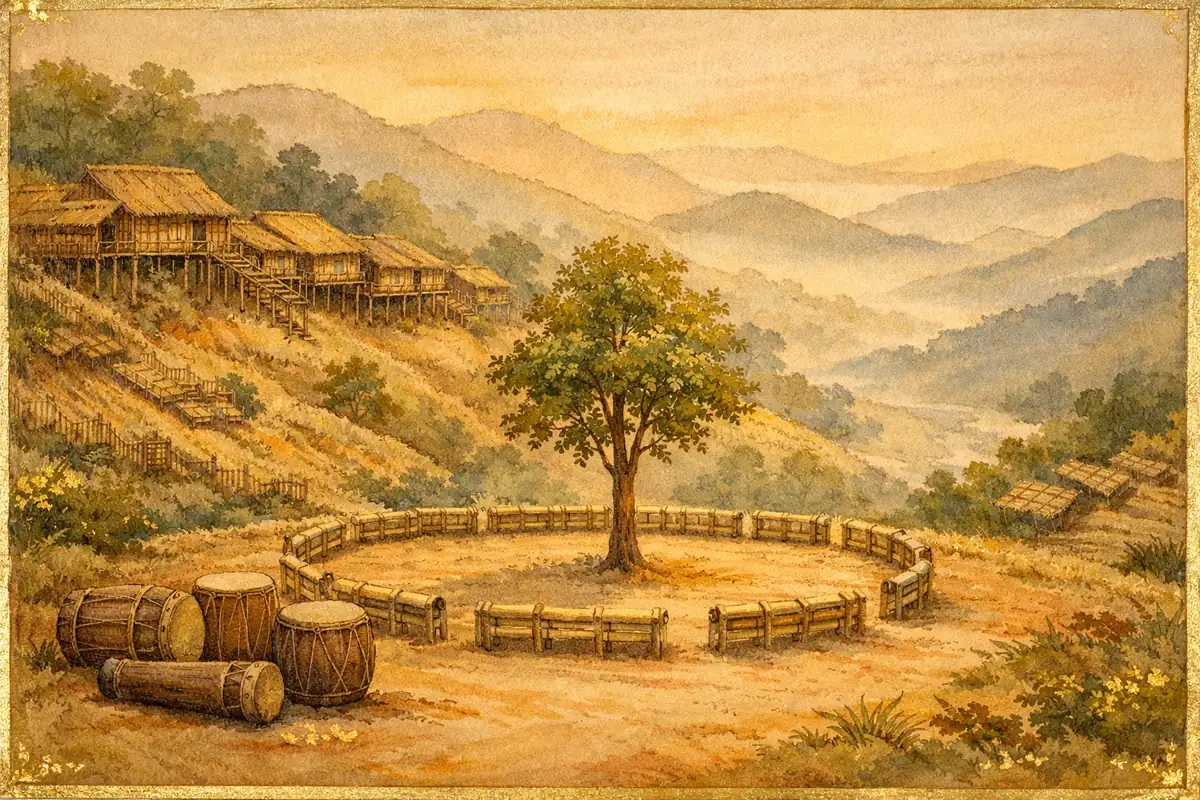
Sikpui, the chief festival, was danced when the year's work was done, only in a year of good harvest and without serious illness or death in the village, and its preparation called for peace in every household. The young people asked the elders' leave, the song leader (zaipu) trained the singers, and in the khuongtuibur rite a bison horn was tied to the biggest drum and rice beer poured over it. A flat ground was prepared with a tall tree set in its centre and seats for the song leader and the old around it (Assam Institute, 2017, pp. 54-56). A rich man could also give the villagers a great feast, the inchawng.
Festivals
Sikpui
Winter; now held on 5 December
The chief Hmar festival, of thanks for the harvest and for peace, with evening dancing that can go on for a fortnight.
Inchawng
When a rich family gives it
A great feast given to the whole village by a rich man, tied to family worship.
Stories and Legends
The children of Manmasi
The Assam Institute report (2017) records that the Hmar call themselves Manmasi-nau, the children of Manmasi, and invoke his name when they set out: going into the forest they tell the weeds on both sides of the path to make way, for the children of Manmasi are coming, and before eating they set aside a little food for their ancestor. Manmasi had three sons, Miachal, Niachal and Nelachal, from whom many peoples of the hills are said to descend; the Hmar trace themselves to Nelachal, the youngest.
Related communities
Sources
- Assam Institute of Research for Tribals and Scheduled Castes, Ethnographic Report on the Hmars of Assam (Guwahati, 2017), Ministry of Tribal Affairs repository. ch. 1 (the name, Sinlung, Manmasi, migration, distribution, p. 12), ch. 3 pp. 37-40 (hnam, clans and sub-clans, inheritance), ch. 4 pp. 41-42 (religion), ch. 6 pp. 54-56 (Sikpui, inchawng), ch. 8 (language, the Gospel of Mark, 1907), ch. 10 pp. 92-94 (village government, buonzawl)
- J. Shakespear, The Lushei Kuki Clans (London: Macmillan, 1912). Part III, pp. 185-186 (Hmar, 'north'; Khawtlang and Khawchhak; the sixteen clans; their movements)
- Census of India 2011, Table A-11: State primary census abstract for individual Scheduled Tribes, Manipur, Mizoram, Assam and Meghalaya
- Census of India 2011, Table A-11 Appendix: District wise Scheduled Tribe population, Manipur
- Constitution (Scheduled Tribes) Order, 1950, as amended, Parts for Manipur, Mizoram, Meghalaya and Assam (autonomous districts), as compiled from the Census of India list of notified Scheduled Tribes
Practice differs by village and family. If something here does not match your family's tradition, trust your elders.