
Juang
At a glance
- Clan word
- Bok
- Descent
- Through the father
- Lives in
- Odisha
- Language
- Juang (Austroasiatic (Munda))
- Population
- 47,095 Census 2011, Table A-11, Odisha, Juang.
- Part of
- Munda
- Region
- East
About
The Juang are a Munda-speaking people of the hills of Keonjhar and Dhenkanal in Odisha, whose homeland is the Juang Pirh around Gonasika. SCSTRTI distinguishes the Hill Juang of the Keonjhar and Pallahara ranges from the Plain Juang. Their villages are grouped into four pirhs under chiefs called sardar, and each village has a majang, the dormitory of the young and the village's meeting house. Clans, called bok, are totemic and exogamous. The Juang are a Scheduled Tribe and a particularly vulnerable tribal group (PVTG) in Odisha; the 2011 census counted 47,095.
Clans and Kinship
Risley (1891) found no sub-tribes: the Juang form one endogamous group, divided into totemic septs named after animals, trees and plants, and a man may not marry in his own sept. SCSTRTI (2008) calls the clan bok; each has a totemic origin, its members are believed to descend from one ancestor, and a woman takes her husband's clan at marriage. All blood relatives are kutumb, and those with whom marriage is possible are bandhu. Hill Juang villages were each of one clan, so a man marries outside his village. Each village is a self-governing unit under its elders, the barabhai or bhalabhai, and holds its swiddens, forest, grazing land and house sites in common. Villages are grouped into four pirhs, Satkhand, Jharkhand, Kathua and Rebena, each under a sardar. The family is patrilineal and patrilocal.
What “Bok” means
Bok is the Juang word for the exogamous clan in SCSTRTI's account (2008); each bok has a totem, an animal, bird, insect, tree, flower, grain or mushroom, and its members keep taboos towards it. Risley (1891) wrote 'sept'.
21 boks
- Alemba
Totem: hailstones · septs named in Risley (1891)
- Baitiriba
Totem: buffalo · septs named in Risley (1891)
- Balimba
Totem: mosquito · septs named in Risley (1891)
- Banaiba
Totem: bear · septs named in Risley (1891)
- Barataba
Totem: boar · septs named in Risley (1891)
- Hatisalaba
Totem: elephant · septs named in Risley (1891)
- Jarigamba
Totem: the jari tree · septs named in Risley (1891)
- Kalimba
Totem: tobacco flower · septs named in Risley (1891)
- Kanchaba
Totem: dog · septs named in Risley (1891)
- Kelobo
Totem: bee · septs named in Risley (1891)
- Keralaba
Totem: pumpkin · septs named in Risley (1891)
- Lihimba
Totem: dove · septs named in Risley (1891)
- Mundiba
Totem: mahua tree · septs named in Risley (1891)
- Munduab
Totem: small mushroom · septs named in Risley (1891)
- Odhalaba
Totem: fox · septs named in Risley (1891)
- Rangataba
Totem: a yellow bird · septs named in Risley (1891)
- Rasamba
Totem: mushrooms that grow on ant-hills · septs named in Risley (1891)
- Saramba
Totem: a tigress · septs named in Risley (1891)
- Sundriaba
Totem: red mushroom · septs named in Risley (1891)
- Talahadaba
Totem: palm tree · septs named in Risley (1891)
- Tenshaba
Totem: a bird · septs named in Risley (1891)
Juang septs named in the entries of Risley's glossary (1891, vols I and II), each described there as a totemistic sept of the Juang of Orissa, in alphabetical order with his glosses and without diacritics. Risley's own Juang list in his appendix could not be read in either scan, and a few more glossary entries were too damaged to use, so the list is incomplete.
In the Official Lists
Scheduled Tribe
Odisha
Listed as: Juang
Checked against the 2011 census table of each state and Wikipedia's compilation of the order; amendments after 2011 were not checked. The Juang are listed only in Odisha. SCSTRTI and the PVTG list reproduced from the 2019 PIB release name them among Odisha's particularly vulnerable tribal groups.
Checked on 2026-11-07 against the sources below. The lists are amended from time to time and can differ by district; for a certificate, the current order or the state's list is what counts.
Name and Origin
In SCSTRTI's account the Juang believe they were the first people born on earth, from a rishi couple who lived at Rusi Tangar, a hillock near Gonasika in Keonjhar, and they hold the Juang Pirh of Keonjhar to be their homeland. Those who live there call themselves Thaniya, the original settlers, and those who moved down to the plains of Keonjhar and Dhenkanal are called Bhagudia, those who left. SCSTRTI gives the meaning of Juang as 'sons of man'. Risley (1891) recorded that the Keonjhar Juangs claimed to be the first people of the country, and that their language was said to be closest among the Munda languages to Kharia.
History
Risley (1891), drawing on Dalton, records 9,398 Juangs in the Tributary States in the census of 1872, and Gonasika as the head village of the tribe. They cleared and burned forest for their fields, and paid no rent to the raja but served him instead. SCSTRTI describes the Hill Juang as living largely by shifting cultivation and the Plain Juang by settled farming; a Juang Development Agency at Gonasika works among them as a PVTG.
Faith and Worship
SCSTRTI records worship of Dharam Deota (the sun), Basumata (the earth) and Gramsiri (the village deity) at the seasonal festivals, with the nagam or dehuri as priest. Risley (1891) named Baram, a forest deity, at the head of Juang worship, then Thanpati the patron of the village, Basuli and Basumati; offerings were made at sowing and harvest and when forest was cleared, and the village priest (dehari) conducted all rites.
Deities named in the sources: Dharam Deota, Basumata
Customs
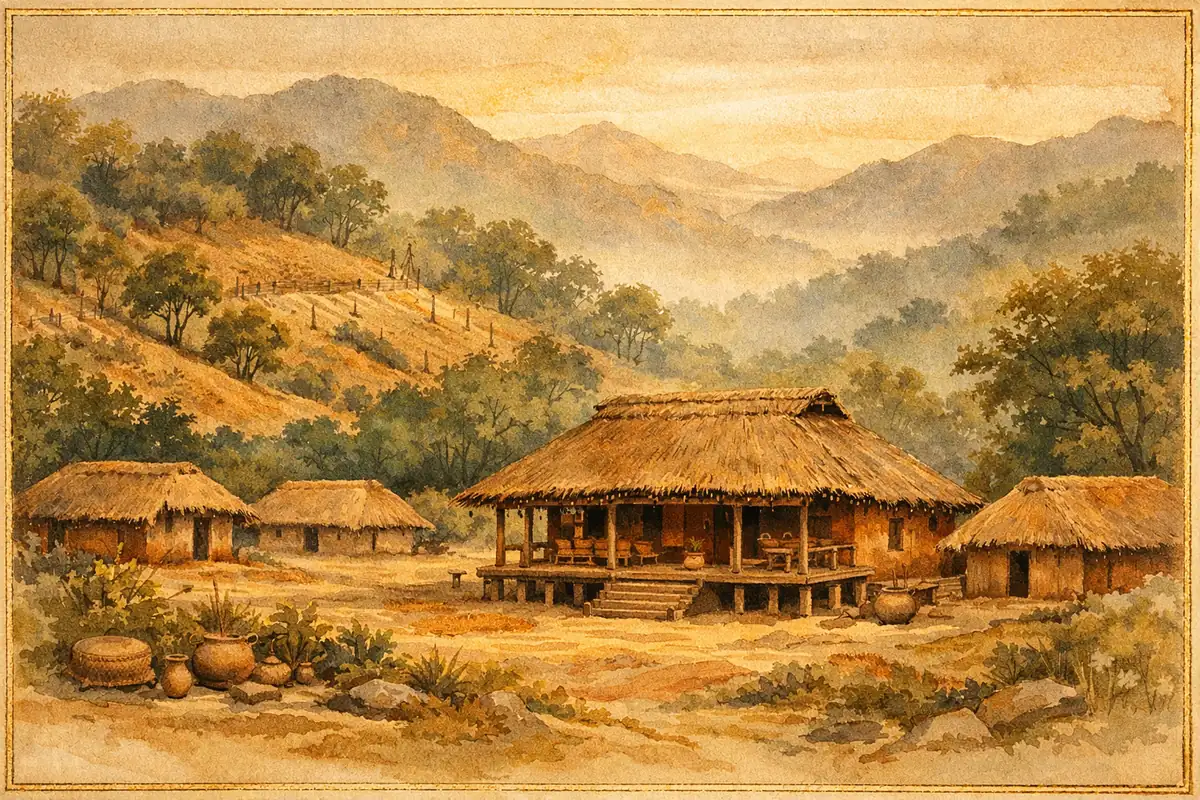
In Risley's time girls married when grown, after free courtship, with a cartload of unhusked rice as the bride-price, and the village priest might sprinkle rice and turmeric on the couple. A widow could remarry, usually her late husband's younger brother. The dead were cremated with the head to the south, and offerings to the ancestors were made in October at the rice harvest. The majang, a large house with three walls and an open front with a raised verandah, is the dormitory of the unmarried young, the elders' court, a guest house, a store for grain and musical instruments, and the place where boys and girls sing and dance on moonlit nights (SCSTRTI).
Festivals
Pus Punei
Pausha (December-January)
The nagam or dehuri sacrifices a pig and sprinkles its blood on the seed grain so that it will sprout well (SCSTRTI).
Amba Nua
Chaitra (March-April)
Dharam Deota, Basumata and Gramsiri are worshipped (SCSTRTI).
Tirtia
Ashadha (June-July)
Dharam Deota, Basumata and Gramsiri are worshipped (SCSTRTI).
Dhan Nua
Bhadra (August-September)
Dharam Deota, Basumata and Gramsiri are worshipped (SCSTRTI).
Related communities
Sources
- SCSTRTI Odisha, Juang (photo handbook, Bhubaneswar, 2008), from the Ministry of Tribal Affairs repository. Foreword; social organisation, kinship, the majang
- SCSTRTI Odisha, tribe profile: Juang. Scheduled Castes and Scheduled Tribes Research and Training Institute, Bhubaneswar; read 7 November 2026
- H. H. Risley, The Tribes and Castes of Bengal: Ethnographic Glossary, vol. I (Calcutta, 1891). s.v. Juang, pp. 350-354; glossary entries for Juang septs (Alemba, Baitiriba, Balimba, Banaiba, Barataba, Hatisalaba, Jarigamba, Kalimba, Kanchaba, Kelobo, Keralaba)
- H. H. Risley, The Tribes and Castes of Bengal: Ethnographic Glossary, vol. II (Calcutta, 1891). Glossary entries for Juang septs (Lihimba, Mundiba, Munduab, Odhalaba, Rangataba, Rasamba, Saramba, Sundriaba, Talahadaba, Tenshaba). Second scan read: https://archive.org/details/tribes-and-castes-of-bengal-volume-2
- Census of India 2011, Table A-11: State Primary Census Abstract for individual Scheduled Tribes (one table for each state). Odisha (catalog 42960)
- Constitution (Scheduled Tribes) Order, 1950, as amended, Parts for Odisha, as compiled in Wikipedia's List of Scheduled Tribes from the Census of India list of notified Scheduled Tribes
- SCSTRTI Odisha, PVTGs of Odisha
Practice differs by village and family. If something here does not match your family's tradition, trust your elders.