
Koya
కోయ
At a glance
- Clan word
- Gotram
- Descent
- Through the father
- Lives in
- Telangana, Andhra Pradesh, Chhattisgarh, Odisha, Maharashtra, Madhya Pradesh, Karnataka
- Languages
- Koya (Dravidian (Gondi group)), Telugu (Dravidian; Telugu script)
- Population
- 7,38,629 Census 2011, Table A-11: Koya entries in undivided Andhra Pradesh, including Telangana (590,739), Odisha (147,137), Maharashtra (388) and Karnataka (365); Koyas within the Gond entries are not counted
- Part of
- Gond
- Region
- South
About
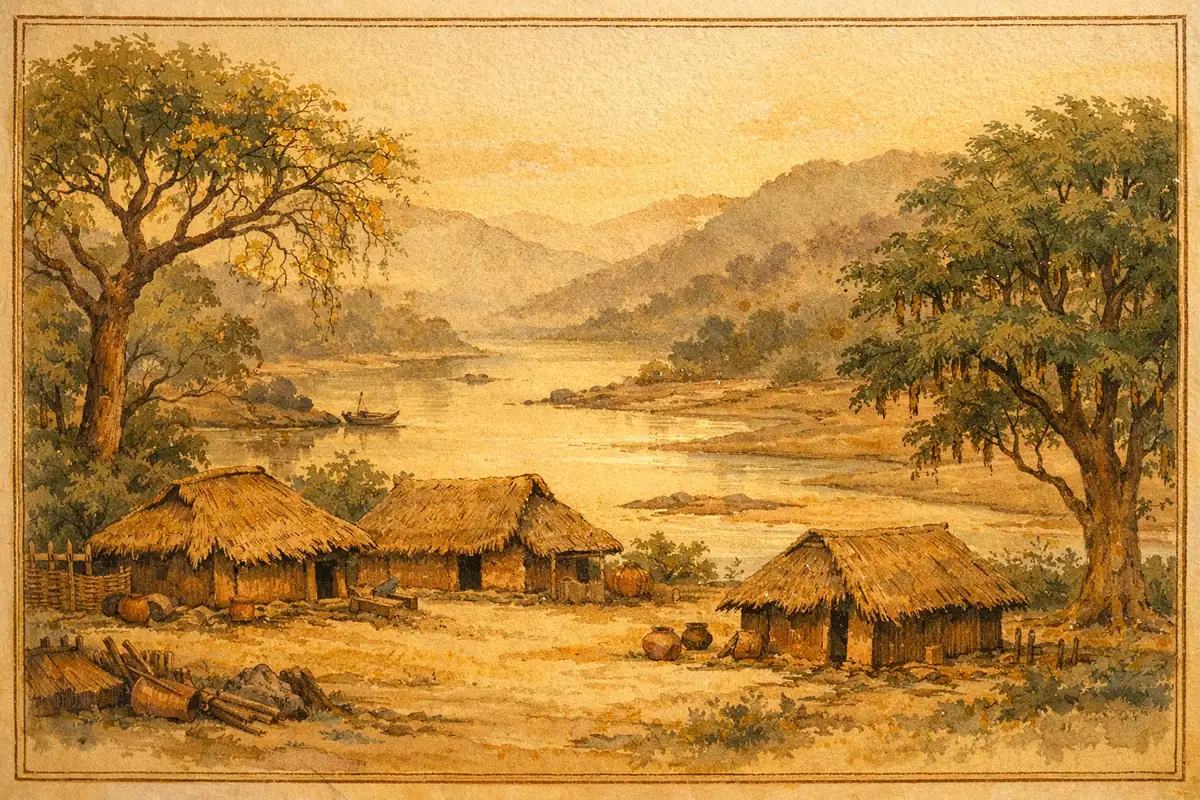
The Koya, who call themselves Koitur, live along the Godavari river and in the forested hills on both its banks, in Telangana, Andhra Pradesh, southern Chhattisgarh and the Malkangiri area of Odisha. Their language is close to Gondi and has borrowed much from Telugu, and Stephen Tyler describes them as a branch of the Gond peoples, closest to the Bison Horn Marias of Bastar. Every Koya belongs to one of five exogamous, patrilineal phratries called gotram. They are a Scheduled Tribe in Telangana, Andhra Pradesh, Odisha, Maharashtra and Karnataka, and are named in the Gond entry in Chhattisgarh and Madhya Pradesh.
Clans and Kinship
All Koyas belong to one of five unranked, exogamous, patrilineal phratries called gotram. Koyas agree that there are five but name them differently from area to area; each has its own deities and a sacred geography in Bastar, and its gods are carried in procession through the Koya country every five years (Tyler). Each phratry is divided into many named exogamous lineages, often named after plants and animals, and a lineage keeps the icon of its god, a metal spear-point, hidden near the 'god shed' at the edge of the village. Cross-cousin marriage is preferred. Twenty-five villages formed a council under a headman and his assistant. The Godavari Gazetteer of 1907 calls the exogamous divisions gattas and notes that members of some marked them on the forehead with a spot or a line (Thurston), and the Patadi are the bards of the Koya clan deities (TCR&TI 1966).
What “Gotram” means
Gotram (from gotra) is the Koya phratry: there are five, each divided into exogamous lineages. The Godavari Gazetteer called them gattas, which the Andhra Pradesh institute takes to be a form of gotra.
5 gotrams
- Perumboyadu
Also called Arogatta (TCR&TI 1966); Peramboya in the Godavari Gazetteer.
- Aidogatta
Aido, 'fifth', or Rayibanda in the Godavari Gazetteer.
- Yedogatta
- Mudogatta
Mudo, 'third', in the Godavari Gazetteer.
- Naligatta
Nalo, 'fourth', or Paredi in the Godavari Gazetteer.
The five gotrams in the order of the Tribal Cultural Research and Training Institute, Hyderabad (The Koyas of Andhra Pradesh, 1966), with the equivalents that Hemingway's Godavari Gazetteer gives (quoted by Thurston, 1909); the Gazetteer also lists an Aro ('sixth') and a Nutomuppayo gatta. Cain's lists of the 1870s give other names (Perumboyudu, Madogutta, Peregatta, Matamuppayo and Vidogutta among the hill Koyas; Paredugatta, Mundegutta, Peramboyina and Wikaloru among the lowland Koyas), and Tyler notes that names differ from area to area. The lineages within the gotrams are not listed.
In the Official Lists
Scheduled Tribe
Telangana, Andhra Pradesh, Odisha, Maharashtra, Karnataka, Chhattisgarh, Madhya Pradesh
Listed as: Koya
Telangana and Andhra Pradesh: 'Koya, Goud, Rajah, Rasha Koya, Lingadhari Koya (ordinary), Kottu Koya, Bhine Koya, Rajkoya'. Karnataka and Maharashtra: 'Koya, Bhine Koya, Rajkoya'. Odisha: 'Koya'. In Chhattisgarh, Madhya Pradesh and Maharashtra, Koya is also one of the names in the long Gond entry.
Census 2011 counted the Koya separately only where Koya is an entry of its own; Koyas within the Gond entries of Chhattisgarh, Madhya Pradesh and Maharashtra are counted as Gond. The census entries also name sub-groups: in undivided Andhra Pradesh 'Doli Koya, Gutta Koya, Kammara Koya, Musara Koya, Oddi Koya, Pattidi Koya' among others, and in Odisha 'Gumba Koya, Koitur Koya, Kamar Koya, Musara Koya'. Checked against the census tables and Wikipedia's compilation of the order.
Checked on 2026-11-07 against the sources below. The lists are amended from time to time and can differ by district; for a certificate, the current order or the state's list is what counts.
Name and Origin
The Rev. J. Cain, writing in the 1870s and 1880s (quoted by Thurston, 1909), recorded that the Koyas of the plains held that famine and quarrels had driven them down from the Bastar plateau about two hundred years before, a kinship the hill Koyas of Bastar (Gutta Kois) acknowledged. They called themselves Koitor, which Telugu speakers rendered as Dorala, 'lords'. A tale recorded by the Tribal Cultural Research and Training Institute of Andhra Pradesh (1966) traces the Koyas to 101 children born under a rela tree (Cassia fistula) on an island, Nattadigadda, surrounded by seven seas.
History
Under the Bhadrachalam zamindars twenty-five Koya villages formed a samutu, each samutu bound in turn to send men to carry loads for the zamindar's troops, and Cain recorded how often Koya villages were plundered by the petty chiefs of the area (Thurston). Tyler writes that the zamindars who held grants from outside rulers controlled only the plains villages; British interest came with the Singareni coal mines and attempts to make the Godavari navigable, and Christian missions began in the 1860s around Dummagudem. The loss of land to settlers from the plains and restrictions on the use of the forests have been lasting Koya grievances (Tyler).
Faith and Worship
Koyas make offerings of animals, grain and liquor to many deities. The most important are female: the earth mother, the smallpox goddess and the goddesses of the lineages and phratries, with male deities such as the Lord of the Jungle and the Lord of Animals as their consorts; ancestors are honoured at an ancestor pot kept near the hearth (Tyler). Village and lineage priests make the sacrifices, and shamans find the cause of illness. A newly married couple visits the shrine of the village goddess, Mutyalamma (TCR&TI 1966). Many Koyas around Dummagudem are Christian.
Deities named in the sources: Mutyalamma
Customs
A marriage is arranged by negotiation or, in the past, by capture; the groom's side bears the cost of the wedding, at which a necklace of black beads is put on the bride and dancers perform with bison-horn head-dresses (TCR&TI 1966). Couples usually live with the husband's family, though bride-service is common and families without sons may take a resident son-in-law; widows may remarry, often a younger brother of the late husband, and divorce is fairly easy. Land and goods are divided equally among the sons, with a share set aside for the marriages of unmarried daughters (Tyler).
Stories and Legends
How the Kaka family got its name
Cain recorded that the Kaka family traced its arrival to seven men of the Are Kapu caste who rode out from near Warangal. The youngest killed a nilgai that was ravaging the land of a Koya king of the Emu family and won his daughter. The next brother shot down an iron-beaked crow with a bamboo bow: its wing fell at Rekapalli, its back at Nadampalli, its legs at Kalsaram and its head at Tirusapuram, villages named for those parts. He was called Kaka, crow, and his descendants the Kaka people (Thurston).
Related communities
Sources
- Stephen A. Tyler, 'Koya', Encyclopedia of World Cultures, vol. 3: South Asia (1992). Read with its sub-pages: Orientation, History, Settlements, Kinship, Marriage and Family, Sociopolitical Organization, Religion
- E. Thurston and K. Rangachari, Castes and Tribes of Southern India, vol. 4 (1909), 'Koyi'. Vol. 4, 'Koyi', from p. 37, quoting J. Cain and the Godavari district Gazetteer (F. R. Hemingway)
- Tribal Cultural Research and Training Institute, Hyderabad, The Koyas of Andhra Pradesh (1966). 'Koyas and their social life': origin tale, social organisation (five gotrams), marriage
- Constitution (Scheduled Tribes) Order, 1950, and the companion orders, as amended: Parts for Telangana, Andhra Pradesh, Odisha, Maharashtra, Karnataka, Chhattisgarh, Madhya Pradesh (as compiled in Wikipedia's List of Scheduled Tribes)
- Census of India 2011, Table A-11: State Primary Census Abstract for individual Scheduled Tribes, Andhra Pradesh, Odisha, Maharashtra, Karnataka. censusindia.gov.in NADA catalog 42967 (Andhra Pradesh), 42960 (Odisha), 42966 (Maharashtra), 42968 (Karnataka)
Practice differs by village and family. If something here does not match your family's tradition, trust your elders.