
Kurumba
At a glance
- Clan word
- Clan
- Descent
- Through the father
- Lives in
- Tamil Nadu, Kerala, Karnataka
- Language
- Kurumba (Dravidian)
- Population
- 9,409 Census 2011, Table A-11: 'Kurumbas' in the Nilgiris district of Tamil Nadu (6,823) and 'Kurumbas, Kurumbar, Kurumban' in Kerala (2,586)
- Region
- South
About
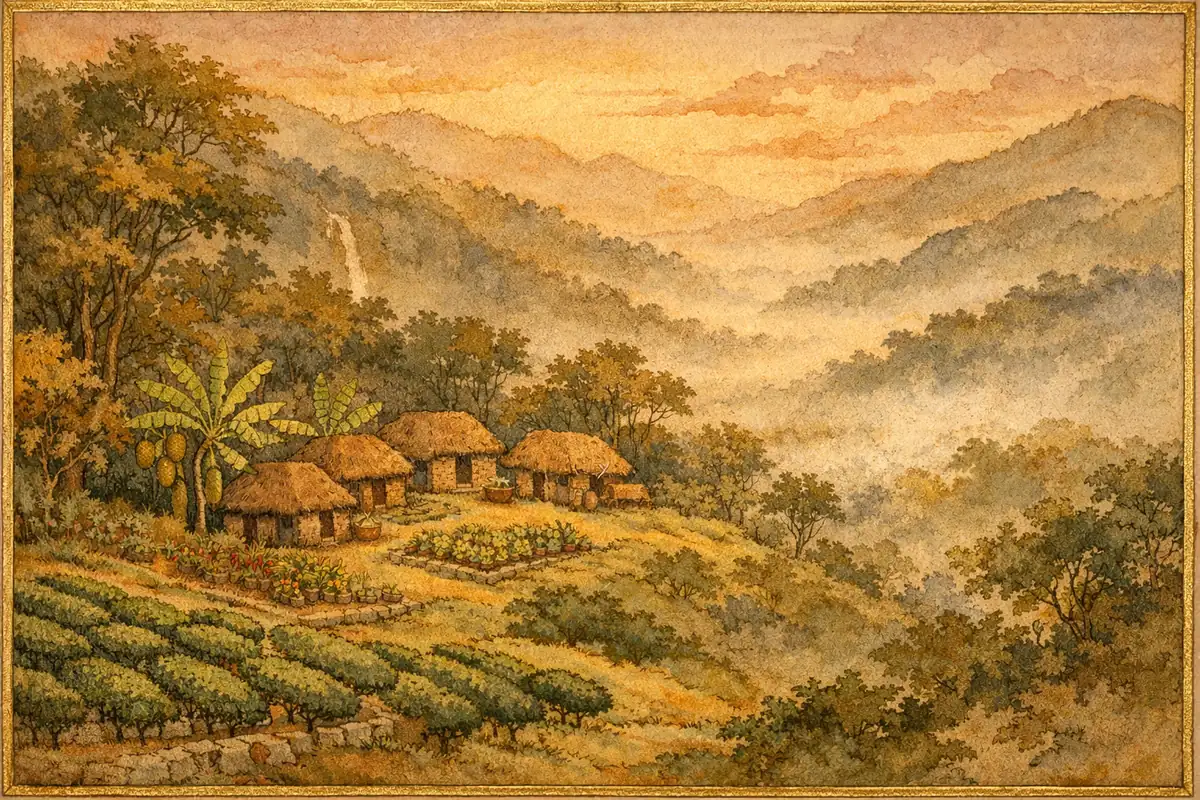
Kurumba is the name of several small forest peoples of the Nilgiri hills and the Wynaad, on the slopes and foothills where Tamil Nadu, Kerala and Karnataka meet. The Encyclopedia of World Cultures counts seven Nilgiri groups, the Alu, Palu, Betta, Jenu, Mullu and Urali Kurumbas and the Mudugas, each distinct in dialect and custom. They lived by shifting cultivation, gathering and trapping, and were known to their neighbours as healers and diviners; most now work on tea and coffee estates. The Kurumbas are a Scheduled Tribe in the Nilgiris district of Tamil Nadu and in Kerala, and a PVTG in both.
Clans and Kinship
Each Kurumba group marries within itself, and the groups are generally organised in exogamous, patrilineal clans; marriage between cross-cousins is common (Kapp and Hockings, in the Encyclopedia of World Cultures). Offices include the village headman (maniagara) and his assistant, which pass in the male line, and the priest (mannugara), who may be a man or a woman. On the Nilgiri hills a Kurumba settlement, called a motta, was a hamlet of four or five wattle-and-daub houses with thatched roofs (Thurston, quoting Grigg). In the Wynaad the Malabar Gazetteer recorded headmen called Muppan among the Mullu Kurumbans and Mudali among the Ten Kurumbans, and none among the Urali Kurumbans (Thurston).
What “Clan” means
The sources used describe exogamous, patrilineal clans among the Kurumba groups but give neither the Kurumba word for a clan nor the clan names.
No list of Kurumba clans was found in the sources used: Thurston names the larger groups (Mullu, Betta, Urali, Ten) but not clans within them, and the Encyclopedia of World Cultures mentions clans without naming them.
In the Official Lists
Scheduled Tribe
Tamil Nadu, Kerala
Listed as: Kurumbas
Tamil Nadu: 'Kurumbas (in the Nilgiri district)'. Kerala: 'Kurumbas'; the Census 2011 entry reads 'Kurumbas, Kurumbar, Kurumban'.
In both Tamil Nadu and Kerala the Kurumbas are one of the Particularly Vulnerable Tribal Groups (PVTGs). Related groups have entries of their own and are not counted here: the Kurumans (Mullu Kuruman and others) in Kerala, Tamil Nadu and Karnataka, the Jenu Kuruba and Kadu Kuruba in Karnataka, and the Kattunayakan in several states. Checked against the Census 2011 tables and Wikipedia's compilation of the order.
Checked on 2026-11-07 against the sources below. The lists are amended from time to time and can differ by district; for a certificate, the current order or the state's list is what counts.
Name and Origin
Thurston (1909) quotes the Madras census report of 1891, which took the Kurumbas for descendants of the Pallava kings scattered by the Cholas, and that of 1901, which treated Kurumban simply as the Tamil form of the Kannada and Telugu Kuruba, the name of the shepherd caste of the plains; whether the forest Kurumbas and the shepherd Kurubas are one people was already disputed in his day. Kapp and Hockings, summarised in the Encyclopedia of World Cultures, leave open whether the Kurumbas descend from early gatherers of the hills or from later farming settlers.
History
The Kurumbas long supplied their Nilgiri neighbours with forest produce, baskets and the tall poles used at Toda funerals, played music at Badaga and Toda festivals, and served Badaga villages as watchmen and as assistant priests at sowing and harvest. Their neighbours also feared them for supposed sorcery, and the Encyclopedia of World Cultures records killings of Kurumbas by neighbouring peoples during the nineteenth century over such fears. As plantations spread and the forest shrank, most Kurumbas moved to lower ground and took work on tea and coffee estates. The Madras census of 1891 named the Mullu, Betta, Urali, Ten and Tachchanadan Muppan as the chief divisions of the Kurumbas of the Nilgiris and Wynaad (Thurston).
Faith and Worship
Kurumba religion centres on the ancestors, with rules of purity and pollution like those of their Hindu neighbours (Encyclopedia of World Cultures). Thurston, quoting Breeks, records the worship of a rough stone called Hiriadeva, set up in a cave or in a circle of stones, with offerings of cooked rice at sowing time, and among some groups the worship of Siva; the Malabar Gazetteer names Masti as the deity of the Ten Kurumbans. Kurumbas near Rangaswami peak and Barliar placed a bone and a small round stone of the dead in an old dolmen (Breeks, quoted by Thurston). Many younger Kurumbas now follow Hinduism or Christianity as well.
Deities named in the sources: Hiriadeva
Customs
Kurumba diviners (kanigara), exorcists (devvagara) and curers (maddugara) were consulted by all the Nilgiri peoples (Encyclopedia of World Cultures). Kurumba musicians played pipes, drums and tambourines at the weddings and funerals of other Nilgiri peoples, and Kurumbas made rattan baskets, bamboo milk vessels and nets, collected honey, resin and gall-nuts, and trapped game in nets (Thurston).
Festivals
Bishu
Vishu, the new year in April
Fletcher (quoted by Thurston) records Kurumbas gathering in numbers at their chief temple near Pandalur for the Bishu feast.
Stories and Legends
The three brothers
A legend of the Nilgiri peoples holds that the Toda, the Kurumba and the Kota were made at the same time by one creator. Three brothers either wronged their parents or quarrelled among themselves, so their father gave each a different calling and ordained that the three should always exchange goods and services; their descendants became the three peoples, bound together from the beginning (Encyclopedia of World Cultures).
Related communities
Sources
- Sara J. Dick, 'Kurumbas', Encyclopedia of World Cultures, vol. 3: South Asia (1992). Read with its sub-pages
- E. Thurston and K. Rangachari, Castes and Tribes of Southern India, vol. 4 (1909), 'Kurumba or Kuruman'. Vol. 4, 'Kurumba or Kuruman', pp. 155-178
- Constitution (Scheduled Tribes) Order, 1950, and the companion orders, as amended: Parts for Tamil Nadu, Kerala (as compiled in Wikipedia's List of Scheduled Tribes)
- Census of India 2011, Table A-11: State Primary Census Abstract for individual Scheduled Tribes, Tamil Nadu, Kerala. censusindia.gov.in NADA catalog 42972 (Tamil Nadu), 42971 (Kerala)
- Ministry of Tribal Affairs list of 75 Particularly Vulnerable Tribal Groups (PIB release 1577166), as compiled in Wikipedia's 'Particularly vulnerable tribal group' (read 2026-11-07)
Practice differs by village and family. If something here does not match your family's tradition, trust your elders.