
Toda
At a glance
- Clan word
- Madol
- Descent
- Differs within the community
- Lives in
- Tamil Nadu, Karnataka
- Language
- Toda (Dravidian)
- Population
- 2,149 Census 2011, Table A-11: Toda in Tamil Nadu (2,002) and Karnataka (147)
- Region
- South
About
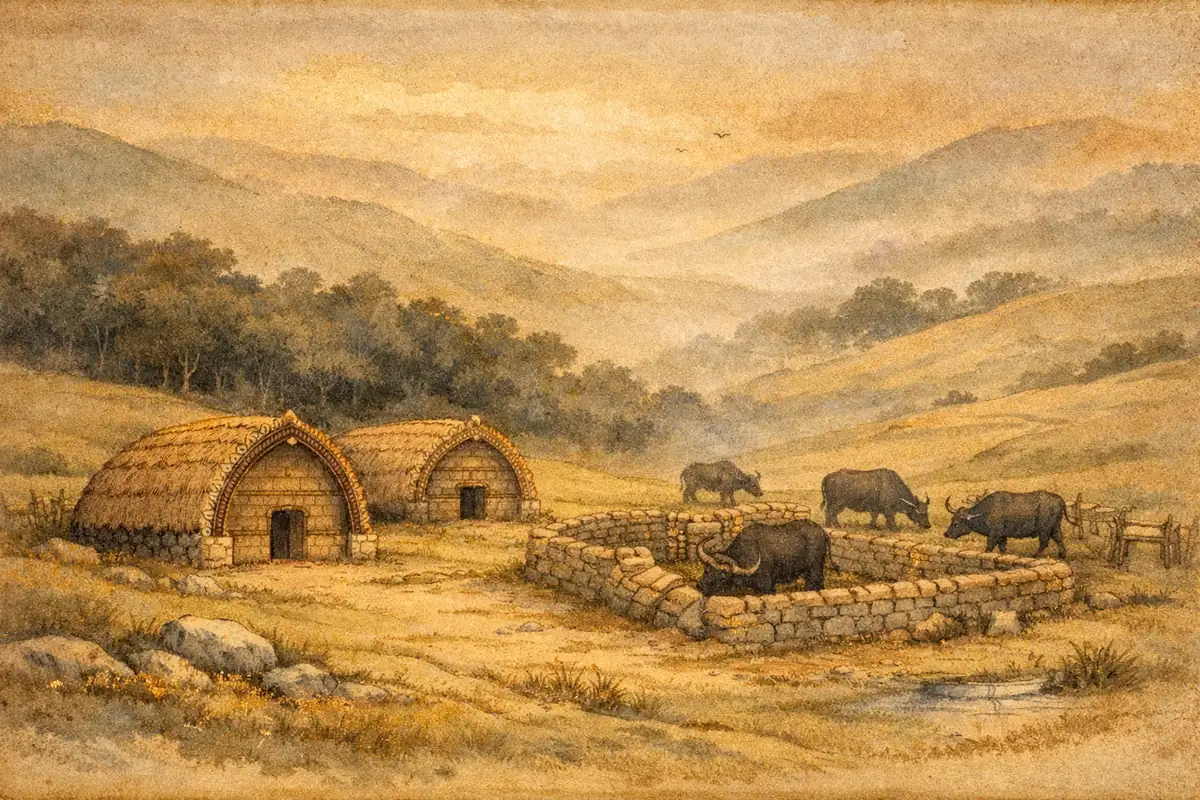
The Toda are a small pastoral people of the Nilgiri hills in Tamil Nadu, who call themselves Ol. Their life has long centred on herds of water buffalo and on sacred dairies, which they regard as their temples. They speak Toda, a Dravidian language with no script of its own, and most also speak Tamil and Badaga. The people are split into two divisions that do not intermarry, the Tartharol and the Teivaliol, each made up of clans. They are a Scheduled Tribe in Tamil Nadu and Karnataka, and in Tamil Nadu one of the Particularly Vulnerable Tribal Groups (PVTGs).
Clans and Kinship
The Toda are divided into two endogamous divisions, the Tartharol and the Teivaliol: a Tarthar man marries a Tarthar woman and a Teivali man a Teivali woman (Rivers 1906). Each division is made up of exogamous clans. A clan owns a group of villages (mad) and takes its name from the chief of them, the etudmad, and its people are called madol, 'village people'. The divisions have different parts in the dairy ritual: the Tartharol hold the most sacred dairies, while the dairymen of the highest grade, the palol, must come from the Teivaliol. Each clan is divided into two kudr, which matter in ritual, and into polm, which share the clan's expenses. Property passes from a father to his sons, and the father is the man who performed the pursutpimi ceremony, whoever the begetter. Walker describes the clans as patriclans and adds that both divisions are also divided into exogamous matriclans, so that each Toda belongs to one of each. Marriage was traditionally fraternal polyandry, now given up, and the proper spouse is a cross-cousin (matchuni). Councils of all the adult men, of the clan, the division and the whole community, settle disputes; there are no formal headmen above the household (Walker).
What “Madol” means
Madol, 'village people', is Rivers's word for the members of a Toda clan, which owns a group of villages (mad) and is named after the chief one. Walker calls these clans patriclans and also records matriclans.
19 madols
- Nodrs
Tartharol
- Kars
Tartharol
- Pan
Tartharol
- Taradr
Tartharol
- Keradr
Tartharol
- Kanodrs
Tartharol
- Kwodrdoni
Tartharol
- Pam
Tartharol
- Nidrsi
Tartharol
- Melgars
Tartharol
- Kidmad
Tartharol
Split off from the Melgars clan in fairly recent times (Rivers).
- Karsh
Tartharol
The people of the village of Karsh, whom Rivers also calls the Karshol; split off from the Melgars clan in fairly recent times.
- Kuudr
Teivaliol
Its people are called Kuudrol or Kuurtol.
- Piedr
Teivaliol
- Kusharf
Teivaliol
- Keadr
Teivaliol
- Pedrkars
Teivaliol
An old offshoot of Kuudr (Rivers).
- Kulhem
Teivaliol
An old offshoot of Kuudr (Rivers).
- Kemen
Teivaliol
Extinct; its last member was said to have died about a century before Rivers wrote.
The clans in Rivers's order (The Todas, 1906, chapter 2), named after their chief villages (Karsh is given as Karshol, its people, so that it is not taken for Kars): twelve of the Tartharol and six of the Teivaliol, with a seventh Teivali clan, Kemen, extinct. Rivers left out the signs for long vowels, and later writers spell several names differently.
In the Official Lists
Scheduled Tribe
Tamil Nadu, Karnataka
Listed as: Toda
Tamil Nadu: 'Toda (excluding Kanniyakumari district and Shencottah taluk of Tirunelveli district)'.
In Tamil Nadu the Toda are one of the Particularly Vulnerable Tribal Groups (PVTGs). The listings were checked against the Census 2011 tables and Wikipedia's compilation of the order, which may not show amendments of 2022 to 2024.
Checked on 2026-11-07 against the sources below. The lists are amended from time to time and can differ by district; for a certificate, the current order or the state's list is what counts.
Name and Origin
Toda is the Badaga form of the name; the people call themselves Ol, 'the men' (Walker). In their own tradition, as an elder of Kanodrs told it to W. H. R. Rivers, the god On brought the first buffaloes out of the earth on the top of the Kundah range, and the first Toda came out of the earth holding the tail of the last buffalo; the goddess Teikirzi later ordained most Toda institutions. Rivers (1906) thought it probable that the Todas came up to the hills from Malabar. Anthony Walker writes that the language branched off before Tamil and Malayalam separated, so the ancestors could have come from east or west, west being the better guess; Todas themselves say they were created on the Nilgiris.
History
The first written evidence of Todas in the Nilgiris is a Kannada inscription of 1117 recording that a Hoysala general 'conquered the Toda' (Walker). The hills became British territory in 1799 and were administered from 1819. The settlement of Ootacamund, the plantations and the markets that followed broke the old exchange in which Todas gave dairy produce to Badaga farmers, Kota artisans and the forest Kurumbas for grain, pots and forest produce. From 1843 the government allotted land (patta) to Toda hamlets and sacred sites, held in common by the clans, and from 1871 the land could not be sold. The census of 1871 counted 693 Todas and that of 1901 counted 805; Walker counted 1,042 traditionalists in 1988, besides a small Toda Christian community that began with a first convert in 1904.
Faith and Worship
Toda religion centres on the sacred buffaloes and the dairies where their milk is churned, which the Todas themselves regard as temples. Each grade of dairy has its own grade of buffalo and of dairyman-priest, and the rules of purity grow stricter up the scale (Rivers). The gods are believed to live on the hilltops of the plateau. Rivers recorded that On, who created the buffaloes and the Todas, went to rule Amnodr, the world of the dead, leaving the goddess Teikirzi to rule the Todas; in Walker's account the goddess, Tokisy, rules the living and her brother On the dead. Many Todas today also worship Hindu deities and visit Hindu temples, and a small community is Christian.
Deities named in the sources: Teikirzi, On
Customs
In the seventh month of a first pregnancy the husband, or one of the husbands, gives his wife a small bow and arrow made of a twig and grass at the pursutpimi ceremony, and the man who gives it is the father of the child for all social purposes (Rivers). Marriages were arranged in infancy and completed when the couple grew up, and marriage between cross-cousins is the orthodox form. Funerals are the most elaborate Toda rites, with buffaloes offered to go with the dead; the second funeral, at which a relic was burned, is now joined to the first (Walker). Toda women embroider geometric designs on the large cloaks, putkuli, that Todas wear.
Stories and Legends
On and the first buffaloes
In the account an elder of Kanodrs gave Rivers, On went with his wife Pinarkurs to the top of the Kundahs and set up an iron bar across the hilltop. Standing at one end he brought 1,600 buffaloes out of the earth, and she brought 1,800 at the other. Behind On's buffaloes came a man holding the tail of the last one, the first Toda, and from his rib On made the first Toda woman. The buffaloes of On became the sacred herds, and those of Pinarkurs the ordinary ones.
Related communities
Sources
- W. H. R. Rivers, The Todas (1906). Ch. 1-2 (the Nilgiri peoples; sketch of social organisation, the clans); ch. 3 (dairies and buffaloes); ch. 9 (the gods, On and Teikirzi); the pursutpimi ceremony; marriage of matchuni; polyandry; inheritance; ch. 20 (genealogies and population)
- Anthony R. Walker, 'Toda', Encyclopedia of World Cultures, vol. 3: South Asia (1992). Read with its sub-pages: Orientation, History, Settlements, Economy, Kinship, Marriage and Family, Sociopolitical Organization, Religion
- Constitution (Scheduled Tribes) Order, 1950, and the companion orders, as amended: Parts for Tamil Nadu, Karnataka (as compiled in Wikipedia's List of Scheduled Tribes)
- Census of India 2011, Table A-11: State Primary Census Abstract for individual Scheduled Tribes, Tamil Nadu, Karnataka. censusindia.gov.in NADA catalog 42972 (Tamil Nadu), 42968 (Karnataka)
- Ministry of Tribal Affairs list of 75 Particularly Vulnerable Tribal Groups (PIB release 1577166), as compiled in Wikipedia's 'Particularly vulnerable tribal group' (read 2026-11-07)
Practice differs by village and family. If something here does not match your family's tradition, trust your elders.