
Mising
At a glance
- Clan word
- Clan
- Descent
- Through the father
- Lives in
- Assam, Arunachal Pradesh
- Language
- Mising (Tibeto-Burman (Tani))
- Population
- 6,80,424 Census 2011, Table A-11, Assam: the entry 'Miri' in the list for the plains. The Assam institute's 2017 monograph gives 687,301 for the Mising of Assam in 2011.
- Part of
- Tani
- Region
- North-East
About
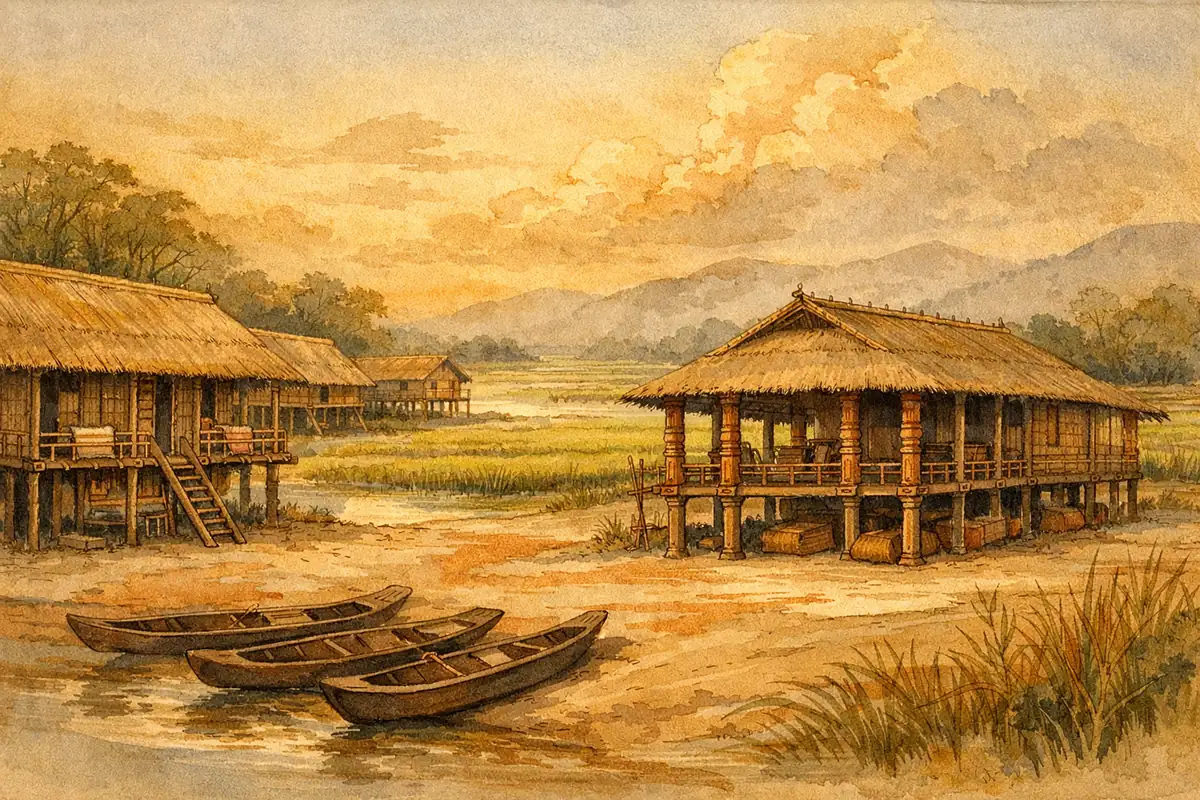
The Mising are a Tani people of the river country of Upper Assam, living along the Brahmaputra, the Subansiri and their tributaries in Dhemaji, Lakhimpur, Sonitpur, Tinsukia, Dibrugarh, Sivasagar, Jorhat and Golaghat districts, with a few around Pasighat in Arunachal Pradesh. Their forebears came down from the hills now in Arunachal Pradesh, and they count the Adi as kin. They build long houses raised on posts against the floods, and Mising women are known as weavers. They are the second largest Scheduled Tribe of Assam's plains, listed under the older name Miri.
Clans and Kinship
The Mising are patrilineal and patrilocal: a bride goes to her husband's family, children take the father's clan name as their surname, and property passes from father to sons. Daughters may share it if they meet their father's funeral costs, and a son-in-law who stays in his wife's father's house until the old man's death may inherit (Sharma Thakur 1987). Above the clans stand two divisions, Barogam and Dahgam. A legend recorded by Sharma Thakur explains them: when the Mising first settled at the foot of the hills there were two villages, one of ten kuri (scores) of houses and one of twelve, and a gam (headman) was appointed for each score of houses; the clans under the ten gams became the Dahgam and those under the twelve the Barogam. The two differ slightly in dialect and custom. Clans are exogamous, and Sharma Thakur (1972) adds that allied clans such as the Pegu and Patir do not intermarry either; he found no totemic clans. Each village has its council, the kebang (do:lung kebang), of the elder men, headed by a gam chosen by its members; the 2017 monograph notes that women do not take part in the kebang. The young men and women of the village form the mimbir yame, led by a deka bora and a tiri bora, which works for any household that asks and runs the village festivals from the murang, the communal hall.
What “Clan” means
The sources opened give no Mising word for the clan; they speak of clans whose names families use as surnames, grouped into two divisions, Barogam and Dahgam.
26 clans
- Doley
Barogam
- Kutum
Barogam
- Kuli
Barogam
Also written Kouli.
- Pait
Barogam
- Patir
Barogam
- Basar
Barogam
- Pasar
Barogam
- Kardong
Barogam
- Pegu
Barogam
Does not intermarry with the Patir (Sharma Thakur 1972).
- Kumbang
Barogam
- Moying
Dahgam
- Chayang
Dahgam
- Murung
Dahgam
- Bori
Dahgam
- Pangging
Dahgam
- Yein
Dahgam
- Panchang
Dahgam
- Paow
Dahgam
- Bosing
Dahgam
- Ayan
Dahgam
- Padum
Dahgam
Padun in Sharma Thakur (1987).
- Saro
Dahgam
- Regon
Dahgam
- Darik
Dahgam
- Taye
Dahgam
- Noroh
Dahgam
Combined from Sharma Thakur (1972; 1987) and the Assam institute's 2017 monograph, all of which give examples only and end their lists with 'etc.'. The scans of the older books are poor, and names that could not be read with confidence are left out. Spellings differ between books and families.
In the Official Lists
Scheduled Tribe
Assam
Listed under the older name Miri, in the part of Assam's list for the plains. The Assam institute's 2017 monograph says the name Miri is now considered offensive.
Arunachal Pradesh's list in the compilation checked has no Miri or Mising entry, but the Census 2011 table for Arunachal Pradesh counts 7,412 people returned as 'Mishing / Miri' among the state's Scheduled Tribes; how the Order covers them there was not checked. The 'Hill Miri' of that table are a different people. Checked against a compilation of the Order and the Census 2011 tables; amendments of 2022 to 2024 were not checked.
Checked on 2026-11-07 against the sources below. The lists are amended from time to time and can differ by district; for a certificate, the current order or the state's list is what counts.
Name and Origin
The Assam institute's writers (Sharma Thakur 1987; the 2017 monograph) derive Mising from mi, man, and shing, water or river: the people who live by the river. Wikipedia, citing Bhandari (1984), glosses it 'man of the soil'. Miri was the name the Assamese gave them; the Mising say it is a corruption of mirui, a word for priestly functions among the Adi, and the 2017 monograph calls it offensive today. All accounts place their earlier home in the hills north of Lakhimpur, among the Adi, Minyong and Padam, with whom they share language and culture; Sharma Thakur records that the Adi call the Mising their brothers of the plains. B. C. Allen's gazetteer (1906) recorded the Mising tradition that they came down to the plains with the Chutiya kings and withdrew again when the Ahoms defeated them, settling in the plains for good under British rule. Sonaram Payeng wrote that raids from the hill Abor drove them down, and that every family of the Doley and Pegu clans left the hills. A genealogy recorded by Sharma Thakur traces the first beings from the earth through Dyuli, Lyut, Tyea and Yepe to Pedo, from whom came the spirits, the birds and beasts, and humankind.
History
The date of the move to the plains is not recorded; Sharma Thakur (1987) places it before the Ahom kings and Allen at the fall of the Chutiya kingdom. The Assam census report of 1881 already described the Mising as two mutually exclusive sections, Barogam and Dahgam, and noted that the Ahoms had called them Chutia because they were found in the Chutiya lands (Sharma Thakur 1972). Settled along the rivers, they grow ahu rice in low, flood-prone fields and fish, and every year face floods and erosion. Many families joined the Vaishnava faith of the satras. The 1971 census counted 259,551 Mising. In the freedom movement Kamala Miri of Golaghat organised a volunteer force of Mising youth in 1942 and died in Jorhat jail in 1943 (Assam institute, 2022).
Faith and Worship
The traditional religion centres on spirits, uie, which must be kept content: the urom uie, spirits of the ancestors, honoured with large pigs and rice beer (apong); taleng uie, of thunder and storm; dabur uie, held to send floods and other calamities, worshipped by the whole village at its edge every few years with the village closed to coming and going; and the gumin uie, the benevolent spirit of a family, held to be a form of the departed soul. The mibu, a priest-diviner who keeps rules of diet and conduct from childhood, finds the cause of illness and leads the rites. Many Mising, especially older people, follow the Bhakatia Pantha, a form of Vaishnava devotion led by bhakats who owe allegiance to the satras; others are Vaishnava in the stricter sense, some are Christian, and many have taken to Donyi-Polo, the faith in the Sun and Moon shared with the other Tani peoples (Sharma Thakur 1987; Assam institute 2017).
Customs
A formal marriage, midang, is arranged by the families, the boy's side bringing apong and betel to propose; it lasts two days, beginning at the bride's house. Marriage by elopement, dugla la:nam, is common and socially accepted, with the bride price (alig) fixed afterwards by the elders of both villages; a mithun was once the standard price. Marriage is barred within the clan, while marriage with the father's sister's or mother's brother's daughter is allowed (Sharma Thakur 1972). The dead are buried in the village burial ground, and the rites end with the tilani on the third day, the mahekia after a month, and the daha, a feast for the whole village, after about a year. Every woman weaves for her family: the sumpa skirt, the galuk breast-cloth and the hura headcloth, and the fluffy gadu blanket.
Festivals
Ali-Ai-Ligang
The first Wednesday of Ginmur Polo (Phagun, February to March)
The festival of sowing: ali means seed, ai fruit and ligang sowing. Young people dance the gumrag from house to house, and a community feast follows (Sharma Thakur 1987).
Po:rag
After the harvest
The great festival held in the murang and organised by the village youth (mimbir yame), with large stores of rice beer prepared in advance; the priest's dance, mibu dagnam, belongs to it.
Stories and Legends
How the Moying came down to the plains
Sharma Thakur (1987) records a tale of the move from the hills. Moying, a famous wrestler of the Minyong, won the hand of Turi of Damra village, whose father had promised her to a wrestler. A feud followed between the two villages, and the outnumbered Moying people decided to leave in a body. The Damra men pursued them, but Dine Mirem, a respected headman of the hills, lay down across the path, and out of regard for him the pursuers turned back. The Moying people came down and founded a village in the plains, where they have lived ever since.
Notable Personalities
Kamala Miri
1894 to 1943
Freedom fighter from Golaghat district, the first Mising to take an active part in the national movement; he led a volunteer force of Mising youth in 1942 and died in Jorhat jail in April 1943 (Assam Institute of Research for Tribals and Scheduled Castes, 2022).
Related communities
Sources
- The Constitution (Scheduled Tribes) Order, 1950, as amended, Parts for Assam and Arunachal Pradesh, as compiled in Wikipedia's List of Scheduled Tribes. Sections Assam (general areas), Arunachal Pradesh
- Census of India 2011, Table A-11, State Primary Census Abstract for individual Scheduled Tribes: Assam. State total for 'Miri' (rest of the state). Companion table for Arunachal Pradesh (catalog/42951): 'Mishing / Miri' and 'Hill Miri'.
- G. C. Sharma Thakur, 'The Miris (Mishings)', in B. N. Bordoloi, G. C. Sharma Thakur and M. C. Saikia, Tribes of Assam, Part I (Tribal Research Institute, Assam, 1987). Introduction, legends of origin, name, house and murang, clans (Barogam and Dahgam), inheritance, kebang, yame mimbir, marriage, religion, death rites, festivals
- G. C. Sharma Thakur, The Plains Tribes of Lakhimpur, Dibrugarh, Sibsagar and Nowgong (Tribal Research Institute, 1972). The Mishings: clan (the 1881 census on Barogam and Dahgam; clan names), marriage and cross-cousin marriage
- The Mising Tribe of Assam: A Monograph (Assam Institute of Research for Tribals and Scheduled Castes, 2017). Chapter 2, A brief profile of the Misings: population, name, religion, murang and kebang, clans, marriage
- Report on Documentation of Life and Works of Prominent Tribal Personalities (Assam Institute of Research for Tribals and Scheduled Castes, 2022). Kamala Miri (pp. 63-66)
- Wikipedia, Mising people (pointer: etymology after Bhandari 1984, Tani languages, festivals, gadu)
Practice differs by village and family. If something here does not match your family's tradition, trust your elders.