
Deori
At a glance
- Clan word
- Jaku
- Descent
- Through the father
- Lives in
- Assam, Arunachal Pradesh
- Language
- Deori (Tibeto-Burman (Bodo-Garo))
- Population
- 49,115 Census 2011, Table A-11: Assam 43,750 (list for the plains); Arunachal Pradesh 5,365.
- Part of
- Bodo-Kachari
- Region
- North-East
About
The Deori are a people of Upper Assam whose name and traditions tie them to the priesthood of the old shrines of the Sadiya country. They live in riverside villages in Lakhimpur, Dibrugarh, Sivasagar, Jorhat and Sonitpur districts, with some in Arunachal Pradesh. They are divided into the Dibongia, Tengapania and Borgoya, named after the rivers they once lived on, and a fourth division, the Patorgoya, which can no longer be traced; only the Dibongia still speak Deori, the others Assamese. Descent is through the father, and every family belongs to an exogamous clan, the jaku. They are a Scheduled Tribe in Assam.
Clans and Kinship
The Deori are patrilineal: children take the father's clan, a married woman joins her husband's, and land and goods pass in equal shares to the sons, never to wife or daughters (Sharma Thakur 1987). Families are often joint, several married brothers living under one head in a long house; the Dibongia call the joint family jakarua jupa. Above the family stand the four divisions, called khel or goyan: Dibongia, Tengapania, Borgoya and Patorgoya, each named after a river or place where it lived. Each division is made up of exogamous clans, called bangsha or jaku, fourteen among the Dibongia. Clans carry duties at the village shrine, the than or, among the Dibongia, the midiku: the Bor Deori, the chief priest, comes from the Sundaria clan among the Dibongia, the Machiaitika among the Tengapania and the Ikucharu among the Borgoya. Nine office-holders serve the shrine, led by the Bor Deori, the Saru Deori, the Bor Bharali and the Saru Bharali; the deodhai, who goes into trance to the beat of drums, is believed to speak for the deity. Secular affairs are in the hands of the gaonbura and the village elders.
What “Jaku” means
Jaku, also called bangsha, is the exogamous Deori clan in the Assam institute's accounts (Sharma Thakur 1987; 2017 study). The four larger divisions are called khel or goyan; Wikipedia gives boja or bahor for the sub-clan.
26 jakus
- Sundaria
Dibongia
Gives the Bor Deori, the chief priest.
- Patriya
Dibongia
Gives the Saru Deori, who assists the Bor Deori and stands in for him.
- Airio
Dibongia
Supplies the Bor Bharali and Saru Bharali, and chooses brides for all the clans (2017 study).
- Saria
Dibongia
Gives the Bora, who collects dues, fowls and firewood for the rites. Also written Chariyo.
- Chitikayo
Dibongia
Supplies the cooks for the shrine (Bhog Randhani). Also written Chitigayo.
- Komtiyo
Dibongia
May hold the office of Bharali when no Airio man is available. Also written Kumatia.
- Lagachyo
Dibongia
Supplies the special baskets for the morong rite. Also written Lagasuya.
- Kaliachaku
Dibongia
Also written Kaliya Chuhoya.
- Telia
Dibongia
Supplies mustard oil for the rites.
- Dupia
Dibongia
Supplies incense for the rites.
- Murang
Dibongia
A later addition to the Dibongia, with no fixed duty at the shrine.
- Sukrang
Dibongia
A later addition to the Dibongia, with no fixed duty at the shrine.
- Mehedaya
Dibongia
A later addition to the Dibongia, with no fixed duty at the shrine.
- Machiaitika
Tengapania
Gives the Bor Deori.
- Bikramiyatika
Tengapania
Gives the Saru Deori.
- Khutiayotika
Tengapania
Gives the Bharali.
- Sakacharutika
Tengapania
- Pagimegeretika
Tengapania
- Phepariyotika
Tengapania
- Chemabariyatika
Tengapania
- Ikucharu
Borgoya
Gives the Bor Deori.
- Chimucharu
Borgoya
Gives the Saru Deori.
- Hizaru
Borgoya
Gives the Bharali.
- Busaru
Borgoya
Gives the Balikatia.
- Lafaru
Borgoya
Gives the Bora.
- Gasaru
Borgoya
Named in old records but no longer traceable.
The clans and their duties as the Assam institute's 2017 study gives them, checked against Sharma Thakur (1987); both end the Tengapania list with 'etc.', and the Dibongia list gives thirteen of the fourteen jaku. The clans of the Patorgoya are not known and may have merged into the Borgoya and Dibongia. Wikipedia lists further sub-clan names. Spellings differ between the two accounts.
In the Official Lists
Scheduled Tribe
Assam
In the part of Assam's list for the plains, outside the autonomous districts.
Arunachal Pradesh's list in the compilation checked has no separate Deori entry, but the Census 2011 table for Arunachal Pradesh counts 5,365 people returned as Deori among the state's Scheduled Tribes; how the Order covers them there was not checked. Checked against a compilation of the Order and the Census 2011 tables; amendments of 2022 to 2024 were not checked.
Checked on 2026-11-07 against the sources below. The lists are amended from time to time and can differ by district; for a certificate, the current order or the state's list is what counts.
Name and Origin
The Assam institute's 2017 study explains Deori as the people who know the gods and how to worship them, from de, god, u, offering, and ri, manner. Wikipedia gives their own name as Jimochaya, 'children of the sun'. Their first home was on the Dibang, the Tengapani and at Patorsal, in today's Lohit district of Arunachal Pradesh and the Chapakhowa area of Tinsukia district; feuds with the hill peoples pushed them westward, and the 1901 census placed their old home on the Kundil river east of Sadiya. Older writers (Dalton 1872, Brown 1895, Endle 1911) treated the Deori as the priestly section of the Chutiya, who once ruled from Sadiya, and the 'Deori-Chutiya' speech as the old Chutiya language; the 2017 study notes that Deoris today do not accept being called a division of the Chutiya or only their priests, while granting a historical link. A folk account in Wikipedia tells that four men carried the stone of the goddess Tamreswari to her temple when no one else could, and were made its priests; they are remembered as the ancestors of the four divisions.
History
The Ahoms entered Assam in the thirteenth century and in time overcame the Chutiya kingdom of Sadiya (Endle 1911; the 2017 study). The Deori remained priests at the shrines of the region: Wikipedia names the Tamreswari temple near Sadiya and Malinithan as served by the Borgoya, the Bura-Buri Than by the Dibongia and the Boliya-hemata temple by the Tengapania. Pushed westward, they settled along the rivers of Upper Assam, where they live by rice cultivation, fishing and weaving in flood-prone country. The census counted 23,080 Deori in 1981 (Sharma Thakur 1987) and 41,161 in 2001 (Assam institute 2017). In the 1930s and 1940s Bhimbor Deori was among the leaders of the plains tribes of Assam.
Faith and Worship
Each village has its shrine, the than or deosal, which the Dibongia call midiku, 'abode of the deity'; the Dibongia midiku has six houses, the chief of them the house of Kundi Mama, with a kitchen for the deity's food and a common kitchen for the feast. The supreme deity is Kundi Mama, also called Gira-Girachi, the old couple; the Assam institute's writers equate Kundi with Shiva and Mama with Parvati, while Wikipedia, in an unreferenced section, describes the faith as the Deori's own. Their children Pisa Dema, also called Balia Baba, and Pisasi Dema or Kechaikhaiti, the goddess Tamreswari, are also worshipped, the Borgoya honouring Tamreswari and the Tengapania Balia Baba. Wednesday is the favoured day for worship. Household deities are honoured with sacrifices, and rice beer (suze) is essential in the rites. Some Vaishnava influence and Hindu festivals have come in, but the old worship continues (Sharma Thakur 1987; 2017 study).
Deities named in the sources: Kundi Mama, Tamreswari
Customs
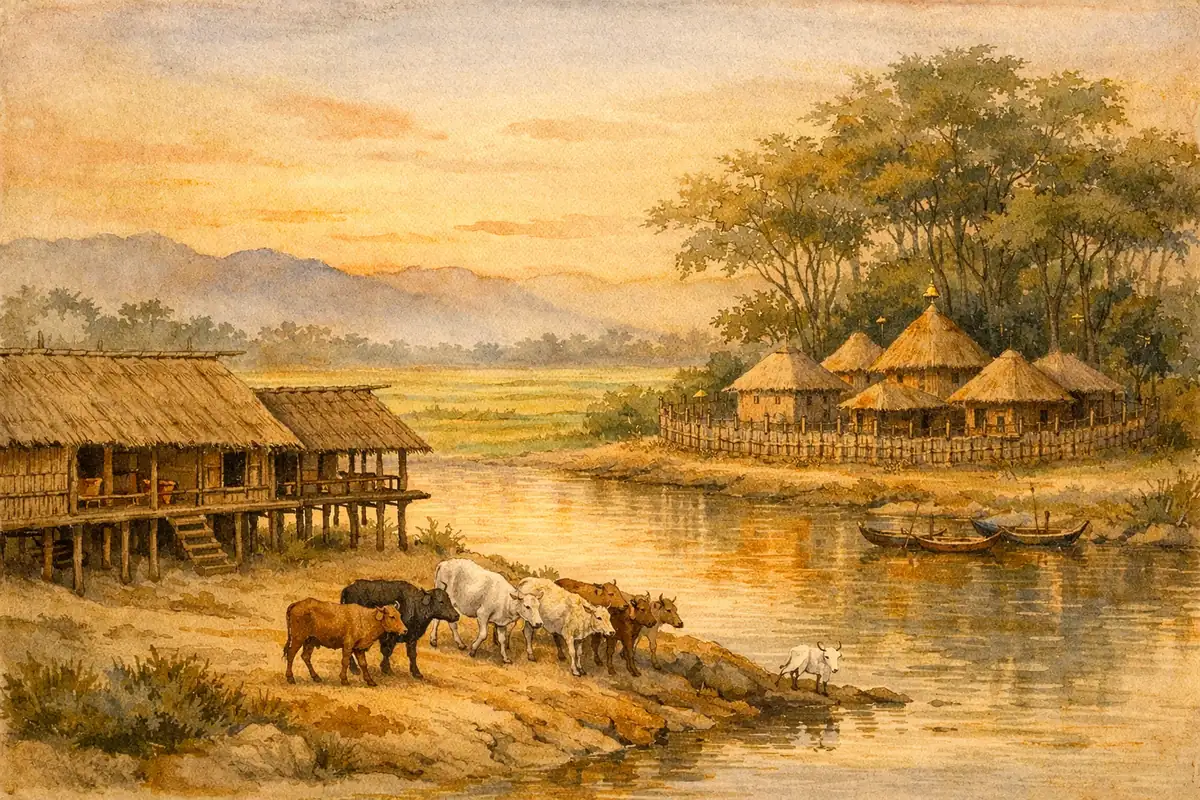
Clan exogamy is strict. Sharma Thakur (1987) names four forms of marriage: the bor biya, a three-day wedding arranged by the parents; the maju biya, a smaller two-day one; the bakat rupia, a one-day ceremony; and, commonest, marriage by elopement, after which the couple must once in their lives hold the suje lagua feast for the heads of three major clans. A go-between, the pathoria, versed in lore, settles the bride price; the bride's family in turn gives a dowry of bell-metal and other goods worth much more. Levirate and sororate are both practised. The dead are cremated on a pyre of seven layers of wood, nine for a priest; children, women who die in pregnancy and the victims of epidemics are buried. Houses are long, raised on posts, with a porch, the misso, open on three sides.
Festivals
Bohagiyo Bisu
Begins on a Wednesday at the Assamese new year in mid-April
The chief festival, opened by worship at the shrine and the ceremonial bathing of cattle. The deodhani dance, which Neog explains as the dance of the 'god's woman', is the essential part of the worship, and parties of young men and of young women go from house to house singing and dancing, starting with the Bor Deori's house (Sharma Thakur 1987).
Magiyo Bisu
From the first Wednesday of Magh (January)
A feast at the morong house attached to the shrine, where the Bor Deori makes offerings to the deities (Sharma Thakur 1987).
Stories and Legends
Tamreswari and Baliababa
The Assam institute's 2017 study gives a story recorded by P. C. Saikia. Kundi Mama decided to give the north-east of the country, from the Dibang to the Lohit, to his eldest son Gailurung Kundi, also called Baliababa, and the land south of the Lohit to his eldest daughter Tamreswari. Early in the morning Tamreswari came disguised as her brother and took his share. When Baliababa found out he wanted to kill her, but Kundi Mama made peace, and Baliababa settled in the south. The quarrel is told to explain why the Borgoya, who worship Tamreswari, and the Tengapania, who worship Baliababa, keep their rites apart.
Notable Personalities
Bhimbor Deori
1903 to 1947
Lawyer and leader of the plains tribes of Assam, a member of the Assam Legislative Council and in 1946 to 1947 a minister in the provincial government (Wikipedia); the Assam institute's 2022 report names him among the founders of the Assam Tribal League.
Related communities
Sources
- The Constitution (Scheduled Tribes) Order, 1950, as amended, Parts for Assam and Arunachal Pradesh, as compiled in Wikipedia's List of Scheduled Tribes. Sections Assam (general areas), Arunachal Pradesh
- Census of India 2011, Table A-11, State Primary Census Abstract for individual Scheduled Tribes: Assam. State total for 'Deori' (rest of the state). Companion table for Arunachal Pradesh (catalog/42951).
- Documentation on Life and Culture of Deori (Assam Institute of Research for Tribals and Scheduled Castes, 2017). Introduction (name, divisions, the Chutiya question, habitat, population, language); clans and their duties (pp. 15-17); ch. IV, religious beliefs, the midiku, Tamreswari and Baliababa (pp. 46-48)
- G. C. Sharma Thakur, 'The Deoris', in B. N. Bordoloi, G. C. Sharma Thakur and M. C. Saikia, Tribes of Assam, Part I (Tribal Research Institute, Assam, 1987). Introduction, houses, family, property and inheritance, clan system, social stratification, marriage, religion, Bisu festivals, death rites
- Report on Documentation of Life and Works of Prominent Tribal Personalities (Assam Institute of Research for Tribals and Scheduled Castes, 2022). Rupnath Brahma: the Assam Tribal League formed with Bhimbar Deori
- Wikipedia, Deori people; Bhimbor Deori (pointers: the name Jimochaya, folk origin, temples served, Bhimbor Deori's dates and offices)
Practice differs by village and family. If something here does not match your family's tradition, trust your elders.