
Pnar
At a glance
- Clan word
- Kur
- Descent
- Through the mother
- Lives in
- Meghalaya, Bangladesh
- Language
- Pnar (Synteng) (Austroasiatic (Mon-Khmer); Latin script)
- Part of
- Khasi-Jaintia
- Region
- North-East
About
The Pnar, also called Jaintia or Synteng, are the people of the Jaintia Hills in eastern Meghalaya, with a smaller number in the Jaintiapur area of Bangladesh. They are close kin of the Khasi and are often counted as a branch of them; their speech, Pnar, is the Synteng dialect of Khasi spoken around Jowai. Descent is through the mother, and Gurdon found that the Pnar kept the old matrilineal customs more closely than the Khasi. The Jaintia Hills take their name from the Rajas of Jaintia. The Pnar are a Scheduled Tribe within the combined Khasi entry, and Synteng is also listed on its own.
Clans and Kinship
The Pnar clan is the kur, the same matrilineal clan as among the Khasi; Gurdon gives jong (or iong) as the Pnar word for it. A child belongs to the mother's clan, and marriage within it is forbidden. Gurdon divides the Pnar into the Syntengs proper, the Nongtungs and the Kharwangs. In a Pnar house he found a grandmother or great-grandmother with her daughters and their children, but not their husbands: a Pnar husband did not live in his wife's mother's house; in Jowai he came there only after dark, eating nothing there because his earnings did not support it. Ancestral land passes from a mother to her youngest daughter, as Heath recorded for the Nongkli doloiship; a man's self-acquired property goes to his mother if she is alive. A family left without daughters may bring in a girl to take the youngest daughter's place, and some Pnar mark this with a feast for the clan. The villages were grouped into doloiships under elected dolois.
What “Kur” means
Kur is the matrilineal, exogamous clan, as among the Khasi. Gurdon (1907) gives jong (iong) as the Pnar word for a clan; the principle of tipkur tipkha, respect for the mother's and the father's clans, uses kur.
2 kurs
- Lalu
The branch of the Diengdoh line that went back to Jowai, in the Diengdoh clan history Gurdon gives. It may not intermarry with the Diengdoh clans of Cherra.
- Malngiang
Gurdon: originally from Maskut in the Jowai sub-division; in the clan history a chief of the Malngiang once held sway in the Jaintia Hills.
Only two clans are listed, because they are the only Pnar clans whose history Gurdon gives. This is not a list of Pnar clans: his clan lists cover the Khasi states of Cherra and Khyrim, and no list of Pnar kur was found in a source read for this page.
In the Official Lists
Scheduled Tribe
Meghalaya, Assam
Listed as: Khasi, Jaintia, Synteng, Pnar, War, Bhoi, Lyngngam
Named within the combined Khasi entry. In Assam the entry is in the part of the list for the autonomous districts.
Scheduled Tribe
Meghalaya, Mizoram
Listed as: Synteng
A separate entry, besides the combined Khasi and Jaintia entry.
Scheduled Tribe
Assam
Listed as: Syntheng
A separate entry in the part of the list for the autonomous districts.
Scheduled Tribe
Mizoram
Listed as: Khasi and Jaintia (including Khasi Synteng or Pnar, War, Bhoi or Lyngngam)
The Pnar have no entry under the name Pnar alone: they are named in the combined Khasi entry, and Meghalaya, Mizoram and Assam's list for the autonomous districts also carry Synteng (Syntheng) as an entry of its own. Checked against a compilation of the Order; amendments of 2022 to 2024 were not checked.
Checked on 2026-11-06 against the sources below. The lists are amended from time to time and can differ by district; for a certificate, the current order or the state's list is what counts.
Name and Origin
Pnar is the people's own name; Jaintia and Synteng are names used by others (Wikipedia, citing Soumen Sen, 2004). Jaintia comes from the former kingdom of Jaintia, whose rulers were Synteng; one account derives the kingdom's name from the goddess Jayanti, another from Sutong, a former settlement. A tradition Gurdon recorded tells of Ka Taben, a woman who came 'from the end of heaven' with her children, was turned away by the plains people and the Khasi, and was taken in by the Siem at Rymbai in the Jaintia Hills, where her children became the household spirits of the Pnar; Gurdon read it as a memory of migration. Another tells how the Siems of Suhtnga, who later became the Rajas of Jaintiapur, descend from U Loh Ryndi and a fish-woman, Ka Lih Dohkha. Like the Khasi, the Pnar trace their people to the Hynniew Trep, the 'seven huts'.
History
The Rajas of Jaintia ruled from Jaintiapur, at the southern foot of the hills in what is now Sylhet, and kept a summer capital at Nartiang; they later became Hindus and spread Hindu customs among the Pnar, and Gurdon found the Pnar of Nartiang honouring Biskurom (Vishvakarma) beside their own deities when a house was built. The Jaintia Hills became British in 1835. The British kept the Pnar way of government: the hills were divided into twenty doloiships, each under a doloi elected by the people and approved by government, with pators, basans and sangots to assist him. At the census of 1901 Gurdon counted 47,883 Syntengs. The Jaintia Hills became a district of Meghalaya after the state was formed in 1972, and are now the East and West Jaintia Hills districts.
Faith and Worship
The traditional religion of the Pnar is Niamtre (Wikipedia, citing the Anthropological Survey of India, People of India: Meghalaya, 1994). As summarised there, its three principles are kamai yei hok, right living and right livelihood; tipbru tipblai, duty to fellow men to reach God; and tipkur tipkha, respect for the members of one's mother's and father's clans. Gurdon wrote that the Pnar spirits were especially numerous, that the Pnar claimed their rites were purer and older than the Khasi ones, and that the Kopili river and its tributary the Myntang were propitiated each year with goats. Many Pnar are now Christian.
Customs
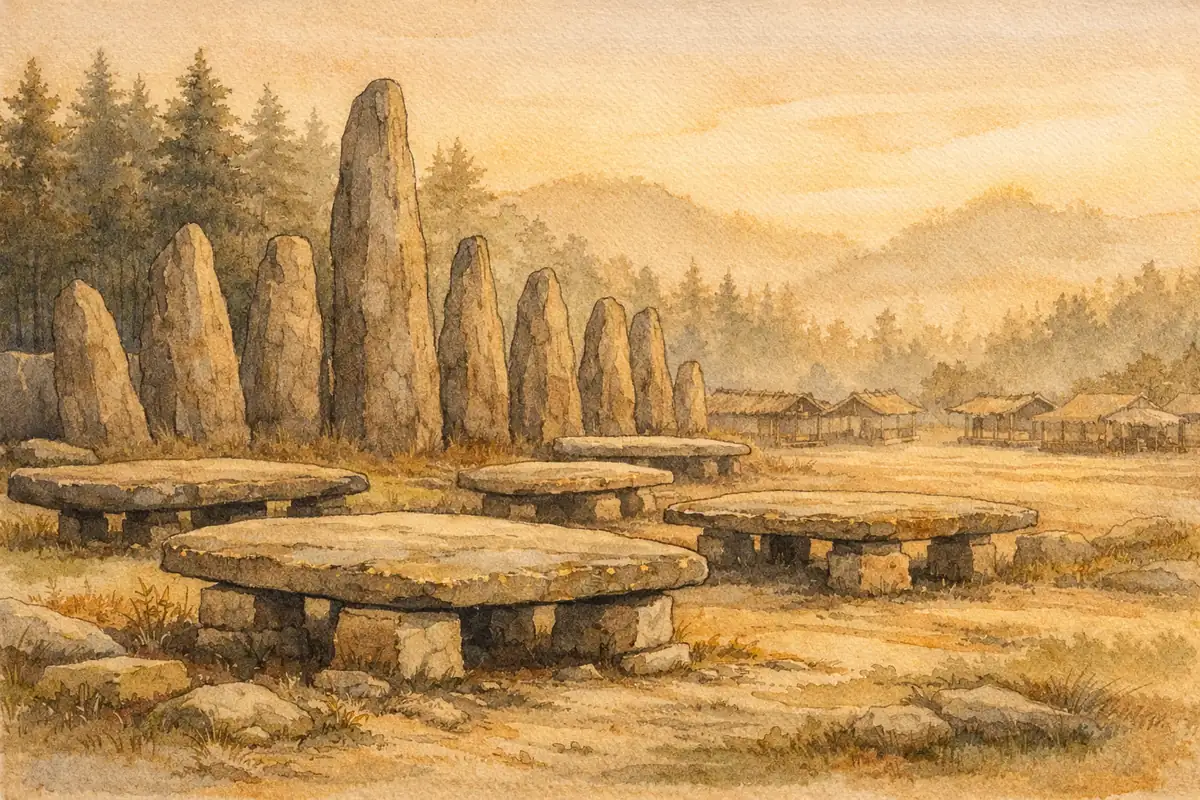
Gurdon describes Pnar customs that differ from Khasi ones. A widow who did not mean to remarry might keep her husband's bones, so that his spirit stayed with her; if she remarried, her children handed the bones to his clan. A child was named by its eldest aunt, who let two sticks fall as names were called. At Nartiang the great standing stones and table-stones by the market, the tallest 27 feet high, are called ki maw jong Siem, and the doloi and his officers make an offering of rice there to the founders of the market. The main festival is Behdienkhlam at Jowai.
Festivals
Behdienkhlam
Every year in June (u Jyllieu), at Jowai and elsewhere in the Jaintia Hills
Gurdon spells it Beh-dieng-khlam, 'driving away the plague with sticks': the men beat the roofs to drive out sickness, then break long poles held across the stream and contend for a great post.
Stories and Legends
U Loh Ryndi and Ka Lih Dohkha
Gurdon prints the Pnar account of the origin of the Siems of Suhtnga. U Loh Ryndi of War Umwi caught a single fish, roasted it and forgot it. Each day after that he came home to find his house swept and his rice cooked, and when he hid and watched, he found a woman, Ka Lih Dohkha, the fish he had caught. She went back to the river when she saw a broom on his threshold, but he found her again at Suhtnga, married her, and she bore him twelve daughters and a son. Their descendants became the Siems of Suhtnga, who later ruled as the Rajas of Jaintiapur.
Related communities
Sources
- The Constitution (Scheduled Tribes) Order, 1950, as amended, Parts for Meghalaya, Assam and Mizoram, as compiled in Wikipedia's List of Scheduled Tribes. Sections Assam (autonomous districts), Meghalaya, Mizoram
- P. R. T. Gurdon, The Khasis (1907), with an introduction by Sir Charles Lyall. Introduction (dolois, 1835; Pnar or Synteng dialect of Jowai); Section I, Habitat (Syntengs, Rajas of Jaintia); Section II, Houses (Nartiang); Section III, Tribal Organization (Synteng divisions; jong), State Organization (doloiships), Marriage, Inheritance (Heath's notes on the Nongkhlih doloiship), Adoption; Section IV, household gods of the Syntengs (Ka Taben), naming, Memorial Stones (Nartiang), Festivities (Beh-dieng-khlam); Section V, U Loh Ryndi and Ka Lih Dohkha
- Wikipedia, Pnar people (pointer: name, Niamtre, Hynniew Trep, Bangladesh; citing Soumen Sen, Khasi-Jaintia Folklore, 2004, and K. S. Singh, People of India: Meghalaya, 1994)
Practice differs by village and family. If something here does not match your family's tradition, trust your elders.