
Khasi
At a glance
- Clan word
- Kur
- Descent
- Through the mother
- Lives in
- Meghalaya, Assam, Bangladesh
- Language
- Khasi (Austroasiatic (Mon-Khmer); Latin script)
- Part of
- Khasi-Jaintia
- Region
- North-East
About
The Khasi are the people of the Khasi Hills in Meghalaya, with smaller numbers in Assam and Bangladesh. They speak Khasi, an Austroasiatic language that Welsh missionaries at Cherrapunji began to write in the Roman script after 1842. Descent is through the mother: a child belongs to the mother's kur, or clan, marriage within the kur is forbidden, and the youngest daughter keeps the family house and its rites. The old Khasi states, each under a syiem chosen from a royal clan with a durbar of elders, still keep their chiefs. The Khasi are a Scheduled Tribe in one entry with the Jaintia (Pnar or Synteng), War, Bhoi and Lyngngam.
Clans and Kinship
The kur (also called jaid) is the Khasi clan: all who descend from one ancestress, the 'grandmother of the root' (ka Iawbei-tynrai), who is greatly revered. Below the kur, Gurdon describes the kpoh ('womb'), the descendants of one great-grandmother, and the iing ('house'), a grandmother with her daughters and their children under one roof. A Khasi saying he records, long jaid na loa kynthei, means 'from the woman sprang the clan'. A man belongs to his mother's kur; once married he is, to his wife's clan, a begetter (u shong kha) and takes no part in its rites. The youngest daughter (ka khun khadduh) 'holds the religion': she performs the family ceremonies in her house and takes the largest share of the ancestral property. The mother's brother (kni) is head of the house and carries out family and clan rites. Clans are strictly exogamous, and clans believed to share descent (iateh kur) may not intermarry either. Above the clan stood the state (hima), headed by a syiem from its syiem family, with succession through the female line. He governed with a durbar of myntris, the heads of leading clans, beside the lyngdohs, priests drawn from priestly clans, and in some states village sirdars and market heads (basans).
What “Kur” means
Kur, or jaid, is the Khasi clan, traced through the mother from one ancestress. It is exogamous. Gurdon gives jong (iong) as the Pnar word for a clan, and notes that the War form khong runs through many clan names, such as Khong-wir and Khong-joh.
53 kurs
- Basa-iew-moit
Cherra and Khyrim lists
May not marry the Majaw or Hynniewta clans (Cherra list).
- Diengdoh
Cherra and Khyrim lists
Gurdon tells how the line split into the Lalu, Diengdohbah and Diengdohkylla clans, which may not intermarry because they share one ancestress.
- Dkhar
Cherra and Khyrim lists
Dkhar is the Khasi word for a person from the plains; Gurdon notes how many clan names begin with it or its short form khar.
- Dohling
Cherra list
- Hynniewta
Cherra list
- Jyrwa
Cherra list
- Khar-kongor
Cherra and Khyrim lists
- Khar-mawphlang
Cherra list
- Khar-synteng
Cherra list
- Khong-bri
Cherra list
- Khong-joh
Cherra and Khyrim lists
- Khong-wir
Cherra and Khyrim lists
- Lyngdoh-Nonglwai
Cherra list
- Lynrah
Cherra list
- Majaw
Cherra list
- Marbaniang
Cherra list
Gurdon: one of the myntri clans of the Mawsynram state.
- Malngiang
Cherra list
Gurdon: originally from Maskut in the Jowai sub-division.
- Mawlong
Cherra list
- Myrthong
Cherra list
Cherra and Khyrim lists
In the Khyrim list it may not marry the Nongkynrih clan.
Cherra and Khyrim lists
Gurdon: one of the myntri clans of the Khyrim state. May not marry the Nongbri clan.
- Nongrum
Cherra and Khyrim lists
Gurdon: one of the myntri clans of the Khyrim state.
- Nongtariang
Cherra list
Gurdon: now one of the Khadar Kur, the twelve leading clans of Cherra, in place of the Marboh clan, which had died out.
- Pohnong
Cherra list
- Rapthap
Cherra list
- Rynjah
Cherra and Khyrim lists
Gurdon: one of the myntri clans of the Khyrim state.
- Shabong
Cherra and Khyrim lists
- Shrieh
Cherra list
Shrieh means monkey. Gurdon found no sign that the clan treated the animal as a totem.
- Sohkhlet
Cherra list
- Sumer
Cherra and Khyrim lists
- Swer
Cherra and Khyrim lists
Cherra list
Each Khasi state chose its syiem from its own syiem family.
- Thabah
Cherra list
- Tham
Cherra list
Tham means crab.
- Bariang
Khyrim list
- Dumpep
Khyrim list
- Hadem
Khyrim list
- Jasia
Khyrim list
- Khar-mukhi
Khyrim list
Gurdon reads names like this one as the lines of ancestresses who came from the plains.
- Khar-umnuid
Khyrim list
May not marry the Khar-bihkhiew clan; Gurdon records that it does not eat pork.
- Khynriem
Khyrim list
- Lawai
Khyrim list
May not marry the Lyngdoh clan.
Khyrim list
The priestly kur: Gurdon writes that the lyngdoh is always appointed from it. In the Khyrim list it may not marry the Pongrup or Mawthoh clans.
- Mawphlang
Khyrim list
- Mawthoh
Khyrim list
May not marry the Pongrup or Lyngdoh clans. Gurdon records its offerings at Rableng hill.
Khyrim list
- Mylliem-muthong
Khyrim list
- Mylliem-ngap
Khyrim list
Named after its ancestress, ka ngap ('honey, the sweet one'). It, Mylliem-pdah and Mylliem-muthong may not intermarry, nor marry the Sohtum clan.
- Mylliem-pdah
Khyrim list
Named after its ancestress, ka pdah.
- Pongrup
Khyrim list
- Sohtum
Khyrim list
- Warbah
Khyrim list
May not marry the War-shong clan.
- War-shong
Khyrim list
A selection, in Gurdon's order, from the two lists of exogamous clans in The Khasis (1907, Appendices A and B), which he drew up from information given by the Siems of Cherra and Khyrim: 100 clans in Cherra and about 200 in Khyrim. It is not a full list of Khasi kurs; Gurdon gave the two states only as examples. Names are spelt as he printed them, with his ditto marks written out (Khong-wir); spellings in use today may differ. The notes give his remarks, including clans that may not intermarry (iateh kur).
In the Official Lists
Scheduled Tribe
Meghalaya, Assam
Listed as: Khasi, Jaintia, Synteng, Pnar, War, Bhoi, Lyngngam
In Assam the entry is in the part of the list for the autonomous districts, not in the list for the rest of the state.
Scheduled Tribe
Mizoram
Listed as: Khasi and Jaintia (including Khasi Synteng or Pnar, War, Bhoi or Lyngngam)
Scheduled Tribe
Tripura
Listed as: Khasia
In each list one entry covers the Khasi together with the Jaintia (Pnar or Synteng), War, Bhoi and Lyngngam. Meghalaya and Mizoram also list Synteng as a separate entry, and so does Assam's list for the autonomous districts (spelt Syntheng). Assam's list for the plains has no Khasi entry. Checked against a compilation of the Order; amendments of 2022 to 2024 were not checked.
Checked on 2026-11-06 against the sources below. The lists are amended from time to time and can differ by district; for a certificate, the current order or the state's list is what counts.
Name and Origin
The Khasi traditions of origin that Gurdon collected disagree. One brings the people from the north into the plains of Sylhet, from which a great flood drove them back into the hills; in that flood the Khasi lost his book while swimming, which is why the Khasi had no writing. Another, which J. B. Shadwell heard, brings them from Burma over the Patkoi range. Gurdon called all of this vague and did not decide. Clan traditions also speak of migration: the Diengdoh clan of Cherra traced its first ancestress to the country beyond the Kopili river. Khasi and Pnar tradition traces the people to the Hynniew Trep, the 'seven huts' or seven families (as summarised in Wikipedia's article on the Pnar, citing Soumen Sen, 2004).
History
Before British rule the Khasi Hills were divided among small states. Gurdon (1907) counted fifteen, each with its own syiem family; the largest were Khyrim, Mylliem, Cherra (Sohra), Nongstoin and Nongkhlaw, and a few smaller ones were ruled by lyngdohs, sirdars or elected wahadadars. U Tirot Singh, ruler of Nongkhlaw, rose against the East India Company in 1829 and fought for four years before he was captured and imprisoned for life. The Jaintia Hills to the east, once ruled by the Rajas of Jaintia, became British in 1835 and were governed through elected dolois, while the Khasi states kept their own government under treaties. The Welsh Calvinistic Methodist mission opened a branch at Cherrapunji in 1842. At the census of 1901 Gurdon counted 176,614 Khasis, of whom 47,883 were Syntengs (Pnar) and 17,125 Christians. Shillong later became the capital of Assam, and the Khasi and Jaintia Hills are now in Meghalaya, a state formed in 1972.
Faith and Worship
The traditional Khasi religion, known as Niam Khasi (ka niam is religion; Gurdon cites U Jeebon Roy's account, Ka Niam Khasi), recognises a creator, U Blei Nong-thaw, often addressed in the feminine as Ka Blei Synshar. It honours the ancestors of the clan, the first grandmother, the first maternal uncle and the father, with offerings of food. It propitiates the spirits of the state, the village, the water and wealth, choosing which to address by breaking eggs, and makes no images. The youngest daughter and the maternal uncle keep the family rites; the lyngdoh, always from a lyngdoh clan, keeps the communal rites and must be assisted by a female priest (ka soh-blei). Gurdon counted 17,125 Christian Khasis in 1901; most Khasis are now Christian.
Customs
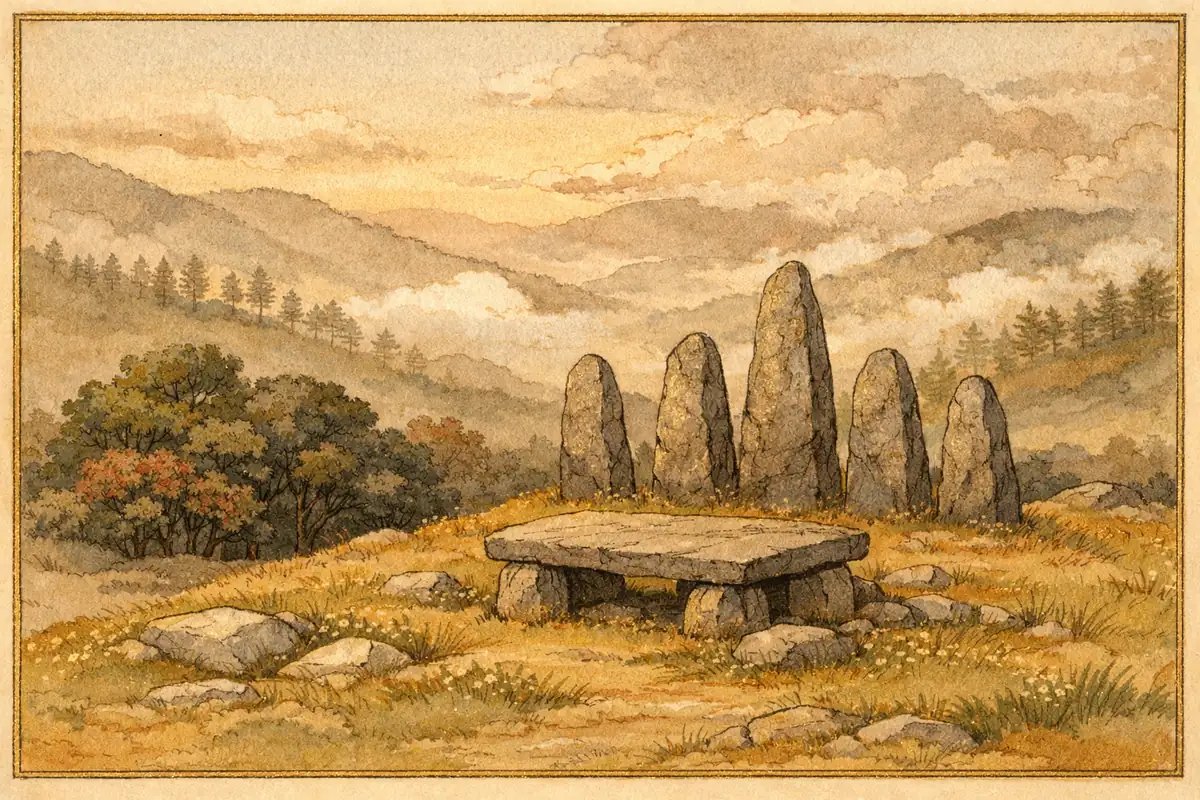
To marry within one's own kur was, in Gurdon's words, the greatest sin a Khasi could commit: it brought excommunication, the refusal of funeral rites, and exclusion of the bones from the clan sepulchre. Among the Khasi a husband usually lived at first in his mother-in-law's house and might later set up his own; among the Pnar he only visited his wife's house. Divorce, by mutual consent, was marked in the open air by an exchange of five cowries before witnesses. A family left without daughters could bring in a girl to take the youngest daughter's place ('rap iing). The dead were cremated and their bones later laid in the clan's stone ossuary, and rows of rough-hewn upright stones, usually in odd numbers with a flat table-stone in front, were raised to ancestors. The Nongkrem dance at Smit is part of the pom-blang, the goat sacrifice of the Khyrim state.
Festivals
Nongkrem dance (Pom-blang)
Late spring, usually May, at Smit (Gurdon)
The syiem of Khyrim, with the high priest and the lyngdohs, sacrifices goats for good crops and a prosperous year; dances follow at the house of Ka Siem Sad, the high priestess.
Stories and Legends
Ka Pah Syntiew, the flower-lured one
Gurdon prints the tradition of the Siems of Shillong. A beautiful girl lived in a cave called Marai, near the source of the Umiam river, and no one could draw her out until a man from Nongjri in the Bhoi country held out a flower and seized her when she reached for it. He married her, and she was called Ka Pah Syntiew, 'the flower-lured one'. After bearing daughters and sons she went back into the cave and never came out again. Believing her the daughter of the spirit of Shillong Peak, the people made her children their Siems, the 'god kings' of Shillong, the present Khyrim and Mylliem. In his chapter on the states Gurdon gives another version, in which the man who drew her out was of the Mylliem-ngap clan.
Notable Personalities
U Tirot Singh
Rising of 1829 to about 1833
Ruler of Nongkhlaw who rose against the East India Company in 1829 and fought for four years before he was captured and imprisoned for life (Gurdon, who spells the name U Tirut Singh).
U Nissor Singh
Around 1900
Khasi scholar and schools sub-inspector, author of a Khasi-English dictionary, who translated the Khasi folk-tales printed in Gurdon's book (Gurdon, 1907).
Related communities
Sources
- The Constitution (Scheduled Tribes) Order, 1950, as amended, Parts for Meghalaya, Assam, Mizoram and Tripura, as compiled in Wikipedia's List of Scheduled Tribes. Sections Assam (general areas; autonomous districts), Meghalaya, Mizoram, Tripura
- P. R. T. Gurdon, The Khasis (1907), with an introduction by Sir Charles Lyall. Introduction (mission and Roman script, treaties, 1835); Section I, Habitat and Origin (pp. 1-11); Section III, Tribal Organization, State Organization, Marriage, Divorce, Inheritance, Adoption (pp. 62-86); Section IV, Ancestor Worship, Priesthood, Memorial Stones, Festivities (pp. 105-157); Section V, folk-tale of the Siems of Shillong; Appendices A and B, Exogamous Clans in the Cherra and Khyrim States (pp. 216-220)
- Encyclopedia of World Cultures, Khasi (Kinship; Sociopolitical Organization; Religion and Expressive Culture), via everyculture.com
- Wikipedia, Khasi people (pointer: Bangladesh, Niam Khasi in the 2011 census religion tables)
- Wikipedia, Pnar people (pointer: Hynniew Trep, citing Soumen Sen, Khasi-Jaintia Folklore, 2004)
Practice differs by village and family. If something here does not match your family's tradition, trust your elders.