
Karbi
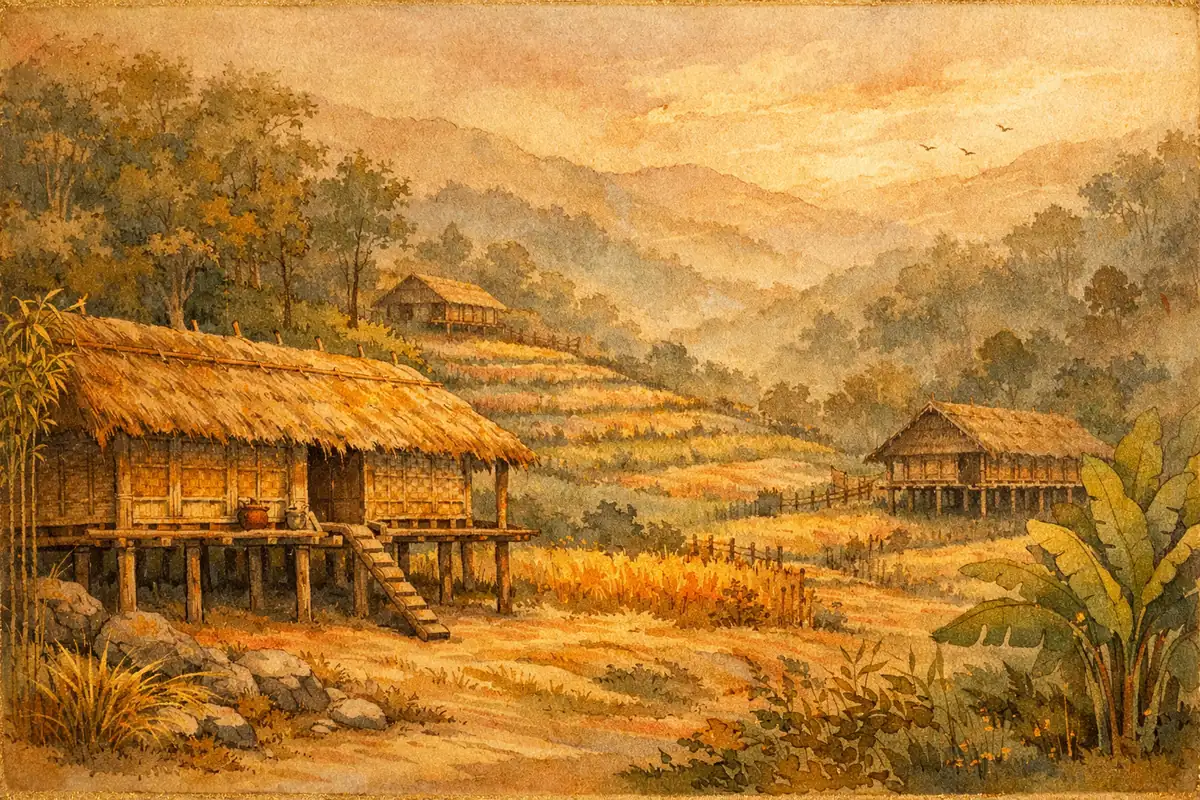
At a glance
- Clan word
- Kur
- Descent
- Through the father
- Lives in
- Assam, Meghalaya, Nagaland, Arunachal Pradesh
- Language
- Karbi (Tibeto-Burman; Latin script)
- Region
- North-East
About
The Karbi, who call themselves Arleng ('man'), are a Tibeto-Burman people whose homeland is the Karbi Anglong hills of central Assam, with smaller groups in the Assam plains, Meghalaya, Nagaland and Arunachal Pradesh. Older books, including Stack and Lyall's monograph of 1908, call them Mikir, the name the Assamese gave them. Karbi society is patrilineal and divided into five exogamous clans, the kur, whose names (Ingti, Terang, Teron, Timung, Inghi) are carried as surnames. They are a Scheduled Tribe as Karbi in Assam's hill districts, and listed under the older name in Meghalaya, Mizoram and Nagaland.
Clans and Kinship
Stack and Lyall describe the hill Karbi as divided into three sections, Chintong, Ronghang and Amri, which are place names rather than lines of descent, and a fourth group, the Dumrali, who settled in the Nowgong plains and took to the plough. Running through all of them are the kur (a word borrowed from Khasi; the Assamese is phoid), the exogamous clans. A child belongs to the father's kur and may not marry within it, but marriage with a first cousin on the mother's side was the usual match. Each kur is divided into sub-kurs, also exogamous, and the books do not agree on how many main kurs there are or where each sub-kur belongs. All kurs were socially equal in Stack's day, though tradition remembered Ingti as the priestly kur. Sons inherit, the eldest a little more; failing sons, brothers and then the nearest man of the kur; a widow could keep the property only by marrying into her husband's kur. Each village had a headman and a council of householders, the me, and villages were grouped into mauzas with a great council, the me-pi.
What “Kur” means
Kur is the Karbi exogamous clan, inherited from the father; Stack and Lyall note that the word comes from Khasi, where the kur is matrilineal. Each kur is split into sub-kurs, and the kur name is used as a surname.
22 kurs
- Ingti
Kur
Also written Engti. Said to have been the priestly kur in former times.
- Terang
Kur
Stack's Teràng; it too claimed the priestly office.
- Teron
Kur
The census of 1891 writes Teràn. Stack had no group of this name.
- Timung
Kur
The census of 1891 writes Tumung.
- Inghi
Kur
Also Enghee; the census of 1891 gives Inghi or Hengse. Stack called this group Lèkthe, and remembered it as the military kur.
- Taro
Sub-kur of Ingti
- Katar
Sub-kur of Ingti
The census of 1891 writes Kathar; Mr. Dundas made Kathar a main group of its own.
- Hènsèk
Sub-kur of Ingti
- Inglèng
Sub-kur of Ingti
- Be
Sub-kur of Terang
- Kro
Sub-kur of Terang
Together with Be, the Be-kuru, who purified outsiders admitted to the tribe in North Cachar (Dundas).
- Ingjar
Sub-kur of Terang
The Injai of other lists; Dundas notes the Injai may not take a wife from the Be group.
- Kangkàt
Sub-kur of Teron
- Làngle
Sub-kur of Teron
- Milik
Sub-kur of Teron
- Tòkbi
Sub-kur of Timung
- Sèngnar
Sub-kur of Timung
- Ròngphar
Sub-kur of Timung
- Hànse
Sub-kur of Inghi
- Tutso
Sub-kur of Inghi
- Bòngrun
Sub-kur of Inghi
- Kràmsa
Sub-kur of Inghi
The five main kurs are in the order of the Assam census of 1891, as printed by Stack and Lyall (1908, Appendix), with the spellings used today in brackets in the notes; Wikipedia gives the same five as Engti, Terang, Enghee, Teron and Timung. The sub-kurs are Stack's, with three for Teron from the census list, in Stack's spelling with its accents. Stack and Lyall print four lists (Stack, the census, Mr. Dundas and the Rev. Mr. Moore) that group the sub-kurs differently, so a family's own reckoning may differ from this one.
In the Official Lists
Scheduled Tribe
Assam
Listed as: Karbi
In the part of Assam's list for the autonomous districts, not in the list for the plains.
Scheduled Tribe
Meghalaya, Mizoram, Nagaland
Listed under the older name Mikir, which Wikipedia, citing the Karbi Anglong district administration, says the community now regards as derogatory.
Assam's list for the plains has no Karbi or Mikir entry in the compilation checked. Checked against a compilation of the Order; amendments of 2022 to 2024 were not checked.
Checked on 2026-11-06 against the sources below. The lists are amended from time to time and can differ by district; for a certificate, the current order or the state's list is what counts.
Name and Origin
The name Mikir was given by the Assamese, and Stack and Lyall (1908) did not know its origin; the people called themselves Arleng, 'man'. The origin of the name Karbi is not settled (Wikipedia). Karbi tradition, as Stack and Lyall recorded it, places the old home in the hills by the Kopili river, which they call Nihang, as against Nilip, the Nowgong country where they later lived. Harassed by wars between Khasi chiefs, they sought the protection of the Ahom kings; their first envoys, unable to make themselves understood, were buried alive in a tank embankment, but after fighting an embassy to the king at Sibsagar won them land, and they have lived at peace since. They also remember a king of their own, Sot Recho, whose seat was at Ronghang, and whose return some expected.
History
Stack, an Assam civil servant, gathered most of the material on the Karbi in the 1880s, and Sir Charles Lyall edited and published it in 1908. The census of 1891 counted 94,829 Mikirs and that of 1901 87,046, a fall Lyall put down to kala-azar in Nowgong and Kamrup; the largest numbers lived in Nowgong, Sibsagar, the Khasi and Jaintia Hills and Kamrup. During the Burmese wars early in the nineteenth century the Karbi left the foothills for the higher hills, and many Assamese who took refuge with them became Karbi. Under British rule their hills were called the Mikir Hills, and in 1935 they were made a Partially Excluded Area; today the Karbi Anglong and West Karbi Anglong districts are governed under the Sixth Schedule through the Karbi Anglong Autonomous Council (Wikipedia).
Faith and Worship
Stack and Lyall found no idols, temples or shrines. The gods (arnàm) are many: Hèmphu, 'head of the house', who owns all the Karbi people and is invoked first in every sacrifice, and Mukràng, close to him; the household gods Arnàm Kethe and Pèng; Rèk-ànglòng, the god of the hill the village stands on; and Arnàm-paro, 'the hundred god', who is honoured at the Rongker. Diviners (uche) find out which god needs an offering. The dead go to Jòm-aròng, the town of Jòm Recho, if the funeral rites are duly done. Wikipedia's account says those who keep the old religion call themselves the sons of Hemphu and Mukrang, and that some Karbi are Hindu or Christian.
Customs
The funeral, chomangkan, is the most elaborate and costly Karbi ceremony: the dead are cremated, and the rites, with the chomàng-kàn dance to the drum, are held when the family can afford them, so that the spirit can enter Jòm-aròng. Stack and Lyall describe two forms of marriage: in the more common one the bride goes to her husband's home after the wedding; in the other, usual when she is an heiress or only daughter, the husband stays and works for his father-in-law for a year or more. No money is paid for the bride. Young men formerly lived in the teràng, the bachelors' house. The Rongker, the annual village festival, is held in June at the start of cultivation, or in some villages in the cold season.
Festivals
Rongker
Yearly, at the start of cultivation in June, or in some villages in the cold season (Stack and Lyall)
The compulsory village festival: goats and fowls are offered to Arnàm-paro and the gods of the hills and rivers for health and good crops; only men eat the sacrifice.
Stories and Legends
Thirong Vangrong, who went to the town of the dead
Stack and Lyall record a tradition that a man called Thi-ròng Vàng-ròng, 'dead-alive, come-alive', used to travel between this world and the town of Jòm Recho, the lord of the dead, and taught the Karbi their funeral rites. Everything there was the other way round: the people went fishing and gathered sticks, and when they waved a lighted brand over them he saw them as fish. In the end he did not come back.
Related communities
Sources
- The Constitution (Scheduled Tribes) Order, 1950, as amended, Parts for Assam, Meghalaya, Mizoram and Nagaland, as compiled in Wikipedia's List of Scheduled Tribes. Sections Assam (general areas; autonomous districts), Meghalaya, Mizoram, Nagaland
- Edward Stack and Sir Charles Lyall, The Mikirs (1908). Section I, numbers, name, traditions of origin (pp. 1-5); Section II, houses; Section III, sections and exogamous groups (pp. 15-17), marriage, inheritance (p. 21), village councils (p. 22), outsiders admitted (p. 23), Appendix, lists of exogamous groups (pp. 23-27); Section IV, religion, gods, funeral ceremonies and the Rongker
- Encyclopedia of World Cultures, Mikir (Kinship; Marriage and Family; Sociopolitical Organization; Religion), via everyculture.com
- Wikipedia, Karbi people (pointer: the name Karbi, the five kurs after T. Bhattacharjee, Sociology of the Karbis, 1986, the Autonomous Council, regions)
Practice differs by village and family. If something here does not match your family's tradition, trust your elders.