
Warli
वारली
At a glance
- Clan word
- Kul
- Descent
- Not recorded in the sources used
- Lives in
- Maharashtra, Gujarat, Dadra and Nagar Haveli, Daman and Diu, Goa, Karnataka
- Languages
- Warli (Indo-Aryan), Marathi (Indo-Aryan), Gujarati (Indo-Aryan)
- Population
- 12,38,066 Census 2011, Table A-11, the 'Varli' entry in each state and union territory: Maharashtra 796,245; Gujarat 328,194; Dadra and Nagar Haveli 112,061; Daman and Diu 1,390; Goa 118; Karnataka 58.
- Region
- West
About
The Warli, written Varli in the official lists, are a people of the hills and coast on the Maharashtra-Gujarat border: the Jawhar, Vikramgad, Mokhada, Dahanu and Talasari talukas of Palghar district, parts of Nashik, Dhule and Nandurbar, the Valsad, Dangs, Navsari and Surat districts of Gujarat, and Dadra and Nagar Haveli. They speak Varli, an Indo-Aryan language, and Marathi or Gujarati, and are known for the white ritual wall paintings of their houses. They are a Scheduled Tribe; the 2011 census counted 1,238,066.
Clans and Kinship
Enthoven (1922) records four endogamous divisions: the Shuddha or 'pure' Varlis, the Murde, the Davar and the Nihir. The Murde and Davar of northern Thana ate together and intermarried, but neither ate nor married with the Nihir of Mahim, Bassein, Jawhar and Vada. The tribe is divided into clans called kul, and marriage within the kul is forbidden, as is marriage within the degree of cousinship. Villages and hamlets often had their own headman. The old woman who conducts weddings, the davleri, and the medium, bhagat, are central figures in Varli ritual.
What “Kul” means
Kul is the word Enthoven (1922) records for the Varli exogamous clans; marriage within one's own kul is forbidden.
22 kuls
- Bantria
- Bhangara
- Bhavar
- Bhendar
- Gabhale
- Jadhav
- Karbat
- Kirkire
- Kondaria
- Meria
- Miske
- Nikhade
- Nimbore
OCR reading uncertain.
- Pagi
- Rivatia
- Sankar
- Shanvar
- Sumbhate
- Tabale
- Thode
OCR reading uncertain.
- Thakaria
- Vangad
The chief kuls as Enthoven (1922, vol. 3, p. 447) lists them, in his alphabetical order. Two names whose scanned text could not be read with confidence (one reads 'Jadhaie', one 'Pileyaua') are left out, and two are marked uncertain. Enthoven gives no totems, and the list is of the Thana Varlis of a century ago.
In the Official Lists
Scheduled Tribe
Maharashtra, Gujarat, Dadra and Nagar Haveli and Daman and Diu, Goa, Karnataka
Listed as: Varli
Dadra and Nagar Haveli and Daman and Diu were separate union territories in 2011 and are one since 2020; the Varli are listed in both former parts.
Checked against the 2011 census tables of each state and union territory and Wikipedia's compilation of the order; amendments after 2011 were not checked.
Checked on 2026-11-07 against the sources below. The lists are amended from time to time and can differ by district; for a certificate, the current order or the state's list is what counts.
Name and Origin
The meaning of the name is not settled. Enthoven (1922), following John Wilson, derives Varli from varal, a small patch of cultivated land, so 'uplander', and notes that others connect it with Varalat, one of the seven old divisions of the Konkan; he found neither convincing and wrote that nothing was known of their origin. He records that they were closely connected with the Thakur, among whom there was a Varli division.
History
Enthoven (1922) found the Varlis of 1901 in large numbers in Thana district, Jawhar, the Surat Agency, Nasik and Khandesh, with their headquarters in Dahanu; in Nasik they lived in Peint and on the Sahyadris, and in Khandesh in the hills west of Akrani. He describes them as partly settled and partly wandering, living in villages and padas, hamlets, for most of the year but moving in search of work in the dry season, and abandoning a village after a death from cholera or smallpox. Wikipedia's account, drawing on studies of Warli social history, records that the Warli held most of the land of the Umbergaon, Dahanu and Palghar talukas until the 1870s, when much of it passed to outside landlords and many Warlis became labourers and sharecroppers on it, bound to unpaid labour called begar. From 1945 Warlis organised against begar and for minimum wages in what is called the Warli revolt, and begar and most such dues were abolished by the early 1950s. By 2011 the census counted more than 1.2 million, about two-thirds of them in Maharashtra.
Faith and Worship
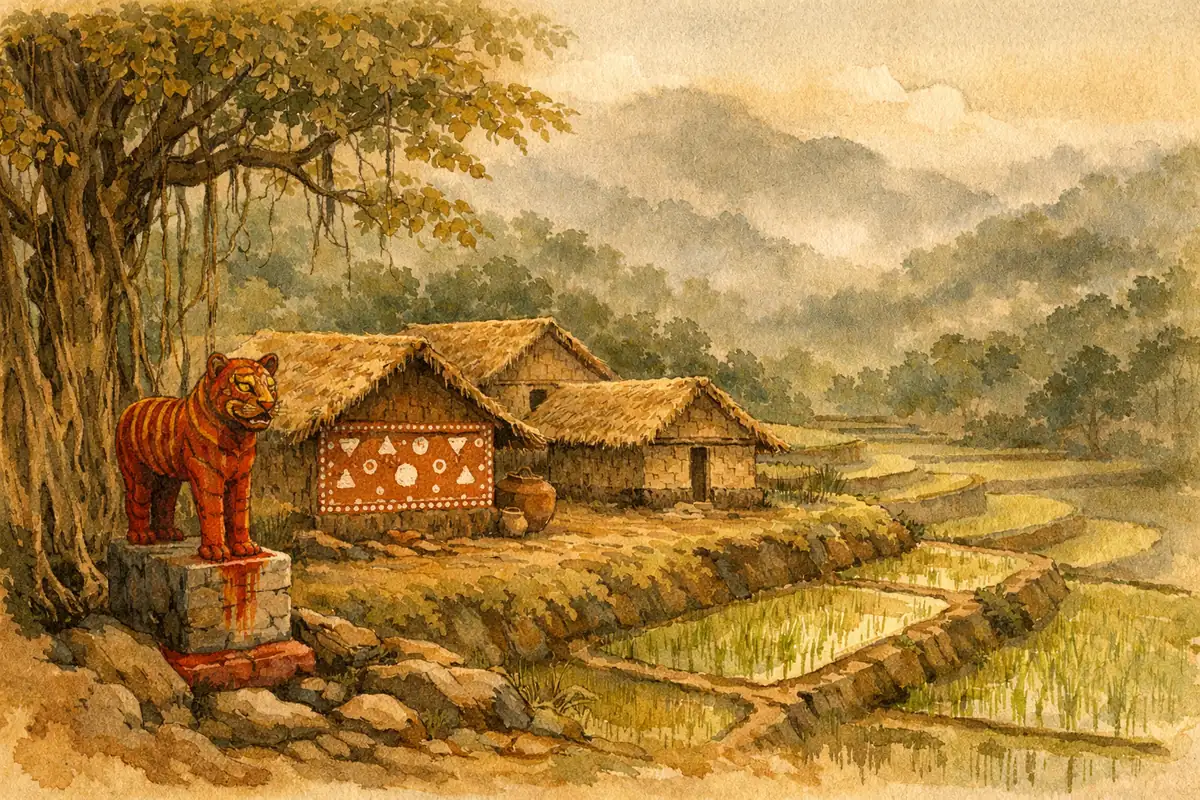
Enthoven (1922) describes the chief Varli god as Vaghya or Vaghoba, the tiger god, kept as a roughly carved tiger or a post daubed with red lead at the village boundary or under a banyan; every year in Kartik all Varlis go to Vaghya with offerings. The household god is Hirva, shown as a bundle of peacock feathers, a hunter or a rider, whose great day is in Margashirsha. They also worship Narayan, the goddess Humai, Bahiroba and Khandoba, and offer first fruits of the mango and the new rice. Mediums, bhagat, are possessed by Vaghya at weddings and choose names for children.
Deities named in the sources: Vaghoba, Hirva
Customs
In Enthoven's account (1922) the proposal comes from the boy's father, and a wedding lasts three days. On the first day the marriage booth is put up and liquor and coconuts offered to Hirva; on the third the davleri, an old woman of the tribe who acts as priestess, ties the couple's garments, leads them five times round the booth and chants the marriage words while a cloth is held between them, after which the guests dance round the pair raised on the shoulders of relatives. Two fairs in April drew many Varlis, at Mahalakshmi in Dahanu and at Nagar near Fattehpur in Dharampur. The dead were cremated, except those whose bodies had sores, who were buried. Warli women traditionally painted the walls inside their houses for weddings and harvests, in white rice paste on a red-brown wall of earth and cow dung, with a bamboo twig as the brush; the paintings are built from circles, triangles and squares around a central square, the chauk (Wikipedia, citing Dalmia's studies). From the 1970s Jivya Soma Mashe and others began to paint outside the ritual, and Warli painting became widely known.
Festivals
Vaghya's festival
Kartik, October or November
All Varlis go to the image of Vaghya, the tiger god, daub it with red lead and make offerings (Enthoven).
Mahalakshmi fair
April
One of two April fairs Enthoven found largely attended by Varlis, at Mahalakshmi in Dahanu.
Notable Personalities
Jivya Soma Mashe
1934-2018
Painter from Dahanu who, from the 1970s, took Warli painting beyond its ritual setting onto paper and canvas and made it widely known; he received the Padma Shri in 2011. He died on 15 May 2018 and was given a state funeral.
Related communities
Sources
- R. E. Enthoven, The Tribes and Castes of Bombay, vol. 3 (1922), 'Varlis'. Vol. 3, pp. 445-452: name and distribution pp. 445-446; divisions and kuls p. 447; birth and marriage pp. 448-449; religion and fairs pp. 450-451; death p. 452
- Wikipedia, 'Warli' (pointer to Dalmia, The Painted World of the Warlis, 1988, and Heredia and Dandekar, 'Warli Social History', Economic and Political Weekly, 2000; read 2026-11-07)
- Wikipedia, 'Jivya Soma Mashe' (dates and awards; read 2026-11-07)
- Census of India 2011, Table A-11, State Primary Census Abstract for individual Scheduled Tribes (Maharashtra; also Gujarat, Dadra and Nagar Haveli, Daman and Diu, Goa and Karnataka). NADA catalog 42966 (Maharashtra), 42963 (Gujarat), 42965 (Dadra and Nagar Haveli), 42964 (Daman and Diu), 42969 (Goa), 42968 (Karnataka)
- Constitution (Scheduled Tribes) Order, 1950, as amended, Parts for the states and union territories named (as compiled in Wikipedia's List of Scheduled Tribes)
Practice differs by village and family. If something here does not match your family's tradition, trust your elders.