
Katkari
कातकरी
At a glance
- Clan word
- Surname
- Descent
- Not recorded in the sources used
- Lives in
- Maharashtra, Gujarat, Rajasthan, Karnataka, Dadra and Nagar Haveli
- Languages
- Katkari (Indo-Aryan), Marathi (Indo-Aryan; Devanagari script)
- Population
- 3,04,215 Census 2011, Table A-11, the Katkari or Kathodi entry in each state and union territory: Maharashtra 285,334; Gujarat 13,632; Rajasthan 4,833; Karnataka 274; Dadra and Nagar Haveli 142.
- Region
- West
About
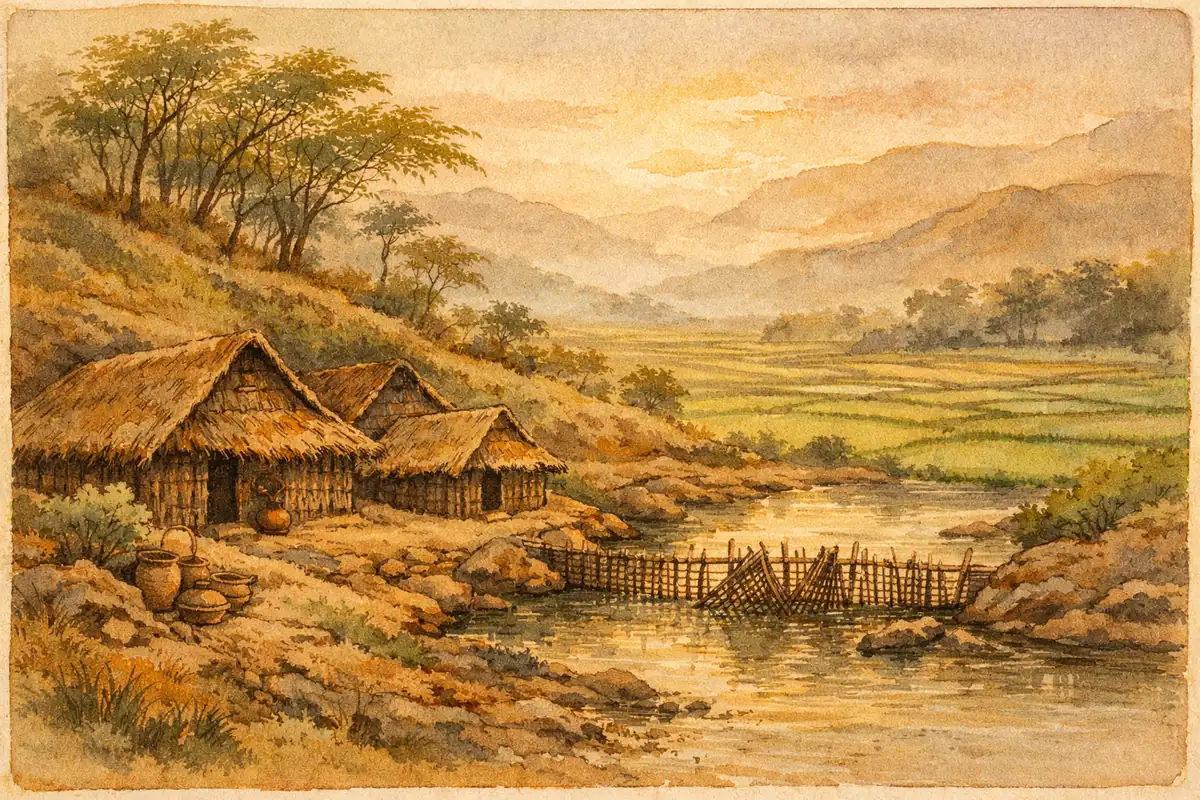
The Katkari, called Kathodi in Gujarat, are a people of the Sahyadri foothills and the Konkan in Maharashtra, chiefly in Raigad, Thane, Palghar and Pune districts, with smaller numbers in south Gujarat. Their name comes from kath, catechu, the extract of the khair tree, which they once made and sold. They live in small hamlets, wadis, and many work as labourers and fishers. They are a Scheduled Tribe and a particularly vulnerable tribal group (PVTG); the 2011 census counted 304,215.
Clans and Kinship
Enthoven (1922) records five endogamous divisions: Athavar, Dhor or Dhed, Sidhi, Son or Maratha, and Varap. Enthoven notes that Son and Dhor divisions are found among the Kolis too. The exogamous divisions are surnames: among the Son Katkaris marriage between people of the same surname is forbidden, while the Dhor had no such rule; first cousins may not marry, second cousins may. Some surnames, such as More and Vaghmare, are thought to be totemic, though the totem is no longer revered. Each hamlet has a headman, the Naik, whom the people consult on all matters, and the groom's party stays at the bride's headman's house at a wedding.
What “Surname” means
Enthoven (1922) records that the Katkari exogamous divisions are represented by surnames; among the Son Katkaris people of the same surname may not marry. No other word for them is given in the sources opened.
32 surnames
- Ahir
- Bagle
- Baraph
- Bhoi
- Chavan
- Dharkar
- Diva
- Gaikvad
- Gangoda
- Gharyare
- Gotarna
- Hilam
- Jama
- Kamdi
- Khutale
- Maje
- Misal
- More
Totem: peacock
Named by Enthoven as one of the surnames held to be totemic.
- Mukane
- Murkhute
- Patkar
- Pavar
- Saura
- Savad
- Selar
- Suvar
- Vaghmare
Totem: tiger
Enthoven tells of a Vaghmare headman near Karjat whose sick son was given a remedy made with earth from a tiger's track and fell worse; the healer blamed the boy's surname.
- Valne
- Valvi
- Vardi
- Vatase
- Wagh
Totem: tiger
The 32 surnames Enthoven (1922, vol. 2, 'Katkaris', section on exogamous divisions) gives, put back into his alphabetical order from the scanned columns; More is written Mora in the scan. The totems for More, Vaghmare and Wagh are the meanings of the words (peacock, tiger-killer, tiger), which Enthoven says were held to be totemic.
In the Official Lists
Scheduled Tribe
Maharashtra, Gujarat, Rajasthan, Karnataka, Dadra and Nagar Haveli and Daman and Diu
Listed as: Kathodi, Katkari, Dhor Kathodi, Dhor Katkari, Son Kathodi, Son Katkari
That is the entry in Maharashtra, Gujarat, Rajasthan and Karnataka (Maharashtra writes Dhor Kathkari); in Dadra and Nagar Haveli simply 'Kathodi'.
The Katkari are a particularly vulnerable tribal group (PVTG), a group within the Scheduled Tribes given special attention, in Maharashtra, where the other two such groups are the Madia Gond and the Kolam, and the Kathodi in Gujarat, in the government list reproduced on Wikipedia from a 2019 press release; the Maharashtra tribal research institute's reports also describe them so. The ST listings were checked against the 2011 census tables and Wikipedia's compilation of the order; amendments after 2011 were not checked.
Checked on 2026-11-07 against the sources below. The lists are amended from time to time and can differ by district; for a certificate, the current order or the state's list is what counts.
Name and Origin
Enthoven (1922) derives Katkari from Marathi kat, catechu, and karne, to make, 'makers of catechu', the tribe's old occupation, and Kathodi from kath and vadi, cake, 'sellers of catechu cakes'; Kathodia is the Gujarati form. The Katkari told him they were descended from the monkeys Rama led against Ravana, whom Rama blessed and made human after his victory. Enthoven noted Bhil words in their speech and a tradition that they came from the north and had first settled in the Athavisi, the Surat district, where one of their divisions takes its name.
History
Enthoven (1922) counted 75,710 Katkaris in 1901, in the Western Ghats of Thana and Kolaba, in the states east of Surat and along the Sahyadris between the Poona and Nasik roads. He describes them as moving their settlements at will in search of hunting or tillage, and abandoning a hamlet after an epidemic. In later years the Maharashtra tribal research institute counted them among the particularly vulnerable tribal groups of the state, and a study it funded of Katkari hamlets in Mulshi taluka of Pune records livelihoods from daily wage labour and seasonal fishing, and notes that the community lives chiefly in Mulshi, Raigad and Thane. Wikipedia's account, drawing on later studies, records that catechu making declined after independence when the Forest Department banned the felling of khair, that restrictions on shifting cultivation followed, and that from the 1950s many Katkari families moved from the hills to the edges of villages on the plains of Raigad and Thane. Under British rule the Katkari were among the communities notified under the Criminal Tribes Act, 1871, a law repealed after independence.
Faith and Worship
Enthoven (1922) found the tiger-god the chief object of Katkari worship, set up in the forest or at the village boundary; the tiger was thought to favour the Katkari, who were unwilling to shoot it. Worship was also paid to the village god, gamdev, and to lesser gods such as Hirva and Jarimari, with offerings of red lead, coconuts and fowls; in Gujarat Bhildev was worshipped. Spirits of the dead, called Cheda, were sometimes kept in Dhor Katkari houses. The Dhor kept Shimga (Holi) and Diwali as holidays, and the Son also the fifteenth of Bhadrapad, for the dead.
Deities named in the sources: Hirva, Jarimari
Customs
In Enthoven's account (1922) the boy's father pays a bride-price, dej, and weddings are held in Margashirsha, Magha, Vaishakh or Shimga. The groom's party stays at the house of the bride's headman, five girls pour water over the couple, the groom ties a necklace of black beads on the bride, and the pair feed each other balls of rice. At the groom's house his sister bars the door until the couple promise their future daughter to her son. Widows may remarry and divorce, dava, was allowed with the headman's consent.
Festivals
Shimga
Phalgun, February or March
The Konkan Holi, kept by both Son and Dhor Katkaris in Enthoven's account.
Diwali
Kartik, October or November
Kept by both Son and Dhor Katkaris in Enthoven's account.
Related communities
Sources
- R. E. Enthoven, The Tribes and Castes of Bombay, vol. 2 (1922), 'Katkaris'. Vol. 2, pp. 170-183: name and origin pp. 170-171; dress, speech and headman pp. 171-172; divisions and surnames pp. 172-174; marriage pp. 175-179; religion p. 180; death pp. 181-182
- A Study on Katkari Tribe in Mulshi Taluka (Environmental Action for Tribal Research and Sustainable Transformation, funded by the Tribal Research and Training Institute, Pune), catalogued in the Ministry of Tribal Affairs repository as 'A Study on Katkari A Primitive Tribal Group in Maharashtra'
- Wikipedia, 'Katkari' (pointer to Weling 1934 and later studies of Katkari livelihoods and land in Raigad and Thane; read 2026-11-07)
- Wikipedia, 'Particularly vulnerable tribal group' (list reproduced from a Press Information Bureau release of 2019; read 2026-11-07)
- Census of India 2011, Table A-11, State Primary Census Abstract for individual Scheduled Tribes (Maharashtra; also Gujarat, Rajasthan, Karnataka and Dadra and Nagar Haveli). NADA catalog 42966 (Maharashtra), 42963 (Gujarat), 42947 (Rajasthan), 42968 (Karnataka), 42965 (Dadra and Nagar Haveli)
- Constitution (Scheduled Tribes) Order, 1950, as amended, Parts for the states named (as compiled in Wikipedia's List of Scheduled Tribes)
Practice differs by village and family. If something here does not match your family's tradition, trust your elders.