
Bonda
At a glance
- Clan word
- Kuda
- Descent
- Through the father
- Lives in
- Odisha
- Language
- Remo (Austroasiatic (South Munda))
- Population
- 12,231 Census 2011, Table A-11, Odisha, 'Bondo Poraja, Bonda Paroja, Banda Paroja'.
- Part of
- Munda
- Region
- East
About
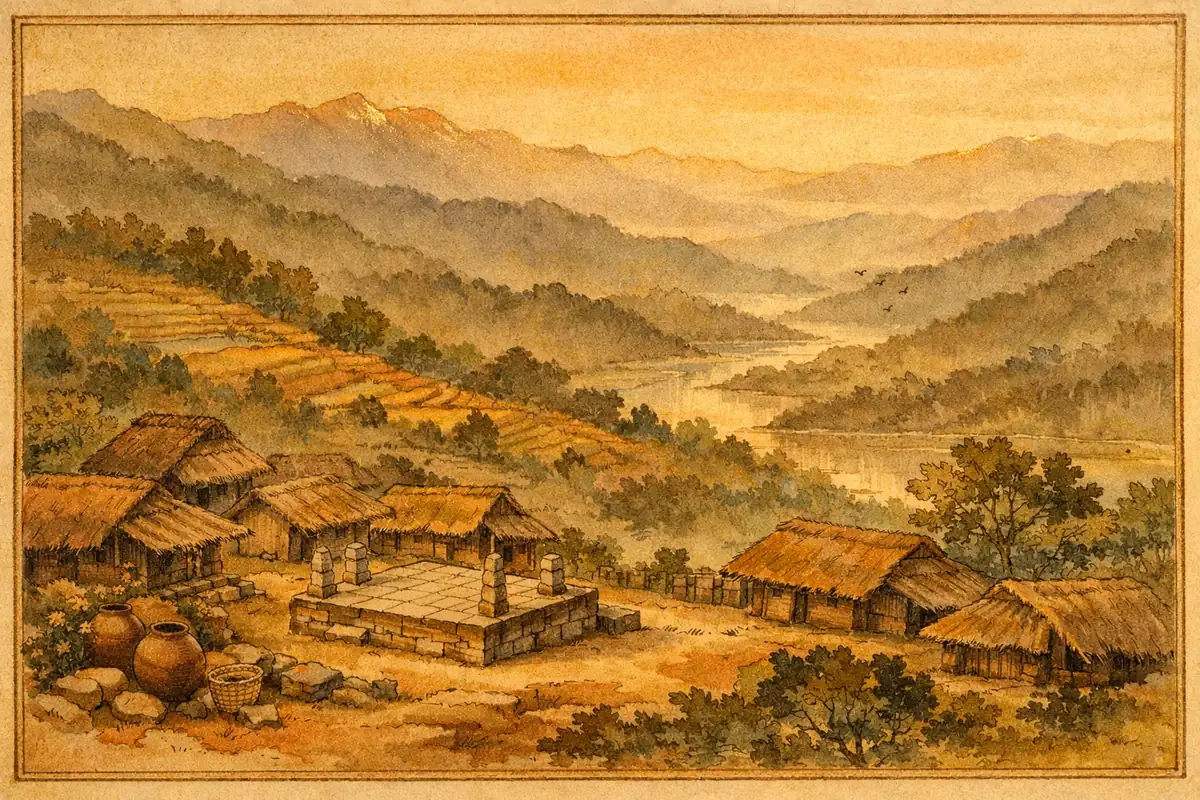
The Bonda, who call themselves Remo, 'man', live in the Bonda hills of Khairput block in Malkangiri district, Odisha, north-west of the Machkund river. They speak Remo, a South Munda language. The hill Bonda count the twelve villages around Mudulipada, the Bara-Jangar group, as one brotherhood whose members may not intermarry. Society is divided into two totemic moieties, Ontal (cobra) and Killo (tiger), and into exogamous clans called kuda. They are a Scheduled Tribe in Odisha, listed as Bondo Poraja, and a particularly vulnerable tribal group (PVTG); the 2011 census counted 12,231.
Clans and Kinship
THRTI (1989) describes a society that is patrilineal and patrilocal, with village exogamy, exogamous clans and two moieties. A son builds his own house soon after marriage, and sons share their father's property equally. The kuda, the exogamous clan, is a group of families believed to descend from one ancestor; most clans are named after village offices, and a woman takes her husband's clan at marriage. Each clan holds its own swiddens within the village and its own burial ground, where menhirs are raised for the dead. All the people of a village treat each other as brothers and sisters and may not marry, and the twelve Bara-Jangar villages around Mudulipada likewise do not intermarry; they share soru, the sacred food, at the Patkhanda festival. Above these stand two moieties (bonso), the Ontal or hantal (cobra) and the Killo (tiger), each with its own myth; because the Ontal are far more numerous, marriage within a moiety now happens. The community council is headed by the bada naik, with the sisa (priest), the dishari (medicine man and astrologer) and the challan or barik (messenger) (SCSTRTI).
What “Kuda” means
Kuda is the Bonda exogamous clan in THRTI's account (1989): families believed to descend from one ancestor, most of them named after village offices. The two moieties above the clans are called bonso.
9 kudas
- Badnaik
named after village offices
- Challan
named after village offices
- Dhangra Majhi
named after village offices
- Mudli
named after village offices
- Kirsani
named after village offices
- Siso
named after village offices
- Dora
later clans
- Digri
later clans
- Mandhara
later clans
The clans THRTI (1989) names, in its order. It notes that Dora, Digri and Mandhara may have begun when people of other communities married in.
In the Official Lists
Scheduled Tribe
Odisha
Listed as: Bondo Poraja
The census table enters 'Bondo Poraja, Bonda Paroja, Banda Paroja'.
Checked against the 2011 census table of each state and Wikipedia's compilation of the order; amendments after 2011 were not checked. SCSTRTI and the PVTG list reproduced from the 2019 PIB release name the Bondo among Odisha's PVTGs; the PIB list also names a 'Bondo Porja' for Andhra Pradesh and Telangana, where the ST list has no separate entry and the 2011 table gives no count.
Checked on 2026-11-07 against the sources below. The lists are amended from time to time and can differ by district; for a certificate, the current order or the state's list is what counts.
Name and Origin
THRTI's monograph (1989) says the origin and affiliations of the Bonda remain obscure. A Gadaba story quoted by Elwin (1950) makes them the descendants of the first Gadaba couple, and Thurston (1909) was told that the Bonda speech connects them with the Gadaba, a link the Bondas themselves denied. Their own legends, THRTI records, place them in the Bonda hills since the time of the Ramayana, and Sita Kunda, the pool where Sita is said to have bathed, is in the village of Mudulipada.
History
Under the old order the Bonda hills belonged to the Maharaja of Jeypore, and the Bondas were his parajas, tenants (THRTI 1989). There were at first twelve villages, all on the hills; as numbers grew new settlements spread out, and SCSTRTI's handbook (2007) counts 32 villages over about 130 square kilometres of hill country. A Bonda Development Agency at Mudulipada works among them as a PVTG.
Faith and Worship
Patkhanda Mahaprabhu, the creator and supreme god, is represented by a long sword kept in a banyan tree at Mudulipada; the shrine of Hundi, the village deity, stands at the village entrance (SCSTRTI). The sindibor, a stone platform in the village, is where the village meets. Thurston (1909) recorded that the Bondas worshipped Takurani in Chaitra and Magh, with animal sacrifice.
Deities named in the sources: Patkhanda Mahaprabhu
Customs
Bonda women weave their own short skirts (ringa) of kereng fibre on a home loom, wear masses of bead and brass necklaces and heavy neck rings of brass and aluminium, and shave their heads, wearing bands of palm leaf and fibre (SCSTRTI 2007). Men wear a narrow loincloth and carry a bow, arrows and a long knife. Wives are often older than their husbands (THRTI; SCSTRTI). The main festivals are Chait Parab, Pus Parab and the Patkhanda Jatra.
Related communities
Sources
- THRTI Odisha, The Bondo (Tribal and Harijan Research-cum-Training Institute, Bhubaneswar, 1989), from the Ministry of Tribal Affairs repository. Introduction (Remo, the Bondo country, legends); Social grouping (family, kuda, village and Bara-Jangar exogamy, the two moieties)
- SCSTRTI Odisha, Bonda (photo handbook, Bhubaneswar, 2007), from the Ministry of Tribal Affairs repository. Foreword
- SCSTRTI Odisha, tribe profile: Bondo Poraja. Scheduled Castes and Scheduled Tribes Research and Training Institute, Bhubaneswar; read 7 November 2026
- E. Thurston and K. Rangachari, Castes and Tribes of Southern India, vol. VI (Madras, 1909). s.v. Poroja, pp. 209-216 (the Bonda Poroja, their speech and worship)
- Census of India 2011, Table A-11: State Primary Census Abstract for individual Scheduled Tribes (one table for each state). Odisha (catalog 42960)
- Constitution (Scheduled Tribes) Order, 1950, as amended, Parts for Odisha, as compiled in Wikipedia's List of Scheduled Tribes from the Census of India list of notified Scheduled Tribes
- Particularly vulnerable tribal group, Wikipedia (pointer only: the PVTG list from the PIB release 'Welfare of particularly vulnerable Tribal groups', 2019)
Practice differs by village and family. If something here does not match your family's tradition, trust your elders.