
Gadaba
At a glance
- Clan word
- Clan
- Descent
- Through the father
- Lives in
- Odisha, Andhra Pradesh, Chhattisgarh, Madhya Pradesh, Telangana
- Languages
- Gutob (Austroasiatic (Munda)), Ollari (Dravidian)
- Population
- 1,31,883 Census 2011, Table A-11, Gadaba entries added together: Odisha 84,689; Andhra Pradesh (undivided) 38,081; Chhattisgarh 8,535; Madhya Pradesh 578.
- Region
- East
About
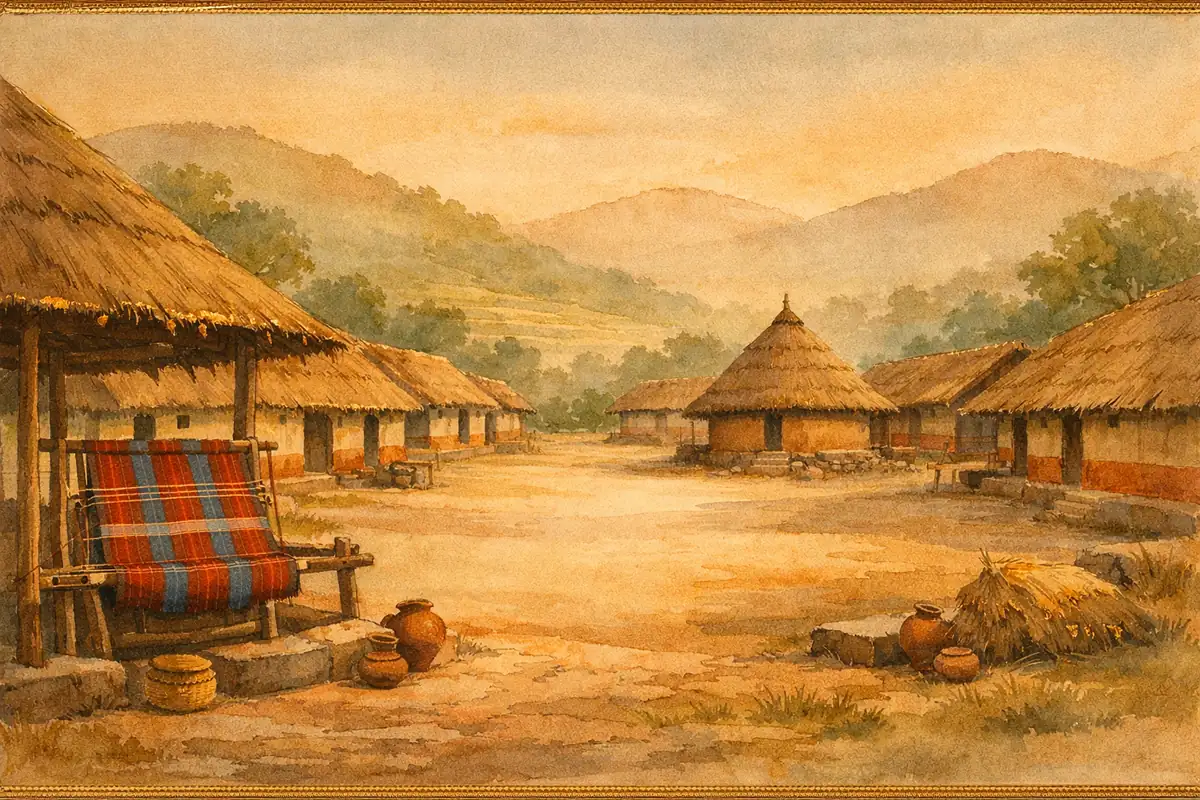
The Gadaba are a people of the Koraput plateau of Odisha, in Koraput, Malkangiri and Nabarangpur, and of the neighbouring hills of Andhra Pradesh, with smaller numbers in Chhattisgarh. Gadaba speak Gutob, a Munda language, or Ollari, a Dravidian one (SCSTRTI). Their villages are built in two facing rows, the women weave striped kerang cloth, and they are known for the dhemsa dance. They are a Scheduled Tribe in Odisha, Andhra Pradesh, Telangana, Chhattisgarh and Madhya Pradesh, and the Bodo and Gutob Gadaba are PVTGs in Andhra Pradesh and Telangana; the 2011 census counted 131,883.
Clans and Kinship
SCSTRTI (2009) describes exogamous totemic clans, among them Khora (sun), Nag or Hontal (cobra), Bag or Khillo (tiger), Bhalu (bear), Gid (vulture) and Kira (parrot); marriage is outside the clan and within the tribe, and the family is patrilineal and patrilocal. Thurston (1909) found the septs Kora (sun), Nag (cobra), Bhag (tiger), Kira (parrot) and Gollari (monkey) among the Bodo and Olaro sections, and noted that Gadabas settled in the plains had forgotten the sept names but would still not harm certain animals, such as the cobra. The village council is headed by the naik, with the challan and the barik as messenger; the disari is priest, medicine man and astrologer (SCSTRTI).
What “Clan” means
SCSTRTI (2009) writes clan or sept, and Thurston (1909) sept; neither gives a Gadaba word. Hontal and Khillo, the cobra and the tiger, are also the names of the two Bonda moieties.
7 clans
- Khora
Totem: sun
Thurston writes Kora.
- Nag
Totem: cobra
Also Hontal.
- Bag
Totem: tiger
Also Khillo; Thurston writes Bhag.
- Bhalu
Totem: bear
- Gid
Totem: vulture
- Kira
Totem: parrot
- Gollari
Totem: monkey
Named by Thurston among the Bodo and Olaro sections.
The clans SCSTRTI (2009) names, in its order, with Gollari added from Thurston's list (1909, vol. II, p. 247). SCSTRTI's 'etc.' shows there are more.
In the Official Lists
Scheduled Tribe
Odisha, Andhra Pradesh, Telangana, Chhattisgarh, Madhya Pradesh
Listed as: Gadaba
Odisha: 'Gadaba' (census table: 'Gadaba, Bodo Gadaba, Gutob Gadaba, Kapu Gadaba, Ollara Gadaba, Parenga Gadaba, Sano Gadaba'); Andhra Pradesh and Telangana: 'Gadabas, Bodo Gadaba, Gutob Gadaba, Kallayi Gadaba, Parangi Gadaba, Kathera Gadaba, Kapu Gadaba'; Chhattisgarh and Madhya Pradesh: 'Gadaba, Gadba'.
Checked against the 2011 census table of each state and Wikipedia's compilation of the order; amendments after 2011 were not checked. The Andhra Pradesh table covers the state before Telangana was formed in 2014. The PVTG list reproduced from the 2019 PIB release names the Bodo Gadaba and Gutob Gadaba for Andhra Pradesh and Telangana; the Gadaba are not among Odisha's PVTGs.
Checked on 2026-11-07 against the sources below. The lists are amended from time to time and can differ by district; for a certificate, the current order or the state's list is what counts.
Name and Origin
Thurston (1909) records a tradition that the Gadaba take their name from the Godavari, on whose banks their ancestors lived before they settled at Nandapur, the old capital of the rajas of Jeypore. SCSTRTI suggests instead that the name is gada with the ending -ba, 'belonging to'. Thurston was told that the Bonda speech is close to the Gadaba language, and Elwin (1950), as THRTI quotes him, gives a Gadaba story that the Bonda descend from the first Gadaba couple.
History
Thurston (1909) describes the Gadaba of the Vizagapatam district as cultivators and hunters; some had been settled by a former raja on the road between Sembliguda and Koraput to carry palanquins. He gives five sections: Bodo (big) or Gutob, Parenga, Olaro, Kaththiri or Kaththara, and Kapu, the last two settled in the plains and said to have come down from the hills. SCSTRTI (2009) lists the Bodo or Gutob, Sano or Parenga, Ollar, Jurumu, Kapu and Kalanji Gadaba, each with some customs of its own.
Faith and Worship
Thakurani, represented by a stone slab at the village shrine (hundi), is the chief village deity; the disari offers fowls to her at Bandapana in Shraban and officiates at all worship (SCSTRTI). From time to time a village holds gottar, a secondary rite for its dead (duma), at a fixed ground, the gotar manda: stones are added to the memorial ground and a buffalo is offered for each of the dead. SCSTRTI's profile says it is held every three to five years; its handbook says it covers all the deaths of a clan over ten to fifteen years.
Deities named in the sources: Thakurani
Customs
Adult marriage and a bride-price are usual, with arranged marriage, capture and other forms; monogamy is the rule (SCSTRTI). Thurston (1909) records that a Gadaba girl had to learn to weave her own cloth before she could marry, from the fibre of jungle plants dyed blue and red-brown, and describes women's large earrings of coiled brass wire. Gadaba villages have houses of three kinds, two rectangular and one round with a conical roof (SCSTRTI).
Festivals
Bandapana Parab
Shravana (July-August)
The disari sacrifices fowls before Thakurani, a stone slab at the village shrine (SCSTRTI).
Dussehra
Ashvina (September-October)
The disari officiates at all the worship (SCSTRTI).
Pus Parab
Pausha (December-January)
Named by SCSTRTI among the main Gadaba festivals.
Chait Parab
Chaitra (March-April)
Named by SCSTRTI among the main Gadaba festivals.
Related communities
Sources
- E. Thurston and K. Rangachari, Castes and Tribes of Southern India, vol. II (Madras, 1909). s.v. Gadaba, pp. 242-252
- SCSTRTI Odisha, Gadaba (photo handbook, Bhubaneswar, 2009), from the Ministry of Tribal Affairs repository. Social life, clans, gottar
- SCSTRTI Odisha, tribe profile: Gadaba. Scheduled Castes and Scheduled Tribes Research and Training Institute, Bhubaneswar; read 7 November 2026
- THRTI Odisha, The Bondo (Tribal and Harijan Research-cum-Training Institute, Bhubaneswar, 1989), from the Ministry of Tribal Affairs repository. Introduction (Remo, the Bondo country, legends); Social grouping (family, kuda, village and Bara-Jangar exogamy, the two moieties)
- Census of India 2011, Table A-11: State Primary Census Abstract for individual Scheduled Tribes (one table for each state). Odisha (catalog 42960); Andhra Pradesh (catalog 42967); Chhattisgarh (catalog 42961); Madhya Pradesh (catalog 42962)
- Constitution (Scheduled Tribes) Order, 1950, as amended, Parts for Odisha, Andhra Pradesh, Telangana, Chhattisgarh and Madhya Pradesh, as compiled in Wikipedia's List of Scheduled Tribes from the Census of India list of notified Scheduled Tribes
- Particularly vulnerable tribal group, Wikipedia (pointer only: the PVTG list from the PIB release 'Welfare of particularly vulnerable Tribal groups', 2019)
Practice differs by village and family. If something here does not match your family's tradition, trust your elders.