
Dimasa
At a glance
- Clan word
- Sengphong
- Descent
- Differs within the community
- Lives in
- Assam, Nagaland, Meghalaya
- Language
- Dimasa (Tibeto-Burman (Bodo-Garo))
- Population
- 1,27,266 Census 2011, Table A-11: Assam 102,961 under 'Dimasa, Kachari' (autonomous districts) and 19,702 under 'Dimasa' (rest of the state); Meghalaya 4,507; Mizoram 96. The 'Dimasa, Kachari' entries may also take in others returned as Kachari.
- Part of
- Bodo-Kachari
- Region
- North-East
About
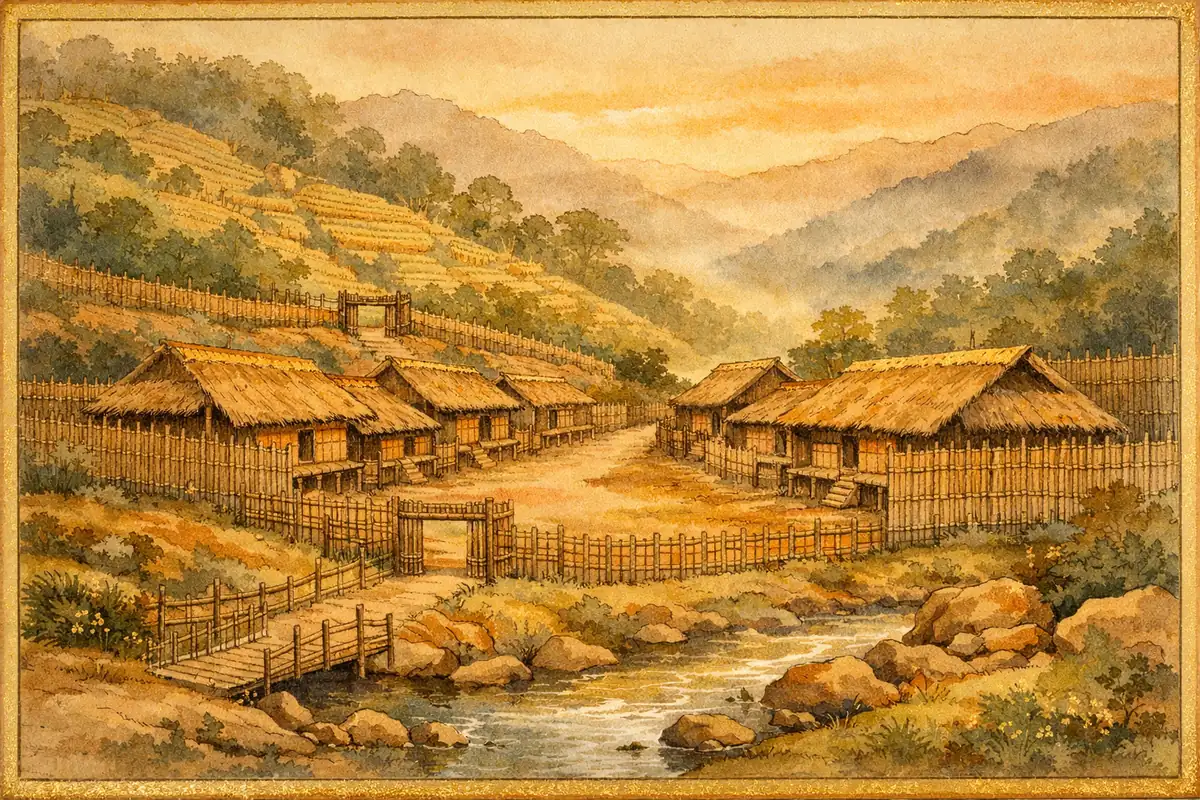
The Dimasa are a Bodo-Kachari people of the North Cachar Hills, now Dima Hasao district of Assam, with smaller groups in Karbi Anglong, the Cachar plains, Nagaland and Meghalaya. Their kings ruled from Dimapur, then from Maibong in the hills, and last from Khaspur in Cachar until 1830. Every Dimasa belongs to a clan of the father's side, the sengphong, or of the mother's side, the julu: sons are counted in the father's clan and daughters in the mother's. They speak Dimasa, a Tibeto-Burman language close to Bodo, and are a Scheduled Tribe in Assam, Meghalaya and Mizoram.
Clans and Kinship
The Dimasa have two sets of exogamous clans. Endle (1911) counted some eighty among the Dimasa of North Cachar and the Hojai of Nowgong, forty of men (sengfong) and forty of women (zulu); Bordoloi (1987, 1988) gives forty sengphong and forty-two julu, and the 1972 district handbook forty-two and forty. A son is counted in his father's sengphong and a daughter in her mother's julu, and no one may marry within the father's or the mother's clan, however distant the tie. Property follows the same lines: a father's land and goods pass to his sons, or failing them to the nearest man of his clan, while a mother's ornaments and household things pass to her daughters, or failing them to the nearest woman of her clan (Bordoloi 1987). Endle names one exception to exogamy, the royal clan Hachumsa, whose members had to marry among themselves. The family is small: married sons set up their own houses. The village (nablai) is led by a headman, the kunang, with an assistant, the dilo, and the elders, who settle disputes; older women join when women are concerned. Above the villages, the old kingdom was divided into twelve daikho, sacred divisions each with a priest, the zonthai, under a head priest, the gisia; priests come only from the Hojaisa clan. Unmarried young men slept in the bachelors' house, the nodrang, which Bordoloi found already in decline.
What “Sengphong” means
Sengphong (Endle sengfong, Bordoloi also semphong) is the clan a son takes from his father; julu (Endle zulu; written zaluk or jalik elsewhere) is the clan a daughter takes from her mother. Wikipedia, citing Ramirez (2007), glosses sengphong as 'holder of the sword'.
2 sengphongs
- Hojaisa
Sengphong
The priestly clan: the zonthai priests of the twelve daikho are chosen only from it (Bordoloi 1987). Bordoloi (1991) also calls Hojaisa one of the forty sengphong.
- Hachumsa
Endle's Ha-chum-sa, 'black earth folk', the royal clan, the one clan whose members had to marry within it.
Only the clans named in the sources opened are given. None of them prints a full list: Endle (1911) counts some eighty clans and Bordoloi (1987, 1988) eighty-two, without naming them. Wikipedia's Dimasa article lists forty sengphong, citing a community website and the Census of India 1961 monograph on the Dimasa Kacharis, which could not be opened; that list is not reproduced here.
In the Official Lists
Scheduled Tribe
Assam, Meghalaya
Listed as: Dimasa, Kachari
In Assam, in the part of the list for the autonomous districts.
Scheduled Tribe
Assam
Listed as: Dimasa
In the part of Assam's list for the plains, outside the autonomous districts.
Scheduled Tribe
Mizoram
Listed as: Dimasa (Kachari)
Assam's list for the plains also has an entry 'Barmans in Cachar', for the Dimasa of the Cachar plains who took the title Barman (Bordoloi and Sharma Thakur 1988); it is counted separately (6,716 in 2011) and not included here. Nagaland's list has an entry 'Kachari' (13,034 in 2011); whether it covers the Dimasa was not checked. Checked against a compilation of the Order and the Census 2011 tables; amendments of 2022 to 2024 were not checked.
Checked on 2026-11-07 against the sources below. The lists are amended from time to time and can differ by district; for a certificate, the current order or the state's list is what counts.
Name and Origin
Di-ma-sa is read as 'son of the big river', from di, water, ma, big, and sa, son (Bordoloi 1987; the 1972 district handbook); Endle (1911) translates it 'big-water-folk'. Bordoloi notes that many rivers of Assam begin with the syllable di, and takes the name to point to the Brahmaputra. Other writers he cites derive it from Hidimba, the wife of Bhima in the Mahabharata, or from the Dhansiri river, called Dima, on which Dimapur stands. The name Kachari was given by outsiders: the handbook suggests that it came into use after the kings moved from Maibong to the country the Sylhet Bengalis called Cachar. Endle records that when the Kachari king Krishna Chandra and his brother Govinda Chandra made a public profession of Hinduism about 1790, Bhima was assigned to the royal line as a mythical ancestor.
History
Endle (1911) gives the outline: the Kachari kings, driven from the Brahmaputra valley by the Ahoms, ruled from Dimapur on the Dhansiri until the Ahoms sacked it about the middle of the sixteenth century; the court then moved to Maibong in the North Cachar Hills, and about 1750, under pressure from the Jaintia king, to Khaspur in the plains of Cachar. Bordoloi (1987) dates the Ahom capture of Maibong to 1706, under king Tamradhwaj. The last king, Gobind Chandra, was driven out by Burmese attacks, restored with the East India Company's help in 1826 and killed about four years later, and the kingdom was annexed in 1830. His general Tula Ram kept part of North Cachar until his death in 1854, when it was joined to Nowgong district (Endle). Ruins of gateways, pillars, ramparts and temples remain at Dimapur, Maibong, Khaspur and Kasamari Pathar. The move to Khaspur touched mainly the court; most Dimasa stayed in the hills and kept their language and customs, while those of the Cachar plains took up Hinduism and the title Barman (Bordoloi and Sharma Thakur 1988). The 1971 census counted 39,344 Dimasa in Assam.
Faith and Worship
Bordoloi (1987) describes Dimasa religion as their own tradition joined with Hinduism. Six ancestral gods, the madai, among them Sibrai, Doo Raja, Naikhu Raja and Waa Raja, are still worshipped, and Sibrai, whom Bordoloi equates with Shiva, is named first in every rite. Spirits held to cause sickness and crop failure are appeased, above all before new jhum land is opened. The twelve daikho priests, under the gisia, perform the main rites for all the Dimasa, and in each village the kunang worships every year the clan god of the sengphong that founded the village. The kings Krishna Chandra and Gobind Chandra formally accepted Hinduism at Khaspur in 1790, and the temples at the old capitals show that Hindu ways had come in much earlier; the Dimasa of the hills still keep the old rites alongside them.
Customs
Most marriages are arranged by negotiation, with a bride price called kalti, which the educated now discourage; the wedding takes place at the bride's house, and after a few days there the couple moves to a new house in the groom's village. One wife is the rule, divorce needs the kunang's approval, and widows may remarry. After a birth, mother and child stay apart until the navel cord falls off. Every Dimasa woman is a weaver: girls weave their own wedding clothes, dye yarn with indigo and herbs, and spin and weave eri silk, and fine bamboo mats and cane baskets are made at home. The young men's association, the hangsao, finishes work in the fields of each household for a small fee, paid after the harvest and spent on the Busu festival (Bordoloi 1987).
Festivals
Busu
After the harvest
The harvest festival and the gayest of the year; a decorated gate, the fangsla, is put up at the village entrance before it (Bordoloi 1987). Wikipedia, citing a Brill study of tribal architecture, says the Dima Hasao council fixed 27 January as Busu Dima day in 1994.
Rajini Gabra and Harni Gabra
Once a year, before the new cultivation
On the day of Rajini Gabra the kunang closes the village gate and worships his family god; that night Harni is worshipped for the protection of the village in the coming year. An outsider who enters in spite of the closed gate must bear the cost of holding the rites again (Bordoloi 1987).
Stories and Legends
The crossing at the heron's ford
Endle (1911) prints a tradition sent to him by a district officer. Long ago the Dimasa were beaten in battle and their king retreated until a deep river barred the way. In a dream a god told him to lead his people into the water at the spot where he would see a heron standing, and to walk straight across without looking back. They found the ford, but a man in midstream looked back for his son, and the water rose. Those who saved themselves by clutching rushes became the Khagrabaria, those who clung to reeds the Nalbaria; the Dimasa are the people who crossed in safety. Endle read it as a memory of the wars with the Ahoms.
Notable Personalities
Gobind Chandra
died 1830
The last king of the Dimasa (Kachari) kingdom at Khaspur in Cachar; after his death the kingdom was annexed by the British (Endle 1911; Bordoloi 1987).
Related communities
Sources
- The Constitution (Scheduled Tribes) Order, 1950, as amended, Parts for Assam, Meghalaya, Mizoram and Nagaland, as compiled in Wikipedia's List of Scheduled Tribes. Sections Assam (general areas; autonomous districts), Meghalaya, Mizoram, Nagaland
- Census of India 2011, Table A-11, State Primary Census Abstract for individual Scheduled Tribes: Assam. State totals: Dimasa, Kachari (autonomous districts); Dimasa and Barmans in Cachar (rest of the state). Companion tables for Meghalaya (catalog/42956), Mizoram (catalog/42954) and Nagaland (catalog/42952).
- B. N. Bordoloi, G. C. Sharma Thakur and M. C. Saikia, Tribes of Assam, Part I (Tribal Research Institute, Assam, 1987). The Dimasa Kacharis, by B. N. Bordoloi: name, settlements and kingdoms, clans, marriage, inheritance, village system, nodrang, religion and daikho, hangsao, festivals
- B. N. Bordoloi and G. C. Sharma Thakur, Tribes of Assam, Part II (Tribal Research Institute, Assam, 1988). Barmans of Cachar: the title Barman, clans (semphong and julu)
- B. N. Bordoloi, Tribes of Assam, Part III (Assam Institute of Research for Tribals and Scheduled Castes, 1991). The Hajongs, racial affinity (Hojaisa as one of the forty sengphong)
- District Hand Book, United Mikir and North Cachar Hills (Tribal Research Institute, Assam, 1972). The Dimasa Kacharis: terminology, meaning of Dimasa, clans
- Sidney Endle, The Kacharis (1911). Section I: distribution table (Southern group), historic sketch (Dimapur, Maibong, Khaspur, Gobind Chandra, Tula Ram), the river-crossing tradition; Section III: sub-tribes, the Dimasa men's and women's clans and the royal clan Ha-chum-sa (pp. 27-28)
- Wikipedia, Dimasa people (pointer: Ramirez on sengphong and julu, Busu Dima day, regions, the 40-clan list and its sources)
Practice differs by village and family. If something here does not match your family's tradition, trust your elders.