
Konyak
At a glance
- Clan word
- Clan
- Descent
- Through the father
- Lives in
- Nagaland, Assam, Arunachal Pradesh, Myanmar
- Language
- Konyak (Tibeto-Burman; Roman script)
- Population
- 2,37,568 Census 2011, Table A-11, Nagaland: Konyak, returned under the entry 'Naga'. Nagaland only.
- Part of
- Naga
- Region
- North-East
About
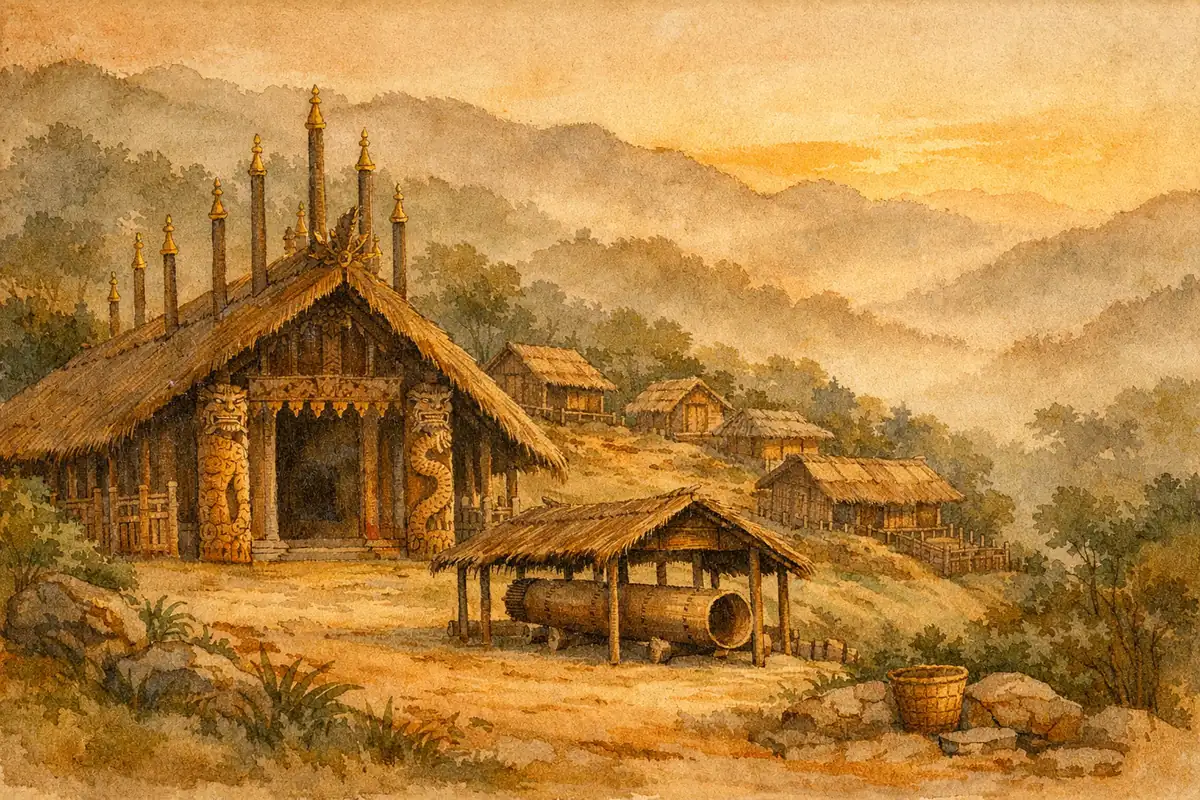
The Konyak are a Naga people whose villages lie in the Mon district of Nagaland, north-east of the Ao country, with related villages in Assam, Arunachal Pradesh and Myanmar. Their villages were ruled by hereditary chiefs, the Ang, and each village was organised around its men's houses, the morungs. Speech changes from one village to the next. They are a Scheduled Tribe within the entry 'Naga' in Nagaland, where Census 2011 counted 237,568 Konyak, the largest Naga tribe in the state's table.
Clans and Kinship
Konyak society was divided into chiefly and common lines. Fürer-Haimendorf (1939, pp. 111-112) describes Oting, where the aristocrats were of the Ang clan and the commoners of the Ben clan: the adult men of the Ang clan formed the chief's council, and a man of either class had to marry a woman of the other, the children belonging to the father's clan. The Great Angs of villages such as Mon, Chi, Sheangha and Hangnyu married only within the Great Ang clan, and only the children of such a marriage took the father's rank; they ruled their own villages and the villages under their overlordship, and no commoner approached them standing upright (p. 44). Hutton recorded two groups found side by side in the same villages, the Thendu, who tattooed the face, and the Thenkoh, who did not (Angami Nagas, p. 385). A village was made up of morungs, each with the houses round it a social and political unit: Wakching had the Oukheang, the oldest, built by the founder of the village, and the Thepong, Balang, Bala and Angban, and a man of the Oukheang had to find his wife in one of the three morungs not related to his own (pp. 68-69).
What “Clan” means
Fürer-Haimendorf (1939) writes of clans, of the Ang and Ben clans, and of morungs as the units that intermarry, but gives no single Konyak word for a clan. Clans pass through the father.
No list of Konyak clans was found in the sources used. Fürer-Haimendorf (1939) names the Ang (chiefly) and Ben (commoner) clans of Oting and the Great Ang clan of the great chiefs; clan names differ from village to village.
In the Official Lists
Scheduled Tribe
Nagaland
Within the single entry 'Naga' in Nagaland's list. Census 2011 counted the Konyak by name under that entry.
Konyak villages also lie in Assam, Arunachal Pradesh and Myanmar; the lists of Arunachal Pradesh and of Assam's autonomous hill districts have an entry 'Any Naga tribes', but no separate census count of the Konyak there was found. The compilation used may not show amendments made between 2022 and 2024.
Checked on 2026-11-07 against the sources below. The lists are amended from time to time and can differ by district; for a certificate, the current order or the state's list is what counts.
Name and Origin
Hutton (1921, Appendix III, pp. 383-384) used 'Konyak' for the tribes north-east of the Ao and Chang. The people of Tamlu applied the names Konyak and Haha to themselves and to the closely related villages east of them, and both names, he wrote, apparently refer to the way the hair is dressed. He quoted Peal's earlier note that the villages between the Dikhu and the Disang were all reputed to descend from one village, Changnyu, a 'tribe-mother' to which many of them sent small presents every year, which were not tribute.
History
Older books know the Konyak villages by their Assamese names, such as Tablungia, Banpara, Mutonia and Namsangia (Hutton, p. 384). The villages round Tanhai and Pungkhung, above Charaideo in the Sibsagar plains, had long ties with the Ahom kingdom: Tanhai tells that an Ahom king who had lost his throne took refuge there and married Watlong, the chief's daughter, and the people pointed out the tank, paved road and stone bridge he built as part of her bride-price (Hutton, p. 385). The Austrian anthropologist Christoph von Fürer-Haimendorf lived among the Konyak from 1936, mostly at Wakching, and described them in The Naked Nagas (1939). Wakching then had some 250 houses and five morungs, and fourteen Konyak villages paid it tribute (p. 43). The American Baptist mission had a footing in only two Konyak villages, Tamlu and Kanching (p. 54); most Konyak are Christian today.
Faith and Worship
In the older religion recorded by Fürer-Haimendorf, the sky-spirit Gawang watches over the crops and punishes wrongdoing in this life. The first sowing of the year was done by a descendant of the village founder on behalf of the whole village: he sacrificed a chicken in his field and asked Gawang for rice and millet (1939, p. 90). Most Konyak are now Christian.
Customs
Girls were tattooed on the legs and arms at eight or nine, and the full tattoo of two broad bands above the knees was finished when a young wife moved into her husband's house: its completion marked her entry into his clan (Fürer-Haimendorf, 1939, p. 119). Boys and girls of intermarrying morungs worked in the fields in gangs together (p. 90). The Konyak of Wanching and Wakching were known as makers of daos, the broad chopping knife of the hills (Hutton, p. 385). Once a year, at the spring festival, families brought out their heirloom beads, shells and brass bells, and the girls danced in them (Fürer-Haimendorf, pp. 219-221).
Festivals
Aoleang
First week of April
The spring festival before the sowing, the chief festival of the Konyak year; Fürer-Haimendorf describes it at Longkhai.
Stories and Legends
The king who married Watlong
Hutton (1921, p. 385) gives the story told at Tanhai, above Charaideo. An Ahom king of Sibsagar who had been dethroned took refuge in Tanhai and married Watlong, the daughter of its chief. When he was restored to his kingdom he went back down to Charaideo with his Naga bride, with dancing and singing, and as part of her bride-price he built a tank, a paved road and a stone bridge, whose remains, with the footprints of the king and his horse, the people of Tanhai still showed.
Related communities
Sources
- C. von Fürer-Haimendorf, The Naked Nagas (London: Methuen, 1939). pp. 43-44 (Wakching; the Angs), 45 (languages of Wakching, Shiong and Tanhai), 54 (Tamlu, Baptist mission), 68-69 (the morungs of Wakching), 90 (first sowing, Gawang), 111-112 (Ang, Ben and Great Ang clans), 119 (tattoo and entry into the husband's clan), 219-221 (the spring festival)
- J. H. Hutton, The Angami Nagas (London: Macmillan, 1921). Appendix III, pp. 383-385 (the name Konyak, Changnyu, Assamese names, Tanhai and the Ahom king, morungs, Thendu and Thenkoh, daos)
- J. P. Mills, The Lhota Nagas (London: Macmillan, 1922), introduction by J. H. Hutton. p. xxxi (Thendu and Thenkoh; the Ang division provides hereditary chiefs)
- Census of India 2011, Table A-11: State primary census abstract for individual Scheduled Tribes, Nagaland
- Constitution (Nagaland) Scheduled Tribes Order, 1970, as compiled from the Census of India list of notified Scheduled Tribes
- Konyak people, Wikipedia (pointer: Mon district; villages in Arunachal Pradesh, Assam and Myanmar; Aoleang in the first week of April)
Practice differs by village and family. If something here does not match your family's tradition, trust your elders.