
Saora
At a glance
- Clan word
- Birinda
- Descent
- Through the father
- Lives in
- Odisha, Andhra Pradesh
- Languages
- Sora (Austroasiatic (Munda)), Odia (Indo-European (Indo-Aryan))
- Population
- 6,74,175 Census 2011, Table A-11, Saora entries added together: Odisha 534,751; Andhra Pradesh (undivided, 'Savaras, Kapu Savaras, Maliya Savaras, Khutto Savaras') 139,424. The Savar and Sawar entries of other states are not included.
- Part of
- Munda
- Region
- East
About
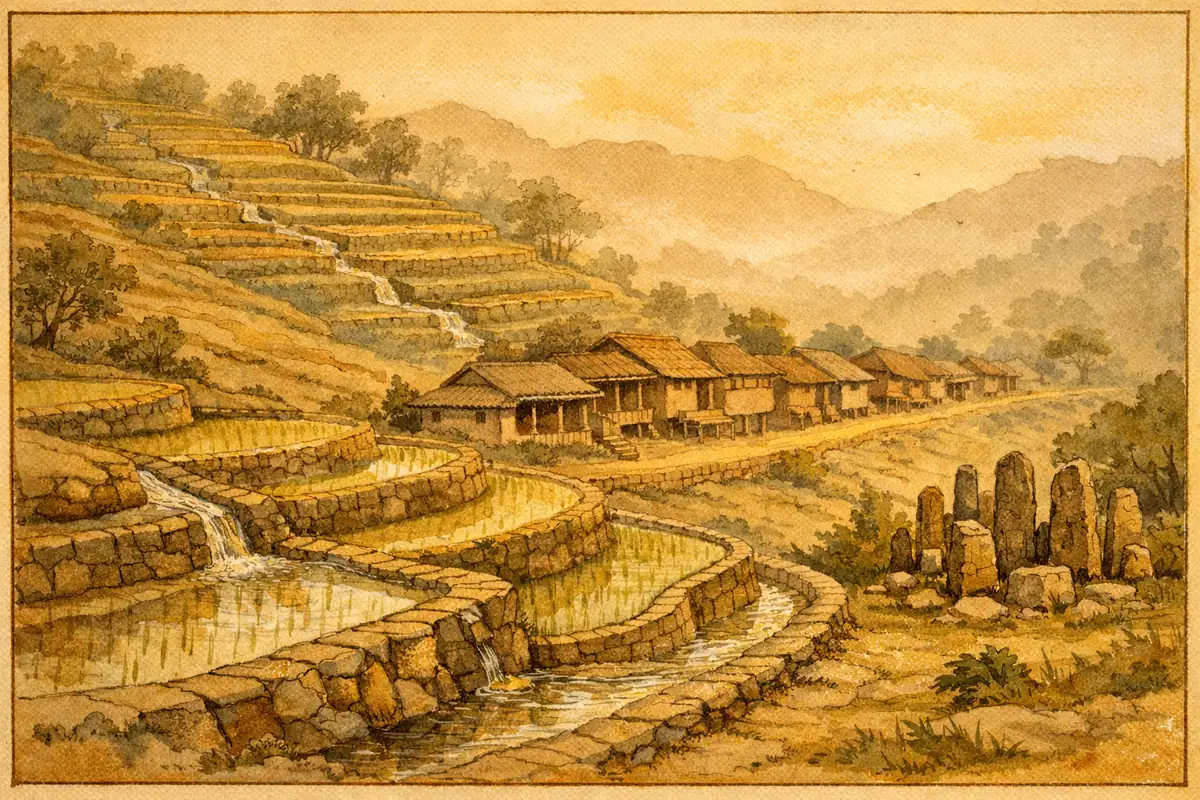
The Saora are a people of the hills of southern Odisha, above all in Gajapati and Rayagada, with others in the north of Andhra Pradesh. They speak Sora, a Munda language. The Hill or Lanjia Saora are known for terraced rice fields on steep slopes, for sacred wall paintings and for their shamans. Unlike their neighbours they have no clans: the one exogamous unit is the birinda, all the descendants of a common male ancestor. They are a Scheduled Tribe in Odisha, Andhra Pradesh and Telangana, and the Saura and Lanjia Saura are particularly vulnerable tribal groups (PVTGs) in Odisha; the 2011 census counted 674,175.
Clans and Kinship
Elwin (1955) found that the Saora have no exogamous totemic clans, no phratries and no moieties. The one fixed unit is the birinda, the descendants of a common male ancestor, which has no name and no totem. A man may not marry a girl of his own birinda, and since the blood of both parents counts, cross-cousin marriage is also forbidden. A woman stays in the birinda of her birth after marriage, so at her death her bones and soul must be brought home. Each birinda has its own burning ground, its own menhirs and its own funeral officiants. Villages are divided into quarters (sahi); the chief (gamang) and the buyya priest head the leading families, and the rest are called poroja or pyat, peasants. The Hill Saora are loosely divided into groups such as the Jati, Arsi and Jadu, and craft groups such as the Kindal (basket-makers), Kumbit (potters), Gontara (brass-workers) and Luara (smiths), which mostly marry among themselves, though not strictly.
What “Birinda” means
Birinda is the Saora word for the patrilineal descent group, all the descendants of one male ancestor. It is exogamous, but it is not a named clan and has no totem (Elwin 1955; SCSTRTI). A married woman remains in her father's birinda.
No clan list: Elwin (1955) and SCSTRTI both state that the Saora have no clans, and the birinda, the family line, has no name.
In the Official Lists
Scheduled Tribe
Odisha, Andhra Pradesh, Telangana
Listed as: Saora
Odisha: 'Saora, Savar, Saura, Sahara', to which the census table adds some thirty names, among them Arsi, Based, Bhima, Jadu, Jati, Kampu, Kindal, Kumbi Kancher, Lanjia, Luara, Malia, Raika, Sudda and Tankala Saora. Andhra Pradesh and Telangana: 'Savaras, Kapu Savaras, Maliya Savaras, Khutto Savaras'.
Checked against the 2011 census table of each state and Wikipedia's compilation of the order; amendments after 2011 were not checked. The Andhra Pradesh table covers the state before Telangana was formed in 2014. The Savar of Jharkhand, West Bengal and Bihar and the Sawar or Sawara of Chhattisgarh, Madhya Pradesh and Maharashtra are separate entries; Elwin (1955) describes such groups as quite unlike the Hill Saora, and they are not counted here. The PVTG list from the 2019 PIB release names the Lanjia Saura and Saura for Odisha and the Kondasavara for Andhra Pradesh and Telangana.
Checked on 2026-11-07 against the sources below. The lists are amended from time to time and can differ by district; for a certificate, the current order or the state's list is what counts.
Name and Origin
Elwin (1955) notes some thirty spellings of the name, Savara, Sabar, Saura and Sora among them, and adopted Saora, the spelling of the 1931 census, as close to what the people call themselves and their language. Saora or Savara appears often in old Sanskrit literature, but Elwin thought the word may then have meant little more than a forest people, and that many groups called by it today differ greatly from the Hill Saora. The Odia neighbours of the Hill Saora call them Lombo Lanjhia, 'long-tailed', from the long tail of the men's loincloth; Ramamurti thought the name resented, but Elwin found some Saoras proud of it.
History
Elwin (1955), following Sitapati, wrote that the Saora country once reached south into Palakonda, Parlakimidi and Tekkali, and that the Saoras there were absorbed by their Telugu-speaking neighbours; those who speak Telugu are called Kampu Saoras, and other plains groups are the Sudda or Sarda and the Based Saoras. Most Saoras of the Madras Presidency were transferred to Orissa when the boundaries were changed in 1936. SCSTRTI (2010) records that, as shifting cultivation yielded less, the Saora built terraced paddy fields up the hill slopes with careful channels for water, and have since planted cashew orchards on old swiddens.
Faith and Worship
Saora religion, which Elwin (1955) studied closely, is addressed to many gods and to the dead, who are approached through male and female shamans, the kuran and kuranboi, who speak with them in trance. The dead are admitted to the company of the ancestors (idaisum) through the guar rite, with a buffalo sacrifice and the setting up of a menhir. Houses carry sacred wall paintings (ittalan), which Elwin called ikons. Small shrines stand in the village street, and wooden posts at the entrance stand for the village guardian (SCSTRTI).
Customs
Marriage is barred within the birinda and between cousins on either side; a man is expected to marry his elder brother's widow (Elwin 1955). Chiefs take wives from other families but prefer to marry among the families of chiefs and priests. The dead are cremated, and in the later guar rite, held for each birinda at its own menhirs, a buffalo is sacrificed and the dead join the ancestors. The gamang is the secular head of the village, the buya the ritual head and the disari the astrologer (SCSTRTI).
Related communities
Sources
- Verrier Elwin, The Religion of an Indian Tribe (Bombay, 1955). Note on spelling and glossary, pp. xxi-xxiii; Introduction, pp. 1-9 (the Saora peoples, Hill Saora, divisions) and pp. 50-53 (marriage and the family, the birinda)
- SCSTRTI Odisha, Saora (photo handbook, Bhubaneswar, 2010), from the Ministry of Tribal Affairs repository. Foreword; social organisation
- SCSTRTI Odisha, tribe profile: Saora. Scheduled Castes and Scheduled Tribes Research and Training Institute, Bhubaneswar; read 7 November 2026
- Census of India 2011, Table A-11: State Primary Census Abstract for individual Scheduled Tribes (one table for each state). Odisha (catalog 42960); Andhra Pradesh (catalog 42967)
- Constitution (Scheduled Tribes) Order, 1950, as amended, Parts for Odisha, Andhra Pradesh and Telangana, as compiled in Wikipedia's List of Scheduled Tribes from the Census of India list of notified Scheduled Tribes
- Particularly vulnerable tribal group, Wikipedia (pointer only: the PVTG list from the PIB release 'Welfare of particularly vulnerable Tribal groups', 2019)
Practice differs by village and family. If something here does not match your family's tradition, trust your elders.