
Korku
कोरकू
At a glance
- Clan word
- Gotra
- Descent
- Not recorded in the sources used
- Lives in
- Madhya Pradesh, Maharashtra, Chhattisgarh
- Language
- Korku (Austroasiatic (Munda); Devanagari script)
- Population
- 9,95,823 Census 2011, Table A-11, the Korku entry (with Bopchi, Mouasi, Nihal, Nahul, Bondhi, Bondeya) in each state: Madhya Pradesh 730,847; Maharashtra 264,492; Chhattisgarh 484.
- Part of
- Munda
- Region
- Central
About
The Korku are a Munda people of the western Satpura hills, in the Khandwa, Burhanpur, Betul and Chhindwara districts of Madhya Pradesh and the old Hoshangabad country, and in the Melghat hills of Amravati in Maharashtra. Their language, Korku, belongs to the Munda branch of the Austroasiatic family; Russell and Hira Lal (1916) note that they live further west than any of their Munda kin. They are a Scheduled Tribe; the 2011 census counted nearly a million.
Clans and Kinship
Russell and Hira Lal (1916) record that an older division into Raj-Korku, the landholding families, and Potharia had given way to four subtribes with territorial names: Mowasi, the largest; Bawaria of the Bhanwargarh tract of Betul; Ruma of Amravati; and Bondoya of the Jitgarh and Pachmarhi hills, known in Wardha as Bopchi. Only the Mowasi kept strictly to marriage within the subtribe. Each subtribe traditionally had 36 exogamous septs, a number that had grown by Russell's time, and marriage within the sept and between first cousins was forbidden. Sept names are mostly those of plants and animals; Korkus told Russell that each sept was named after the thing behind which its ancestor hid after a great battle, and Wikipedia's account of the Melghat Korku has the same story told of Shiva in the form of a lion. Each sept has its own place for the Sedoli rite for the dead. Present-day village councils, the Korku panchayat, are headed by a Patel with a priest (padihar) and a kotwar.
What “Gotra” means
Russell and Hira Lal (1916) write of exogamous septs; present accounts of the Korku of Melghat call them gotra. Each subtribe was said to have 36 of them, named mostly after plants and animals.
24 gotras
- Atkul
Totem: a gorge
Its ancestor hid in a gorge after the battle.
- Bhuri Rana
Totem: a dove's nest
- Dewda
Totem: a rice plant
- Jambu
Totem: jamun tree
Wikipedia's Melghat list writes Jambhu.
- Kasada
Totem: a river bed
Wikipedia's Melghat list writes Kasda, soil.
- Takhar
Totem: a cucumber plant
- Sakum
Totem: teak tree
Wikipedia's Melghat list writes Sakom.
- Banku
Russell glosses it as forest-dweller.
- Bhurswa
Also Bhoyar; Russell suggests the name of the Bhoyar caste.
- Basam
Also Baoria; Russell glosses it as the god of beehives.
- Marskola
Also Mawasi; taken by Korkus to mean a field flooded by rain.
- Killibhasam
Its ancestor is said to have eaten the flesh of a heifer half-eaten by a tiger and parched by a forest fire.
- Akandi
Hoshangabad; glossed as 'the benighted one'.
- Tandil
Totem: a rat
Hoshangabad.
- Chuthar
Totem: a flying black bug
Hoshangabad.
- Lobo
Totem: a piece of cloth
A member of this sept throws away his food if the word lobo is spoken while he eats.
- Makyatotha
One of ten septs that give daughters in marriage without the regular ceremony.
- Jondhratotha
- Dharsima
- Changri
- Khambi
- Dagde
- Kullya
- Bursuma
Septs as Russell and Hira Lal (1916, vol. 3, pp. 555-556) name them, in their order: the septs explained by the story of the battle, other septs with their meanings, three from Crosthwaite's Hoshangabad list, and the ten septs (Russell's footnote, of which Lobo and Killibhasam are given above) that marry off daughters without the regular rite. Russell's spellings are kept. Wikipedia's account of the Korku of Melghat, citing Deogaonkar (1990), lists sixteen clans there, among them Bethe (bilwa tree), Bhusum, Mawasi, Dhikar, Selu, Chilhati, Korilua, Tota, Chathwa and Mara (peacock); that book was not opened.
In the Official Lists
Scheduled Tribe
Madhya Pradesh, Maharashtra, Chhattisgarh
Listed as: Korku, Bopchi, Mouasi, Nihal, Nahul, Bondhi, Bondeya
One entry that also names the Bopchi, Mouasi (Mowasi), Bondhi and Bondeya divisions; the 2011 census gives the population of the entry as a whole.
Checked against the 2011 census tables for Madhya Pradesh, Maharashtra and Chhattisgarh and Wikipedia's compilation of the order (which writes Nihar for Nihal in Chhattisgarh). Amendments after 2011 were not checked. Madhya Pradesh also has a small separate entry, 'Karku' (265 people in 2011), not counted here.
Checked on 2026-11-07 against the sources below. The lists are amended from time to time and can differ by district; for a certificate, the current order or the state's list is what counts.
Name and Origin
Russell and Hira Lal (1916) explain the name as koru, man, with the plural ending ku, so 'men' or 'tribesmen', and place the Korku with the Korwa and the Kols of Chota Nagpur by language and by shared clan names. In the Korku story they record, Mahadeo was asked to people the empty Vindhya and Satpura hills; his crow Kageshwar found an anthill of red earth between the Saoligarh and Bhanwargarh ranges of Betul, and from it Mahadeo shaped a man and a woman, Mula and Mulai, whose images were trampled by the horses of Indra until he made a dog to guard them. Mula and Mulai became the ancestors of the tribe. A second story, of descent from the city of Dhar, Russell thought was taken from neighbouring castes.
History
Russell and Hira Lal (1916) counted about 150,000 Korkus in the Central Provinces and Berar, in Hoshangabad, Nimar, Betul and Chhindwara, with about 30,000 in the Berar plain below the Satpuras and a few thousand in Bhopal. The hill tract they held, Kalibhit and Melghat, was known to the Marathas as the Mowas, and the largest Korku division is still called Mowasi; Russell records that in the eighteenth century bands from these hills, often led by dispossessed Rajput chiefs, levied a payment called tankha mowasi on the villages of the Berar plain. A Korku zamindar was, Russell notes, the hereditary guardian of Mahadeo's shrine at Pachmarhi. Today many Korku villages of Maharashtra lie in and around the Melghat Tiger Reserve (Wikipedia).
Faith and Worship
Russell and Hira Lal (1916) record the sun and moon as the chief Korku deities, both called Gomaj, the word also used for god; the head of each family offered a white she-goat and a white fowl to the sun every third year. Village deities were Dongar Deo, god of the hills, worshipped at Dasahra on the nearest hill; Mutua Deo, a heap of stones in the village; and Mata. The village priest, the Bhumka, keeps tigers from the village boundary through Bagh Deo. Korkus also worship Mahadeo, and Russell found that they considered themselves Hindus.
Deities named in the sources: Dongar Deo, Mutua Deo, Bagh Deo
Customs
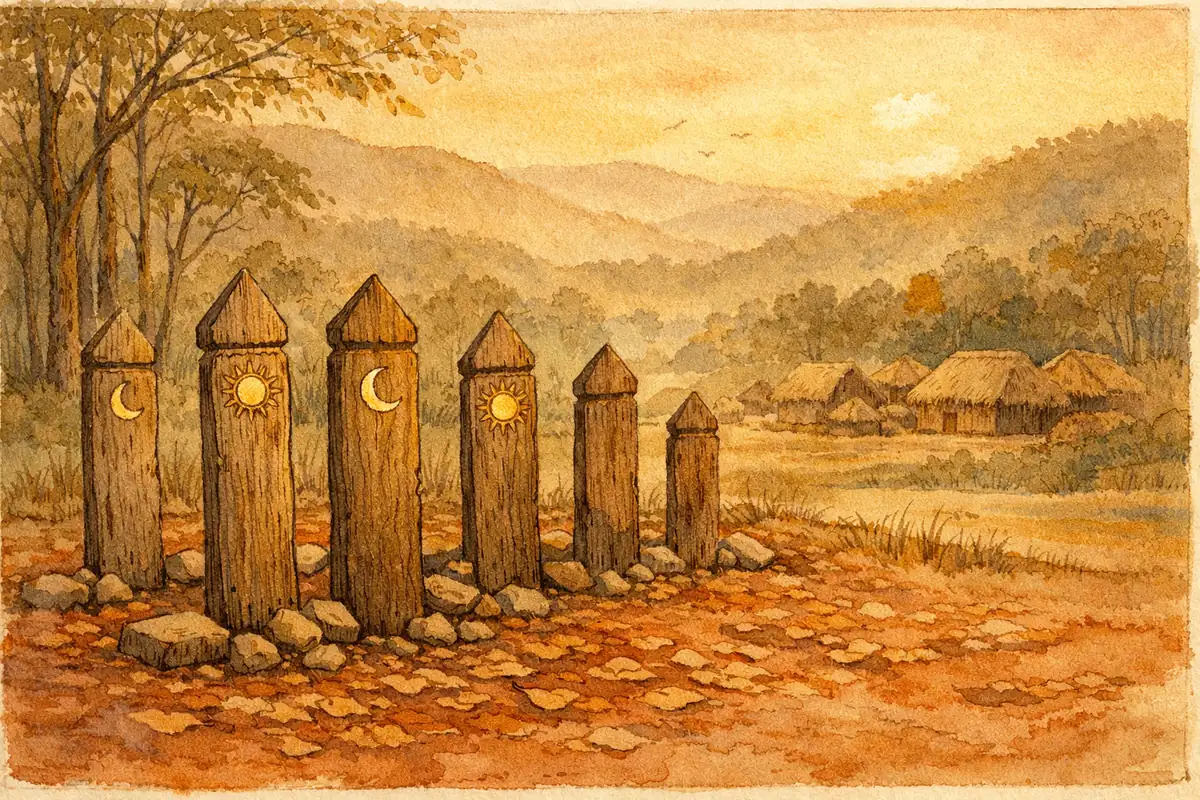
Russell and Hira Lal (1916) describe a betrothal in which the bride-price is fixed by a set exchange of plates of counting seeds between the women of the girl's party and the men of the boy's, and a wedding in which the groom is first taken to Mutua Deo. The dead are first joined to the ancestors in the Pitar Miloni rite and then, between four months and fifteen years after death, laid to rest in the Sedoli: a teak or salai tree is cut and a post called munda carved with the sun and moon and a mounted figure of the dead, and set up at the sept's burial place, to which a Korku must return however far he has moved. Wikipedia names Hari and Jitori as planting festivals.
Festivals
Dasahra
Ashvin, September or October
When Dongar Deo, the god of the hills, is worshipped on the hill nearest the village (Russell and Hira Lal).
Stories and Legends
Mula and Mulai, made from red earth
In the Korku story Russell and Hira Lal record, Rawan asked Mahadeo to people the empty Vindhya and Satpura hills. Mahadeo sent his crow Kageshwar to find an anthill of red earth, which it found in Betul. Mahadeo shaped a man and a woman from it, but each time two fiery horses sent by Indra trampled the images. At last he made a dog and gave it life, the dog kept the horses away, and the two images, Mula and Mulai, came alive as the first Korkus.
Related communities
Sources
- R. V. Russell and Hira Lal, The Tribes and Castes of the Central Provinces of India, vol. 3 (1916), 'Korku'. Vol. 3, pp. 550-570: distribution and name pp. 550-551; legends pp. 551-554; subdivisions and septs pp. 554-556; marriage pp. 556-558; religion and the Bhumka pp. 559-561; the Sedoli and the munda pp. 565-566
- 'Korku', Encyclopedia of World Cultures, vol. 3: South Asia
- Wikipedia, 'Korku people' (pointer to Deogaonkar, The Korku Tribals, 1990, and Fuchs, The Korkus of the Vindhya Hills, 1988; read 2026-11-07)
- Census of India 2011, Table A-11, State Primary Census Abstract for individual Scheduled Tribes (Madhya Pradesh, Maharashtra, Chhattisgarh). NADA catalog 42962 (Madhya Pradesh), 42966 (Maharashtra), 42961 (Chhattisgarh)
- Constitution (Scheduled Tribes) Order, 1950, as amended, Parts for Madhya Pradesh, Maharashtra and Chhattisgarh (as compiled in Wikipedia's List of Scheduled Tribes)
Practice differs by village and family. If something here does not match your family's tradition, trust your elders.